
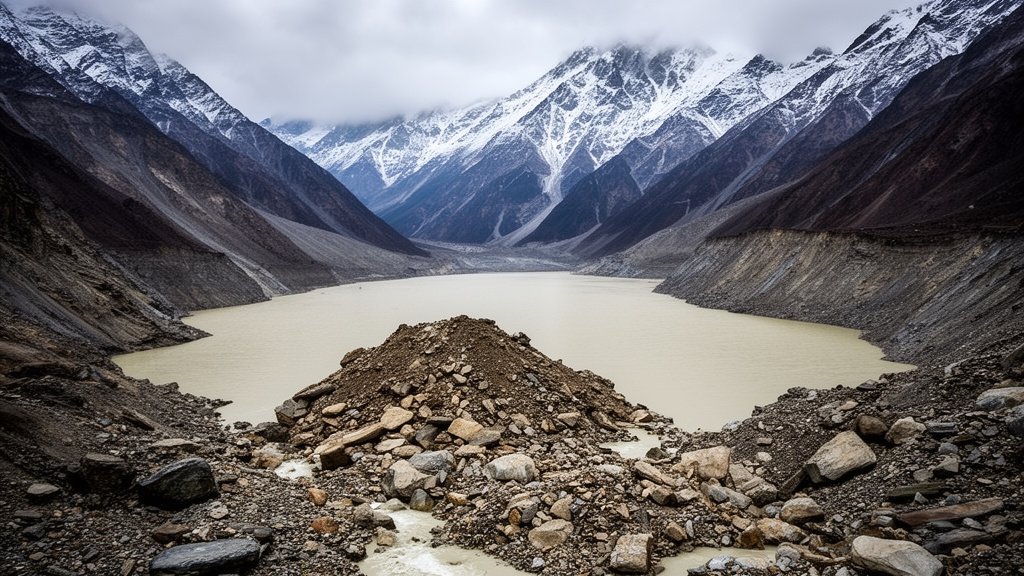
A catastrophic flood event has devastated the Nepal-China border region, claiming at least 469 lives and leaving over 1,500 individuals missing, as emergency responders and engineering teams battle to stabilize a precarious barrier lake that threatens to trigger further destruction. The high-altitude disaster, triggered by intense, unseasonal rainfall, has isolated mountain communities and severed key logistics arteries, forcing an immediate, large-scale cross-border search and rescue operation in one of the world’s most challenging terrains.
Key Highlights
- Casualties: 469 confirmed deaths with 1,500 people still officially reported as missing across the border zones.
- Immediate Threat: A unstable barrier lake, formed by landslide debris, is currently being monitored by expert engineering teams to prevent a potential secondary outburst flood.
- Geological Context: The flooding has been exacerbated by complex Himalayan geomorphology, characterized by fragile terrain and the increased risk of Glacial Lake Outburst Floods (GLOFs).
- Response Efforts: Coordination is underway between local authorities, the Nepal Army, and international geological monitoring agencies to stabilize the waterway and reach cut-off villages.
The Himalayan Deluge: Anatomy of a Border Catastrophe
The current crisis in the Himalayas is not merely a localized weather event; it is a manifestation of compounding geological and environmental stressors. The region, known for its extreme verticality and unpredictable climate, has been overwhelmed by a sudden, severe surge in rainfall that triggered massive landslides. These landslips did not simply destroy infrastructure—they fundamentally altered the local topography by blocking major water channels. The resulting dam, or “barrier lake,” now holds a dangerous volume of water, creating an imminent threat of failure that could release a torrent of debris and floodwaters down the valley, potentially multiplying the current death toll of 469.
The Barrier Lake: An Engineering Nightmare
The primary focus for disaster management teams is the barrier lake. When mountainsides collapse into narrow river valleys, the resulting debris dams often form lakes that grow rapidly as upstream runoff fills them. If these dams breach suddenly, they release a “wall of water,” causing destruction far greater than the initial rainfall. Engineering teams from both sides of the border are currently attempting to carve controlled drainage channels to lower the water level gradually. The difficulty cannot be overstated: the altitude, thinning air, and continued instability of the slope above the lake make traditional heavy machinery deployment nearly impossible. This requires a reliance on specialized engineering, drone-assisted surveillance, and, in some instances, risky manual interventions.
Scientific Perspectives and Environmental Triggers
Experts from the International Centre for Integrated Mountain Development (ICIMOD) have long warned that the Hindu Kush-Himalayan region is particularly susceptible to these cascading disaster events. The confluence of climate change—which is accelerating glacial melt—and localized extreme weather creates a “double-whammy” effect. Rising temperatures are causing high-altitude permafrost to degrade, weakening the rock faces that hold up the landscape. When heavy monsoon or post-monsoon rains strike these weakened slopes, the resulting landslides are significantly larger and more frequent than in previous decades. This disaster serves as a sobering case study in how interconnected geological and climatic risks are becoming the new baseline for Himalayan infrastructure security.
Infrastructure and Humanitarian Logistics
The logistics of this response are hampered by the sheer remoteness of the region. Many affected areas rely on single-access mountain roads, which have been washed away or buried under meters of sediment. This has necessitated the use of heavy-lift helicopters and rope-rescue teams, though these assets are limited by the volatile weather conditions that continue to plague the area. The humanitarian challenge is two-fold: immediate search and rescue to find the 1,500 missing persons, and long-term supply chain stabilization to prevent a secondary crisis of starvation or lack of medical care in the isolated border villages.
Regional Cooperation and Geopolitics
This event has necessitated unprecedented levels of cooperation between Kathmandu and Beijing. Disaster management often transcends political boundaries, and the shared nature of the Himalayan watershed means that flooding on one side of the border is rarely contained there. Collaborative data sharing regarding river levels and satellite imagery of the barrier lake’s progression is the only viable path to mitigating the downstream risks. Both nations are under immense pressure to finalize a cross-border disaster response protocol that ensures rapid deployment of resources without the administrative gridlock that typically slows international humanitarian efforts.
FAQ: People Also Ask
Why are barrier lakes so dangerous in the Himalayas?
Barrier lakes formed by landslides are inherently unstable. Unlike engineered dams, they are composed of loose, unconsolidated sediment. When the pressure of the water behind them exceeds the structural integrity of the debris pile, they can breach suddenly, resulting in catastrophic “flash” floods that carry massive boulders and mud, obliterating everything in their path downstream.
What are the main obstacles to the search and rescue efforts?
The primary obstacles are the terrain and weather. The altitude limits the flight ceiling of standard rescue helicopters, and the weather is highly unpredictable, with frequent cloud cover and high winds. Additionally, the destroyed road infrastructure means rescuers must often hike into deep valleys, which significantly slows down the search for the 1,500 missing individuals.
Is this flooding related to climate change?
While extreme weather events have always occurred in the Himalayas, the scientific consensus suggests that climate change is intensifying the frequency and severity of these events. Increased atmospheric water vapor leads to heavier rainfall, and warmer temperatures contribute to slope instability through the thawing of permafrost, both of which are contributing factors to the scale of this disaster.