
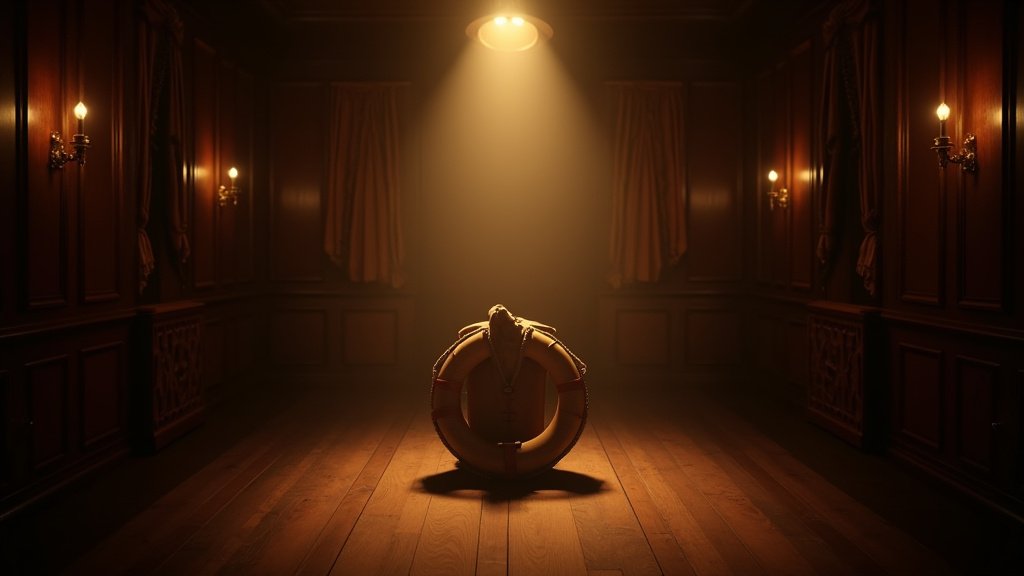
In a testament to the enduring, haunting fascination with the RMS Titanic, a life jacket worn by first-class survivor Laura Mabel Francatelli has sold at auction for a staggering £670,000—approximately $906,000 USD. The sale, conducted by Henry Aldridge & Son, far exceeded pre-auction estimates of £250,000 to £350,000, underscoring the aggressive market for items directly linked to the 1912 maritime tragedy. This artifact serves not just as a piece of safety equipment, but as a visceral, tangible connection to the night the ‘unsinkable’ ship descended into the Atlantic.
Key Highlights
- Record-Breaking Sale: The life jacket sold for £670,000 ($906,000 USD), more than doubling the high end of its initial pre-sale estimate.
- Historical Provenance: The item was worn by Laura Mabel Francatelli, a secretary to the Cosmo Duff-Gordon family, who famously escaped on Lifeboat 1.
- Unique Signatures: Beyond its historical utility, the life jacket is notably marked with signatures from other survivors who shared the lifeboat, significantly elevating its rarity.
- Auction Context: The sale was held by Henry Aldridge & Son in Devizes, United Kingdom, solidifying their status as the premier house for Titanic-related memorabilia.
The Immutable Value of Maritime Tragedy
The sale of Laura Mabel Francatelli’s life jacket is not merely a transaction; it is a profound reflection of the ‘Titanic phenomenon.’ Over a century after the White Star Line vessel struck an iceberg on its maiden voyage, interest in the human stories behind the tragedy remains undiminished. While many historical artifacts lose value over time, Titanic-related memorabilia operates in a distinct, hyper-inflated market class. Collectors are not purchasing simple antiques; they are acquiring proximity to one of the most defining moments of the 20th century.
The Psychology of Preservation
Why do we pay nearly a million dollars for a cork-filled, canvas life jacket? The answer lies in the scarcity and the narrative weight of the object. Modern historical collecting has moved beyond art and jewelry, gravitating toward objects that possess ‘soul’—items that were physically present during catastrophic events. The life jacket is a symbol of survival against impossible odds. Unlike the ship itself, which lies deteriorating at the bottom of the ocean, items like this are portable, tangible proofs of the human element in a story largely defined by engineering failure.
The Provenance of Lifeboat 1
Laura Mabel Francatelli’s connection to the tragedy adds a layer of complexity to the auction. Francatelli was a secretary to Lady Duff-Gordon, and the pair, along with Sir Cosmo Duff-Gordon, were famously scrutinized for their escape on Lifeboat 1, which carried significantly fewer people than its capacity allowed. The life jacket, bearing the signatures of those who survived alongside her, essentially serves as a historical document—a ‘guestbook’ of the lifeboat. This dual function—as a survival device and a commemorative record—is what pushed the bidding war into the stratosphere.
The Economics of the Titanic Market
This sale is part of an ongoing trend in the memorabilia sector. We are currently witnessing a massive appreciation in the value of maritime historical assets. Consider the gold pocket watch sold in 2024 for over $2 million, which once belonged to the captain of the RMS Carpathia, the ship that rescued 700 Titanic survivors. The market is increasingly dominated by ultra-high-net-worth individuals and private museums who view these items as blue-chip investments. The scarcity of these items—limited by the fact that the Titanic is a closed historical event with no ‘new’ inventory being created—ensures that supply is fixed while global demand continues to rise.
The Ethical Dimensions of Auctioning History
While the auction world celebrates these price tags, the trade of tragic artifacts often sparks heated debate. Is it appropriate to profit from the garments of a disaster survivor? This question is frequently raised by historians and ethicists. However, the counter-argument, often put forth by auction houses like Henry Aldridge & Son, is that these private sales are often the only way to ensure the preservation of these delicate items. In a private collection, an item is cataloged, protected, and often eventually loaned to public institutions. If left in family attics or unmanaged estate sales, these pieces of history could be lost to decay or ignorance.
Comparing Tangible vs. Digital History
In an increasingly digital world, the visceral nature of a physical life jacket offers a grounded reality that VR or digital archives cannot replicate. There is a weight to the canvas, the texture of the aged cork, and the faded ink of the signatures that creates an immediate, synaptic connection to the past. This ‘sensory history’ is a primary driver in the surging market. Collectors are looking for grounding in a transient world, and objects that have survived the ocean’s depths—or at least the aftermath of such events—carry a sense of permanence.
The Future of Titanic Collectibles
As we look toward the future, the supply of Titanic artifacts will undoubtedly continue to dwindle as more items are acquired by private entities and permanently removed from the market. We can predict that prices will continue to climb, potentially reaching levels that exclude even the most dedicated private collectors, leaving the market to institutions and mega-wealthy conglomerates. The ‘Titanic’ brand is effectively recession-proof, consistently outperforming traditional luxury asset classes.
FAQ: People Also Ask
Q: Why was this specific life jacket so valuable?
A: It was a unique combination of provenance and historical evidence. It belonged to a documented first-class survivor, Laura Mabel Francatelli, and was signed by other survivors from her lifeboat, making it a rare, dual-purpose historical record.
Q: Did Laura Mabel Francatelli survive the sinking?
A: Yes, she was a first-class passenger and secretary to Lady Duff-Gordon. She escaped the sinking ship on Lifeboat 1 and lived until 1967.
Q: What is the most expensive piece of Titanic memorabilia ever sold?
A: The record is currently held by a gold pocket watch belonging to Captain Arthur Rostron of the RMS Carpathia, which sold for over $2 million USD in 2024.
Q: Where was the auction for the life jacket held?
A: The auction was managed by Henry Aldridge & Son, a renowned auction house based in Devizes, Wiltshire, United Kingdom, which specializes in Titanic and White Star Line memorabilia.