
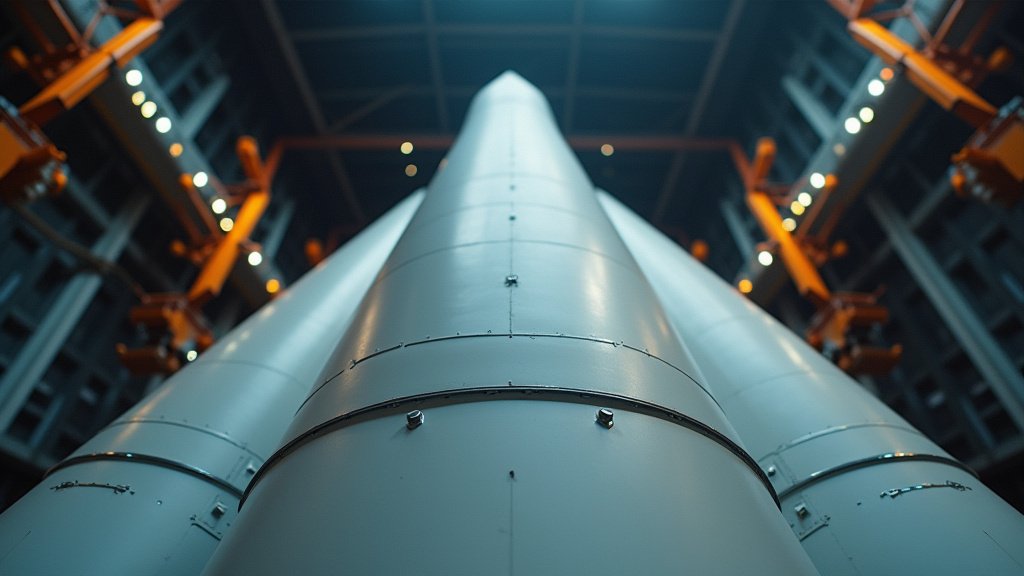
Blue Origin has officially entered the era of rocket reusability. Today, April 19, 2026, the company successfully executed the third flight of its massive New Glenn launch vehicle, marking the first time a New Glenn booster—the “Never Tell Me The Odds” core—has been reflown. This historic mission, designated NG-3, lifted off from Launch Complex 36 at Cape Canaveral Space Force Station, carrying the BlueBird 7 satellite for AST SpaceMobile into low-Earth orbit. The successful recovery of the booster on the Jacklyn droneship confirms that Blue Origin is now a fully capable competitor in the high-stakes, high-cadence market of heavy-lift orbital logistics, fundamentally challenging the long-standing reusability monopoly previously held by SpaceX.
Key Highlights
- Historic Milestone: The NG-3 mission marks the first successful reuse of a New Glenn first-stage booster, validating the design philosophy behind the rocket’s 25-flight lifespan target.
- Strategic Payload: The flight successfully deployed AST SpaceMobile’s BlueBird 7, a critical component in the company’s next-generation direct-to-smartphone cellular broadband constellation.
- Competitive Shift: By proving rapid reflight capabilities, Blue Origin moves from a developmental phase into an operational, high-cadence launch provider, challenging SpaceX’s Falcon 9 dominance.
- Operational Excellence: The “Never Tell Me The Odds” booster, which previously flew the NG-2 mission in November 2025, performed as expected, signaling the maturity of Blue Origin’s refurbishment and engineering teams.
The Engineering Triumph of New Glenn’s Reusability
The successful reflight of the New Glenn booster is not merely a public relations victory for Blue Origin; it is a profound engineering achievement that validates nearly a decade of development. The challenge of reusing a heavy-lift rocket is exponential compared to its disposable predecessors. It requires not just the structural integrity to survive the immense stresses of launch and atmospheric re-entry, but also the sophisticated thermal protection systems and precise guidance, navigation, and control (GNC) software required to return a 57-meter-tall first stage to a precise point in the Atlantic Ocean.
The Anatomy of a Reflight
Unlike traditional expendable rockets, New Glenn’s first stage is powered by seven BE-4 engines, which operate on liquid oxygen and liquid methane (methalox). This choice of propellant is critical for reusability. Methane burns cleaner than the kerosene (RP-1) used in older rocket engines, significantly reducing the amount of soot and residue that builds up within the turbomachinery. This clean-burning characteristic is a major enabler for rapid turnaround times, as it minimizes the labor-intensive refurbishment processes—such as engine scrubbing and internal component replacement—that were previously thought to be inevitable in the early days of liquid-fueled booster reuse.
During the NG-3 mission, the booster followed a trajectory profile refined from the previous NG-2 flight. After separating from the second stage, the booster performed an atmospheric entry burn, utilizing its grid fins for directional control before executing a precise landing burn. The fact that the “Never Tell Me The Odds” core performed this landing successfully on its second outing is a testament to the telemetry data collected during its debut. Blue Origin engineers have utilized the insights from the 2025 ESCAPADE mission to tune the thrust-to-weight ratios and the timing of the landing legs’ deployment, effectively eliminating much of the “trial and error” phase typically associated with rocket development.
The Significance of the AST SpaceMobile Partnership
While the primary headline focuses on the rocket hardware, the payload itself is equally transformative for the telecommunications industry. AST SpaceMobile is not launching generic data satellites; they are launching the infrastructure for a space-based cellular broadband network designed to connect directly to standard, unmodified smartphones.
BlueBird 7 represents a significant leap in antenna technology. The satellite features what is effectively the largest commercial communications array ever deployed in low-Earth orbit. By utilizing the 7-meter payload fairing of the New Glenn rocket, AST SpaceMobile can launch larger, more capable satellites in a single go, or stack multiple satellites to reach their target constellation density of 45 to 60 satellites by the end of 2026. This capability is the linchpin of their business model. For Blue Origin, securing this partnership is a massive validation of their heavy-lift utility. It proves that New Glenn is not just an experimental platform for NASA or government contracts, but a reliable workhorse for the burgeoning commercial space economy.
Competitive Dynamics: Challenging the Falcon Era
For the past decade, SpaceX’s Falcon 9 has defined the standard for orbital reusability. Its ability to land boosters and fly them repeatedly revolutionized the economics of space access, dropping the cost-per-kilogram to orbit by an order of magnitude. Until today, SpaceX has essentially held a monopoly on this capability in the Western commercial market.
The entry of New Glenn into the operational reusability sphere changes the competitive calculus entirely. Customers now have a viable, high-performance alternative for heavy-lift needs. This is particularly relevant for the Department of Defense’s National Security Space Launch (NSSL) program and the growing market for private constellation deployment. When commercial entities have choices, launch costs tend to stabilize or decrease, and innovation cycles accelerate.
Furthermore, the New Glenn architecture offers a wider fairing diameter—7 meters compared to the 5.2 meters of the Falcon 9—which allows for the transportation of larger, more complex payloads that were previously restricted to the most expensive expendable rockets. This opens a new market niche for Blue Origin: the “oversized” payload sector, where they can offer the cost benefits of reusability for satellites and instruments that SpaceX simply cannot fit inside its fairings without significant (and expensive) folding and deployment mechanisms.
Building the Future Cadence
Looking toward the remainder of 2026, the question on the industry’s mind is not whether New Glenn can reuse its boosters, but how quickly it can cycle them. The company has stated that its long-term vision involves a turnaround time of just 30 days between flights. Achieving this will require more than just engineering the rocket; it requires the construction of massive, industrial-scale processing hangars at Cape Canaveral that can handle multiple booster cores simultaneously.
Recent announcements regarding the potential construction of a West Coast launch facility at Vandenberg Space Force Base suggest that Blue Origin is thinking beyond the Atlantic launch corridor. Polar and sun-synchronous orbits require different launch paths, and expanding to the West Coast would effectively double the company’s launch capacity.
As the “Never Tell Me The Odds” booster is inspected and analyzed for wear and tear, Blue Origin will be looking to its next scheduled flights. With a manifest that includes the Blue Moon lunar lander, Amazon’s Leo constellation, and continued NSSL missions, the New Glenn program is transitioning from a high-tech science project into the backbone of a new space-industrial complex. The successful landing today serves as the “proof of concept” for this transition. The era of the reusable New Glenn has officially begun, and the space industry is watching closely to see if they can match, or perhaps even exceed, the operational tempos that have redefined spaceflight over the last decade.
FAQ: People Also Ask
What makes New Glenn’s reuse different from the Falcon 9?
While both systems use liquid-fueled boosters that land on downrange ships, New Glenn is significantly larger—the first stage is 57 meters tall and 7 meters in diameter. Its use of liquid methane (methalox) is a key differentiator, as methane burns cleaner than the kerosene used in Falcon 9, potentially allowing for easier engine refurbishment and faster turnaround times.
How does this impact launch costs?
Reusability is the single largest factor in reducing launch costs. By not having to build a new multi-million dollar first-stage booster for every mission, Blue Origin can amortize the manufacturing cost across dozens of flights. This competitive pressure is expected to drive down market rates for heavy-lift launches, benefiting commercial and government customers alike.
Will this affect the launch schedule for the rest of 2026?
Yes, in a positive way. Success today validates the reliability of the system, giving customers increased confidence in the company’s ability to meet launch deadlines. With the backlog of satellites, including Amazon’s Leo constellation and upcoming lunar missions, a high-cadence, reliable launch schedule is critical to Blue Origin’s long-term business goals.
What is the significance of the AST SpaceMobile payload?
AST SpaceMobile aims to provide direct-to-smartphone cellular connectivity globally. Using New Glenn allows them to launch larger satellites (BlueBird 7) that can communicate more effectively from orbit. This is a “killer app” for modern spaceflight, as it brings high-speed, direct satellite-to-phone internet to every corner of the planet, bypassing traditional cellular infrastructure.