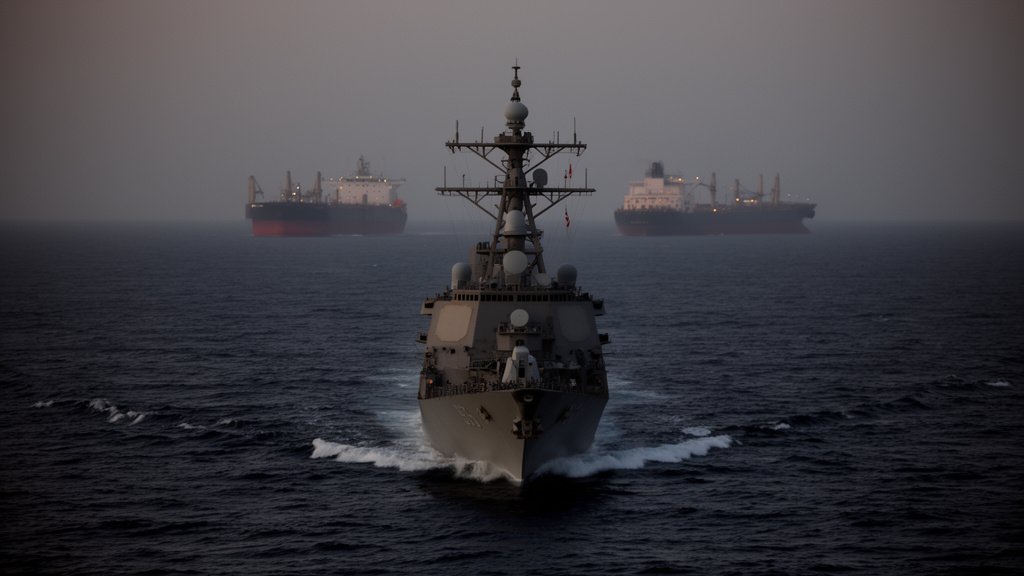
The delicate balance of the ongoing Middle East conflict shattered early Wednesday morning as the Islamic Revolutionary Guard Corps (IRGC) seized two container ships within the strategic Strait of Hormuz. The aggressive maritime maneuver occurred mere hours after U.S. President Donald Trump announced an extension of a tenuous ceasefire, a move initially intended to provide a diplomatic window for peace talks. The seizure marks a significant, volatile pivot in the maritime security landscape, underscoring the deep-seated friction between Washington and Tehran that remains unresolved despite high-level mediation attempts.
Key Highlights
Ships Seized: The IRGC confirmed the capture of the Epaminondas and MSC Francesca*, directing both vessels toward the Iranian coast.
- Violation Claims: Iranian authorities alleged the ships were operating without proper authorization and tampering with navigation systems, labeling the disruption of the Strait a “red line.”
- Ceasefire Standoff: The aggressive action contradicts the optimism surrounding the extended U.S.-Iran ceasefire, which was designed to halt attacks while a “unified proposal” from Tehran is drafted.
- Maritime Security: The UK Maritime Trade Operations (UKMTO) also reported additional attacks, including a container ship coming under fire off the coast of Oman, elevating risk assessments for all commercial transit in the region.
The Strait of Hormuz: A Flashpoint in the Ceasefire Era
The Strait of Hormuz, long recognized as one of the world’s most critical maritime chokepoints, has become the primary theater for the latest chapter of the Iran-U.S. standoff. Despite the diplomatic lifeline provided by the ceasefire extension, the reality on the water remains starkly different. The seizure of the Epaminondas and the MSC Francesca is not merely a localized naval operation; it is a calculated signaling by the IRGC, demonstrating that while political negotiations may be paused, the military operational tempo remains unyielding.
The Anatomy of the Seizure
Reports from the UKMTO and Iranian state media indicate that the Epaminondas, a Greece-flagged vessel, and the MSC Francesca were intercepted in a coordinated manner. The Epaminondas reportedly sustained bridge damage from gunfire during the initial stages of the encounter. This tactical escalation suggests a move by Tehran to enforce its “red line” regarding maritime order—a phrase that carries distinct strategic implications. For the shipping industry, which relies on the Strait for the transit of roughly a quarter of the world’s seaborne oil, the incident serves as a grim reminder that current security guarantees are insufficient.
The Diplomacy-Security Gap
There is a widening chasm between the rhetoric in Washington and the reality in the Persian Gulf. President Trump’s extension of the ceasefire was intended to facilitate a breakthrough in talks, ostensibly mediated by regional partners in Pakistan. However, the IRGC’s actions reveal a potential disconnect between the political leadership in Tehran and the military command responsible for naval operations. If the Iranian government is unable or unwilling to constrain the IRGC’s maritime activities, the prospect of a lasting peace deal remains slim. The U.S. Navy’s continued blockade of Iranian ports further complicates this dynamic, as Tehran views the restriction of its own trade as a justification for the disruption of global shipping lanes.
Economic Shockwaves and Energy Security
The immediate aftermath of the seizures has sent tremors through global commodity markets. Brent crude prices surged on Wednesday as traders factored in the renewed risk premium of the Strait of Hormuz closure. The incident highlights the vulnerability of the global supply chain, where a single localized conflict can trigger inflationary pressures worldwide. Insurance premiums for vessels operating in the region are expected to skyrocket, potentially forcing shipping lines to reroute or pause operations entirely, which would exacerbate the ongoing energy crisis currently straining European and Asian economies.
The Role of Mediators
Pakistan, acting as a crucial intermediary, finds itself in an increasingly difficult position. The cancellation of face-to-face talks in Islamabad, which were intended to capitalize on the ceasefire extension, suggests that neither the U.S. nor Iran is currently prepared to compromise on their fundamental demands. The IRGC’s naval aggression serves as a leverage point, a blunt instrument used to exert pressure on the U.S. to lift the port blockade. As long as this cycle of provocation and retaliation continues, the mediation process risks becoming a formality rather than a substantive path to de-escalation.
FAQ: People Also Ask
Q: What ships were seized by Iran in the Strait of Hormuz?
A: The IRGC seized two container ships: the Epaminondas (a Greece-flagged vessel) and the MSC Francesca. Both were directed toward the Iranian coast after being accused of violating maritime navigation protocols.
Q: Does the ceasefire extension include maritime security?
A: While President Trump extended the ceasefire to allow for diplomatic proposals, the agreement does not appear to have neutralized the immediate military tension at sea. The U.S. continues to enforce a blockade on Iranian ports, and Iran continues to view the disruption of the Strait as a defensive measure against this blockade.
Q: How does this impact global oil prices?
A: The Strait of Hormuz is a vital conduit for world energy trade. The seizure of commercial vessels and the threat of further instability have caused oil prices to rise, as markets react to the increased risk of prolonged closures and the potential for a wider energy supply crisis.
Q: What is the current status of peace talks?
A: Peace talks in Pakistan have faced significant setbacks. While mediators are working to convene both sides, the recent escalations in the Strait of Hormuz have undermined confidence in the process, making it difficult for delegations to move toward a unified agreement.