Bibha Chowdhuri was a brilliant Indian physicist, and her legacy in Bibha Chowdhuri Physics is finally gaining the recognition it deserves. She researched cosmic rays and particle physics, making groundbreaking contributions that were unfortunately overlooked for decades. This is the story of a true hero in her field and a significant figure in Bibha Chowdhuri Physics.
Early Life and Education in Physics
Bibha Chowdhuri was born in Kolkata in 1913. Her family valued education highly. Her father was a doctor, and her mother supported progressive ideals. Society placed many limits on women then. However, Bibha pursued science with determination. She studied physics at Calcutta University. She was the only woman in her M.Sc. class of 24. She earned her master’s degree in 1936. She became one of the first women to achieve this, a true trailblazer from the start, and a foundational figure in the story of Bibha Chowdhuri Physics.
Pioneering Research with D.M. Bose in Cosmic Ray Research
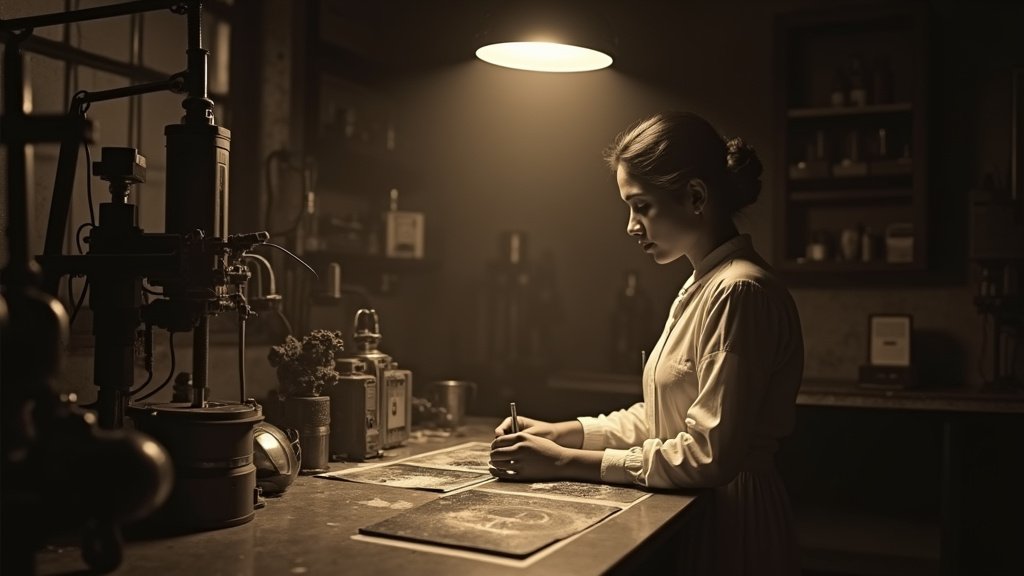
Chowdhuri joined the lab of Debendra Mohan Bose. He was a respected physicist. At first, Bose hesitated to accept her. He felt his research was not “suitable for women.” However, Bibha persisted. She convinced him to let her join. This marked the start of important research, particularly in cosmic ray research. Together, they studied cosmic rays. They used photographic emulsion plates, a novel technique then. They made significant discoveries about mesons. Mesons are subatomic particles. Their findings were published in Nature. These papers were highly regarded. However, World War II disrupted their work. Resources like sensitive plates became scarce. Their pioneering project faced major setbacks, impacting the advancement of Bibha Chowdhuri Physics.
Doctoral Studies Abroad and Particle Physics History
Lack of resources led Chowdhuri abroad. She pursued her PhD at the University of Manchester. She worked under Patrick M.S. Blackett. He was a Nobel laureate physicist. Her doctoral thesis focused on extensive air showers. These are cascades of particles that occur when cosmic rays hit the atmosphere. Her time in Manchester offered new insights. It also brought some media attention. An article called her “India’s New Woman Scientist.” It highlighted her skill with cosmic rays, a crucial area in particle physics history. She felt it was a tragedy fewer women pursued physics.
Contributions at TIFR and PRL: Indian Women in Science
Chowdhuri returned to India in 1949. Homi J. Bhabha recruited her for TIFR. She was the first woman scientist there. She led the cloud chamber group. Her research explored penetrating cosmic-ray components. She identified new K-mesons. Her work contributed to understanding particle interactions, marking a significant step for Indian women in science. Later, she joined the Physical Research Laboratory (PRL). She worked on Kolar Gold Fields (KGF) experiments. These studies involved high-energy muons. Her dedication to research never wavered. She spent decades in the field, a testament to her commitment to Bibha Chowdhuri Physics.
The “Unsung” Aspect and Forgotten Scientists
Despite her groundbreaking work in Bibha Chowdhuri Physics, Chowdhuri received little recognition. Many male colleagues earned national awards. Their joint research often overlooked her role. She was not elected to major Indian science academies. Some even described her work at TIFR as “erased.” She was “steps away from Nobel Prize” territory. However, external factors and timing prevented her acclaim. Gender discrimination played a significant role. Her story was largely forgotten for years, making her one of the forgotten scientists. This news is about uncovering her past and revitalizing the study of Bibha Chowdhuri Physics.
Revival of Her Legacy: Women in STEM
Recently, efforts have revived her story. Science historians Rajinder Singh and Suprakash C. Roy wrote a book. It is titled “A Jewel Unearthed: Bibha Chowdhuri.” This book brought her life and work to light. It highlights her courage and determination. Posthumous honors have also emerged, celebrating her place among women in STEM. The International Astronomical Union named a star “Bibha.” This happened in 2018. The Indian government established a chair professorship in her name. These acts finally acknowledge her contributions. They are making a huge difference in her recognition and the appreciation of Bibha Chowdhuri Physics.
A Lasting Inspiration for Physics Trailblazers
Bibha Chowdhuri’s life shows immense scientific dedication. She overcame societal barriers. She made key contributions to physics. Her research advanced our understanding of particles. She is a powerful example for all people, and a significant figure for physics trailblazers. Her story inspires future generations. It encourages them to pursue their interests. It shows them how one person can make a difference. Her legacy now shines brightly. It is a trending topic among those interested in science history and the impactful field of Bibha Chowdhuri Physics.