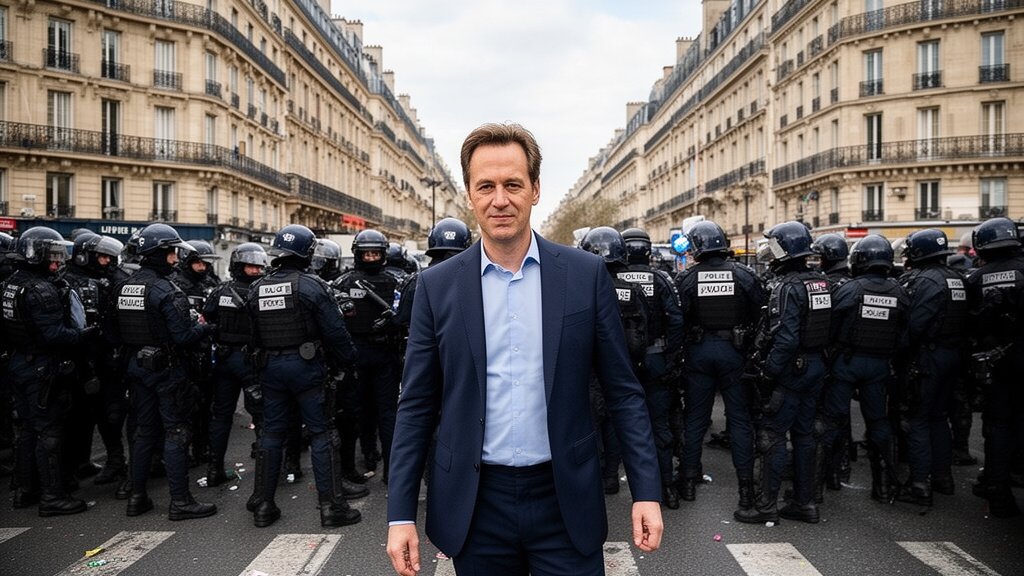
French security forces have detained nearly 1,000 individuals as anti-government protests flared across major urban centers, marking a significant escalation in ongoing civil unrest. The demonstrations, driven by a volatile mix of public dissatisfaction regarding rising cost-of-living expenses and contested education policy reforms, have forced an intensive containment response from law enforcement. Paris Police Prefect and Interior Minister official Laurent Nunez confirmed the sweeping number of arrests, noting that while many protesters gathered for peaceful assembly, specific factions separated to engage in property destruction and violent confrontation with authorities.
Key Highlights
- Mass Detention: Nearly 1,000 individuals arrested across France as the government grapples with nationwide demonstrations.
- Official Confirmation: Interior Minister Laurent Nunez stated the figures are expected to rise as investigations into property damage continue.
- Core Grievances: Protests are fundamentally anchored in economic instability, specifically inflation and energy costs, alongside deep-seated opposition to recent education policy shifts.
- Law Enforcement Response: Authorities were forced to intervene when splinter groups within the marches moved to vandalize private property and breach police cordons.
The Anatomy of the French Escalation
The current wave of unrest in France represents a complex convergence of long-standing systemic issues and immediate socio-economic pressures. What began as organized, peaceful marches quickly devolved in several districts, requiring heavy police presence. According to reports from the Interior Ministry, the decision to engage in mass arrests was a direct response to the movement of “black bloc” elements and agitators who utilized the cover of the larger protests to damage urban infrastructure, storefronts, and public property.
The Economic Catalyst
At the heart of the frustration lies a deteriorating economic climate. French citizens are currently contending with the compounding effects of European inflation, which has hit the lower and middle classes hardest. The cost of fuel, heating, and staple food items has increased the financial burden on the average household, creating a sense of abandonment by the central government. This is not merely a protest against the current administration but a manifestation of the “cost-of-living crisis” that has been simmering across the Eurozone. The protest organizers argue that existing subsidy programs are insufficient to buffer against the soaring costs, leading to demands for structural economic change rather than temporary relief measures.
Education Reform: A Point of Contention
Parallel to the economic grievances is a deep skepticism regarding the government’s proposed education policies. Recent reforms aimed at curriculum adjustment and funding reallocations have been met with stiff resistance from teachers’ unions and student organizations. Critics argue that the reforms prioritize administrative efficiency over pedagogical quality and accessibility. The alignment of student demonstrators with general economic protesters has created a formidable coalition that is proving difficult for the administration to manage through traditional diplomatic channels. The presence of student groups at the forefront of the marches has added an urgency to the rhetoric, as many young people view these reforms as a long-term threat to their professional prospects in a competitive European labor market.
Law Enforcement and Public Order
Laurent Nunez’s statement underscores the fine line French law enforcement must walk. By acknowledging the high number of arrests, the government is signaling a “zero-tolerance” approach toward vandalism, yet they are simultaneously trying to avoid suppressing the fundamental right to protest. The use of CRS (Compagnies Républicaines de Sécurité) units, specialized in riot control, has been intensified in areas where property damage was reported. This strategy, while effective at preventing further destruction, risks inflaming tensions between the state and the demonstrator base. Historical context suggests that such heavy-handed tactics often act as a force multiplier for protest attendance, turning smaller, focused groups into widespread movements of public defiance.
Secondary Angles: Understanding the Wider Context
To fully grasp the magnitude of these events, we must examine the historical precedent of French civil resistance. France possesses a unique political culture where street protest is considered a legitimate, and often necessary, component of the democratic process.
1. The Cyclical Nature of French Dissent: Unlike other Western nations where dissent is often channeled through judicial or legislative lobbying, French citizens frequently look to the streets as the primary arena for political negotiation. This creates a recurring cycle where economic strain almost inevitably leads to public occupation of urban spaces.
2. The EU Economic Pressure: While the protests are domestic, they are inextricably linked to EU-wide energy policies. France’s struggle to balance fiscal responsibility with social welfare is a microcosm of the challenges facing the entire European Union. The government is essentially trapped between fulfilling EU debt-reduction requirements and pacifying a restive populace.
3. The Future of Governance: The high number of arrests presents a political dilemma. If the government continues to rely on police intervention, it risks alienating the moderate base. Conversely, if it yields to protest demands, it may set a precedent that undermines its authority and fiscal planning for the remainder of the term.
FAQ: People Also Ask
Q: What was the primary trigger for these protests?
A: The protests are a culmination of multiple stressors, primarily the soaring cost of living and specific, contentious educational policy reforms that critics argue negatively impact students and faculty.
Q: Are the protests expected to continue?
A: Yes, intelligence reports and the rhetoric from union leaders suggest that further demonstrations are likely until a concrete dialogue with the government is established.
Q: How does the government justify the 1,000 arrests?
A: Interior Minister Laurent Nunez stated that the arrests were necessary due to specific factions engaging in property damage and violence, which moved beyond the scope of peaceful protest.
Q: What is the significance of the involvement of student organizations?
A: Student participation adds a generational dimension to the conflict, framing the education reforms as a long-term socio-economic threat, which often increases the scale and visibility of the protests.
Q: Is there a history of such large-scale arrests in France?
A: France has seen similar, though distinct, waves of arrests during previous movements, such as the pension reform protests or the Yellow Vest movement, confirming that the current situation fits within a established pattern of intense civil-state friction.