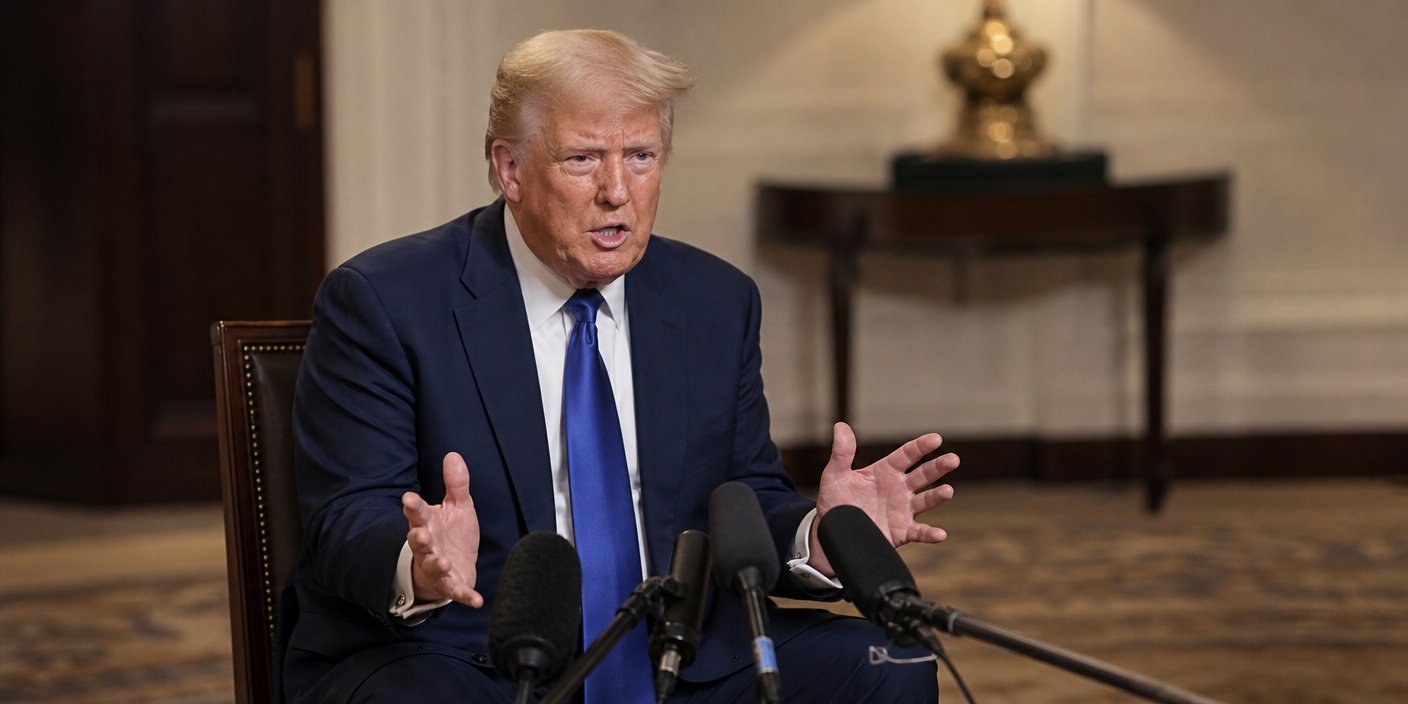
In an era defined by political hyperbole, the current administration has ventured into a new frontier: the redefinition of basic arithmetic. Health and Human Services Secretary Robert F. Kennedy Jr. recently ignited a firestorm of criticism during a Senate Finance Committee hearing, where he attempted to validate President Donald Trump’s mathematically impossible claims regarding drug price reductions. By suggesting that the President employs a ‘different way of calculating’ percentages, the administration has effectively signaled an embrace of ‘alternative math’ as a policy communication tool, sparking intense debate over whether this represents a genuine misunderstanding of economics or a deliberate strategy to redefine objective reality.
Key Highlights
- The Impossible Claims: President Trump has repeatedly claimed drug price reductions exceeding 100% (e.g., calling a drop from $600 to $100 a ‘600% reduction’), which is mathematically impossible as price drops cannot exceed 100%.
- The HHS Defense: Secretary Robert F. Kennedy Jr. explicitly defended these figures during Senate testimony, asserting that there are ‘two ways’ to calculate percentages, effectively endorsing the President’s non-standard statistical model.
- Mathematical Reality: Economists and independent analysts note that these calculations appear to conflate percentage decreases with percentage increases (calculating the return to the original price rather than the reduction from it), leading to wildly distorted economic narratives.
- The Trust Gap: Critics argue that the defense of these figures undermines the credibility of the HHS and the White House, suggesting a trend where political convenience overrides factual accuracy in public policy discourse.
The Anatomy of ‘Alternative Arithmetic’ and Political Rhetoric
The Statistical Mirage
At the heart of the current controversy lies a fundamental disconnect between standard accounting practices and the administration’s public-facing economic narrative. To illustrate the absurdity, one must look at the specific examples cited by the President and supported by Secretary Kennedy. If a medication is priced at $600 and the cost is reduced to $100, the actual price reduction is 83.3%. This is a straightforward calculation: the difference ($500) divided by the original price ($600). However, the administration’s logic appears to be applying a inverted calculation: the difference ($500) divided by the new price ($100), yielding a 500% figure, which they then conflate with a ‘reduction’ rather than a ‘markup’ or ‘increase.’
This is not merely a semantic error; it is a structural failure in how the administration communicates value. When an official of the stature of the Health and Human Services Secretary stands before the Senate Finance Committee and validates such errors, it raises alarms about the competency of the advisors surrounding the President. The decision to double down on ‘alternative math’—rather than correcting the President’s public statements—suggests a political culture where the primary directive is not the accuracy of the data, but the preservation of the President’s rhetorical framing.
The Erosion of Shared Reality
This incident is the latest chapter in a long-standing tension between political discourse and quantitative evidence. Historically, political figures have massaged numbers to put their policies in the best light—for example, cherry-picking start dates for economic growth or emphasizing specific metrics over others. However, the Trump-RFK Jr. approach differs by attempting to bypass the laws of mathematics entirely. By labeling standard, universally accepted arithmetic as just ‘one way of calculating,’ the administration is attempting to subjectify objective truths.
This strategy is particularly dangerous in the context of the Department of Health and Human Services. HHS manages trillions of dollars in taxpayer funds, oversees public health data, and regulates the pharmaceutical industry. If the leadership at HHS cannot agree on the basic principles of subtraction and percentages, what confidence can the public—or the financial markets—have in the agency’s complex modeling for healthcare costs, pandemic response, or insurance projections? The risk is that the administration is fostering an environment where internal data is warped to fit the President’s preferred narrative, leading to potentially disastrous policy decisions grounded in fantasy rather than fact.
The ‘Post-Truth’ Policy Framework
Beyond the immediate fallout, this episode signals a deeper shift in how the current administration interacts with expertise. We are witnessing the normalization of ‘post-truth’ policy, where internal consistency is prioritized over external reality. When experts, economists, and mathematicians point out the impossibility of the administration’s figures, they are dismissed as ‘calculators’ or part of an establishment that doesn’t understand the ‘new way’ of doing things.
This framing creates a powerful, albeit circular, defense mechanism. By characterizing the rejection of their math as a form of elitist arrogance, the administration insulates itself from criticism. It forces supporters to choose between trusting their eyes (and basic school-taught math) or trusting the political entity they support. This, in turn, accelerates the polarization of information. The danger here is that by devaluing the currency of truth—specifically objective, verifiable data—the administration weakens the very institutions necessary to solve complex national problems. When numbers become fluid, accountability becomes impossible.
Looking Ahead: The Consequences of Institutional Distrust
As the administration continues to promote this narrative, the potential for long-term institutional damage grows. Congressional oversight committees are likely to intensify their scrutiny of the HHS, not just on drug pricing, but on the integrity of the data that drives all policy decisions under Secretary Kennedy. Furthermore, the pharmaceutical industry, which relies on precise financial forecasting and regulatory compliance, may find itself operating in a chaotic environment where the goalposts of ‘savings’ and ‘costs’ shift based on the administration’s fluctuating definitions.
Ultimately, this ‘losing fight over arithmetic’ is a microcosm of a larger governance crisis. If the executive branch cannot align itself with the basic reality of how percentages work, it serves as a harbinger of how it will handle more complex challenges. For the American public, the takeaway is clear: in this administration, numbers are no longer treated as facts to be discovered, but as malleable assets to be manufactured. The challenge for the legislative branch, the media, and the electorate will be to force a return to an objective baseline before the divergence between reality and rhetoric becomes too wide to bridge.
FAQ: People Also Ask
Q: Why does the administration claim a 600% reduction is possible?
A: The administration appears to be using a flawed formula that calculates the percentage of the original cost that the new price represents, or it is calculating the difference relative to the lower price, which is mathematically invalid when describing a price reduction.
Q: Is it legally permissible to use ‘alternative math’ in government reporting?
A: While there are no specific laws against a politician being wrong about math in a speech, federal agencies are generally required to use accurate, evidence-based data for official reports, budget projections, and regulatory filings. Misrepresenting data in official capacity can have legal and ethical implications.
Q: How does this affect public trust in the HHS?
A: Public trust is heavily reliant on the perceived competence and integrity of agency heads. When a Cabinet Secretary defends demonstrably false data, it risks delegitimizing the agency’s scientific and economic output, potentially causing stakeholders to doubt the validity of health-related information, such as drug safety warnings or public health initiatives.
Q: Has anyone in the administration corrected these statements?
A: To date, there has been no formal retraction or correction from the White House or HHS. Instead, the administration has consistently defended the rhetoric, framing it as a valid, alternative perspective on economic calculation.