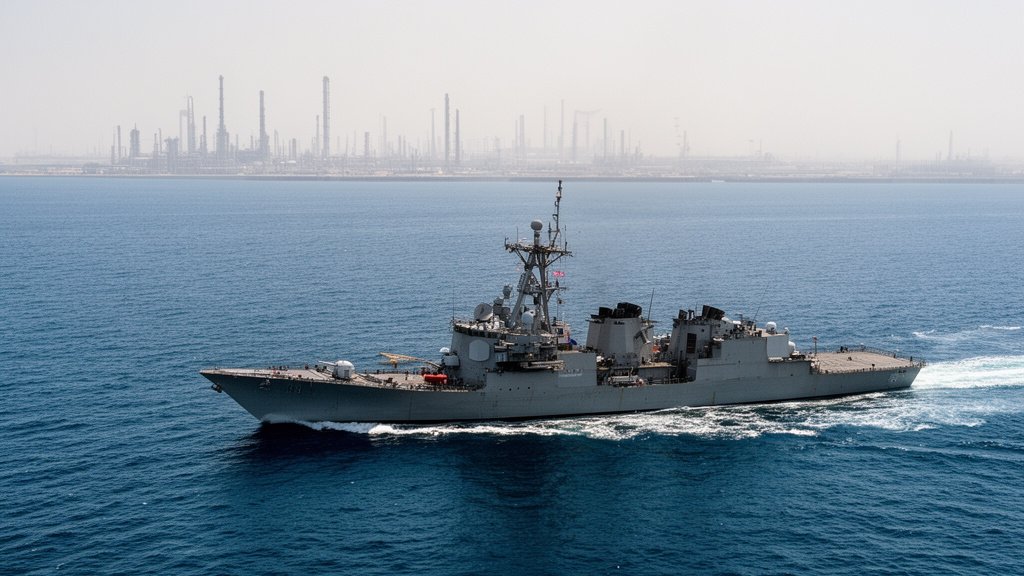
The United States and Iran traded significant aerial strikes for the second consecutive day on Thursday, July 9, 2026, escalating the ongoing conflict over the critical Strait of Hormuz. The U.S. military stated that its latest operations against Iran were designed to degrade Tehran’s capacity to threaten maritime traffic in the crucial waterway, citing recent attacks on commercial vessels. This marked a significant ramp-up in the conflict, following President Donald Trump’s declaration that a preliminary ceasefire agreement with Iran was “over.”
Escalation Over a Vital Waterway
Strait of Hormuz, a narrow waterway that serves as a chokepoint for a significant portion of the world’s oil supply, has been a persistent flashpoint in the broader Middle East war. Iran has maintained its insistence on controlling the strait, despite its historical role in ensuring free passage, particularly before the U.S.-Israeli attacks that triggered the current conflict in February 2026. The recent exchange of fire underscores the lack of progress on de-escalation, with Iran continuing its aggressive posture towards ships transiting the strait.
U.S. Objectives and Iranian Retaliation
U.S. Central Command reported striking approximately 90 military targets across Iran’s coastline. These targets included air defense systems, coastal surveillance assets, missile and drone storage sites, naval capabilities, and military logistics infrastructure. The strikes were explicitly aimed at diminishing Iran’s ability to disrupt commercial shipping and endanger civilian mariners. In response, Iran’s Islamic Revolutionary Guard Corps (IRGC) announced strikes on U.S. military bases in Kuwait and Bahrain, signaling a direct retaliatory measure and a warning of further action if the U.S. air campaign persisted. Explosions were reportedly heard in Bahrain’s capital, Manama, shortly after air raid sirens sounded, indicating a heightened state of alert in the region.
Shifting Political Landscape and Diplomatic Stalemate
President Trump’s declaration of the ceasefire’s collapse came just days after a framework for peace was announced, offering a brief period of global relief. The breakdown of these negotiations, coupled with Trump’s strong rhetoric towards Iranian leaders, suggests a hardening of U.S. policy. The conflict also occurs against the backdrop of Iran’s internal mourning for its slain Supreme Leader, Ayatollah Ali Khamenei, who was killed in February 2026. His son and successor, Mojtaba Khamenei, remains largely out of public view following the attack. The ongoing dispute over Iran’s nuclear program has also remained a significant point of contention, adding another layer of complexity to the geopolitical tensions.
Human Cost and Economic Impact
The intensified strikes have resulted in casualties, with Iran’s health ministry reporting at least 14 deaths and dozens of injuries over the two days of U.S. attacks. Official Iranian news agency IRNA confirmed three deaths and several injuries in Iran from the latest strikes. The renewed hostilities have also led to a resurgence in oil prices, highlighting the significant economic implications of the conflict in the Strait of Hormuz, a vital artery for global energy transport.
FAQ: People Also Ask
What is the strategic significance of the Strait of Hormuz?
The Strait of Hormuz is a vital maritime chokepoint that connects the Persian Gulf to the Gulf of Oman and the open ocean. It is one of the world’s most important oil transit points, with a significant portion of global oil production passing through it daily. Control or disruption of this strait can have profound impacts on global energy markets and international trade.
Why has the U.S. and Iran’s ceasefire collapsed?
According to U.S. President Donald Trump, the ceasefire with Iran collapsed due to continued Iranian actions, specifically citing recent strikes against commercial ships in the Strait of Hormuz. Despite a preliminary peace agreement and the start of negotiations, disagreements over key issues, including control of the Strait and Iran’s nuclear program, led to the breakdown.
What were the targets of the latest U.S. strikes in Iran?
U.S. forces targeted approximately 90 military sites along Iran’s coastline. These included air defense systems, coastal surveillance assets, missile and drone storage sites, naval capabilities, and military logistics infrastructure.
How did Iran respond to the latest U.S. strikes?
Iran retaliated by firing missiles and drones at U.S. military sites in neighboring Gulf Arab states, specifically targeting bases in Kuwait and Bahrain. The IRGC stated that these strikes were a direct response and warned of further action if the U.S. air campaign continued.
What is the reported human toll of the recent strikes?
Iran’s health ministry has reported that at least 14 people have been killed and dozens wounded as a result of the two days of U.S. strikes. Official Iranian news agency IRNA specifically reported three deaths and several injuries from the latest round of attacks.