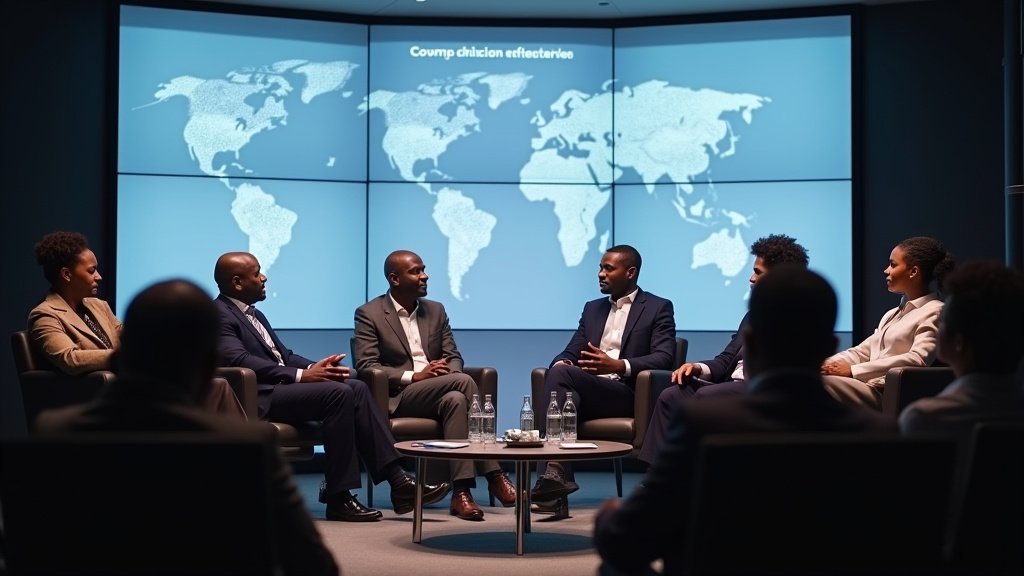
The 9th Media Freedom Festival, orchestrated by Moxii Africa, has officially commenced, serving as a critical frontline defense as South Africa gears up for the 2026 Local Government Elections. Amidst a rapidly evolving technological landscape, the festival has brought together journalists, civil society advocates, and tech policy experts to address the precarious intersection of media freedom and the integrity of electoral processes. The overarching theme—preserving information integrity against the backdrop of AI-driven misinformation—reflects a growing consensus: that the ability of the electorate to make informed decisions is being fundamentally challenged by the rise of synthetic media.
Key Highlights
- The 9th Media Freedom Festival: Hosted by Moxii Africa, this edition marks a significant escalation in the scope of advocacy, specifically focusing on electoral readiness.
- Electoral Integrity: The event centers on the 2026 Local Government Elections in South Africa, emphasizing the protection of verified information at the municipal level.
- Combating Synthetic Threats: Discussions focus on technical and ethical strategies to identify and neutralize AI-driven misinformation, deepfakes, and automated disinformation campaigns.
- Multi-Stakeholder Collaboration: Experts from media houses, civic tech organizations, and electoral commissions are converging to establish a unified framework for rapid response to digital falsehoods.
The Digital Frontline: Defending Truth in the 2026 Cycle
The 2026 Local Government Elections represent the most digitally vulnerable election cycle in South African history. As the world witnesses a surge in generative AI tools capable of creating hyper-realistic audio, video, and text, the capacity for bad actors to manipulate public sentiment has increased exponentially. Moxii Africa has framed this year’s Media Freedom Festival as a defensive fortification against the erosion of truth, acknowledging that local government—the sphere of government closest to the people—is uniquely susceptible to micro-targeted disinformation campaigns.
The Anatomy of AI-Driven Misinformation
At the festival, experts highlighted that the challenge is no longer just about ‘fake news’ as a broad concept, but about the specific, weaponized deployment of AI. Large Language Models (LLMs) can now be used to generate vast quantities of localized, misleading content that mimics the vernacular and concerns of specific communities. During the 2026 election cycle, this poses a direct threat to the democratic process by potentially suppressing voter turnout, inciting localized unrest, or character-assassinating candidates using deepfake audio recordings.
The festival delegates are debating the implementation of watermarking standards and verification protocols that media houses must adopt. However, there is a clear recognition that technology alone cannot solve the problem. The consensus emerging from the event is that ‘Information Integrity’ must be treated as a public good, requiring sustained investment in media literacy programs for voters and robust whistleblower protections for journalists who expose these networks.
Moxii Africa and the Path to Accountability
For years, Moxii Africa has been the vanguard of press freedom in the region. By positioning the 2026 election cycle as the focal point, the organization is pivoting toward ‘Predictive Advocacy.’ This means moving beyond reactive debunking and toward proactive system design. The discussions are not merely academic; they involve concrete proposals for ‘Election Integrity Task Forces’ that will operate in real-time throughout the voting period, providing rapid verification of viral claims.
Accountability in this context is twofold: holding political actors accountable for the content they disseminate and holding digital platforms accountable for their algorithmic recommendation systems that amplify divisive or fraudulent content. The festival is drafting a charter for ‘Digital Electoral Responsibility,’ which calls on tech platforms to provide transparent data on political advertising and to deploy ‘circuit breakers’—mechanisms to slow the spread of potentially harmful unverified content during the critical 48-hour window before polling stations open.
Societal and Economic Impacts
The ripple effects of unchecked misinformation extend far beyond the ballot box. Economically, the cost of disinformation campaigns can be devastating. Local municipalities already struggling with infrastructure delivery cannot afford the volatility caused by AI-fueled riots or the misallocation of resources triggered by false information. When information integrity fails, trust in government institutions declines, leading to a breakdown in the social contract.
Historically, South Africa has seen the impact of social media in amplifying political polarization. However, 2026 introduces a new, accelerated dimension of risk. The festival is exploring how to harness the same AI tools for ‘Good Governance’—using algorithmic analysis to fact-check candidate claims in real-time, thereby providing voters with an objective lens through which to evaluate party manifestos and track records. This creates a fascinating secondary angle: the democratization of high-level auditing tools for the average citizen.
Future Predictions: Towards a Post-Truth Defense
As the festival concludes its preliminary sessions, the vision for the future is clear. The ‘Post-Truth’ era is not an inevitability, but a condition that can be managed through architecture and legislation. The recommendations coming out of the 9th Media Freedom Festival are expected to influence policy shifts across the SADC (Southern African Development Community) region. If South Africa can successfully navigate the 2026 elections without succumbing to a tide of synthetic disinformation, it will set a global benchmark for protecting democratic systems in the age of artificial intelligence. The battle is just beginning, and the stakeholders at the festival are clear: in 2026, the integrity of the vote is inextricably linked to the integrity of the information ecosystem.