
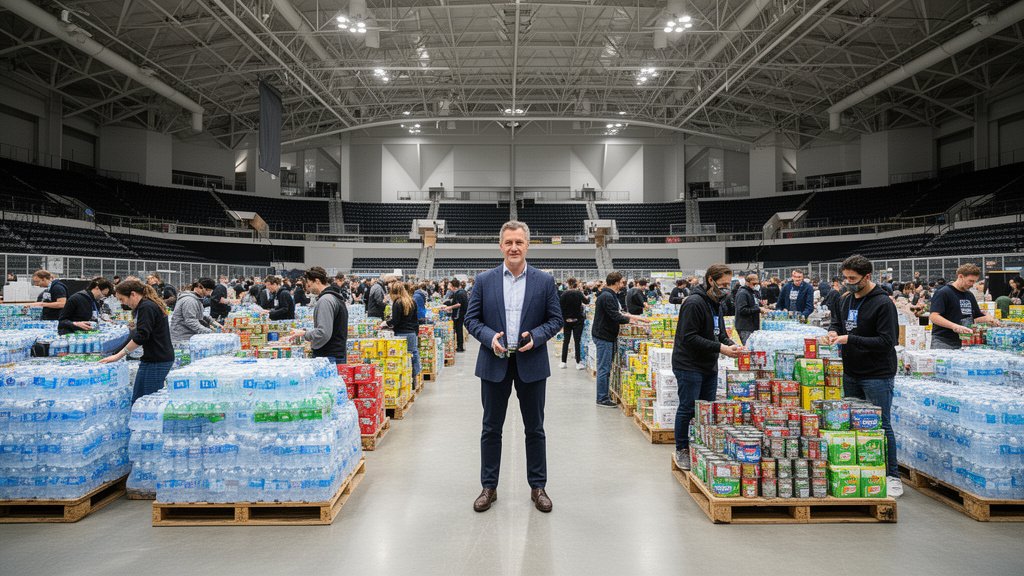
During the intense, rapidly evolving crisis of the August 2023 McDougall Creek wildfire, the Kelowna Events Centre—operating primarily through Prospera Place—transformed from a sports and entertainment venue into the most critical lifeline for thousands of displaced residents. As provincial infrastructure faced unprecedented pressure, the city’s response was defined not just by professional emergency teams, but by a surge of community volunteers who effectively managed a logistical operation of staggering scale. This rapid transformation provided an essential buffer for those losing their homes, illustrating how localized, grassroots action can integrate with formal government protocols to prevent humanitarian catastrophe.
The Anatomy of a Grassroots Emergency Response
The activation of the Emergency Support Services (ESS) reception centre at Prospera Place occurred in the dark hours of the wildfire’s escalation. As evacuation orders expanded, the physical space required to process residents—providing them with shelter, food, and emotional support—quickly outpaced the capacity of existing government personnel. The situation was dire; thousands of people were arriving simultaneously, many having fled with only the clothes on their backs.
This is where the community stepped in. Spontaneous volunteerism in Kelowna did not just happen; it was systematized. Residents arrived at the Events Centre doors not looking for shelter, but looking for ways to serve. Within hours, these civilians organized into ad-hoc shifts, creating a secondary support layer that managed everything from traffic control in the parking lots to the complex intake of evacuees. This volunteer workforce acted as the ‘connective tissue’ of the relief effort, bridging the gap between official ESS mandates and the immediate, messy reality of disaster management.
Scaling the Logistics of Kindness
One of the most complex challenges faced by the organizers at the Kelowna Events Centre was the ‘tsunami of generosity.’ When the public hears of a disaster, the immediate reaction is to donate. However, without strict control, this creates a logistical nightmare. The Events Centre became a temporary warehouse. Volunteers were tasked with the monumental job of sorting, categorizing, and distributing pallets of donated water, canned goods, clothing, and hygiene products.
Experts in disaster logistics often cite the ‘disaster donation paradox’—where well-meaning contributions actually block access to necessary aid. The Kelowna volunteer force effectively neutralized this risk. By establishing a rigid triage system at the loading docks, they ensured that only high-priority, currently needed items moved to the floor, while excessive or unneeded goods were diverted or cataloged for later distribution. This sophisticated level of operational management, executed by citizens with no prior disaster training, allowed the professional staff to focus on critical tasks like housing placement and financial aid disbursement.
The Emotional Infrastructure
While the logistical success was quantifiable, the emotional impact was arguably more significant. For an evacuee, the Events Centre was not just a processing hub; it was a place of trauma, fear, and profound uncertainty. The presence of empathetic, familiar faces—neighbors, teachers, and local business owners acting as volunteers—provided a sense of normalcy in the chaos. This human element of the response prevented the ‘institutional feel’ that often exacerbates the psychological shock of displacement.
Volunteers acted as impromptu counselors, translators for international students, and caretakers for pets brought in by evacuees. The Events Centre management explicitly encouraged this, recognizing that the mental health of the displaced was as critical as their physical safety. The community response effectively turned a sterile, cold venue into a warm, supportive shelter.
Lessons for Future Disaster Planning
If the Kelowna Events Centre effort provides a blueprint for the future, it is in the concept of ‘integrated volunteerism.’ Municipal governments are now analyzing how the rapid activation of the public helped prevent a total system collapse. Future emergency protocols are likely to include pre-vetted volunteer registries and established donation-processing templates, based heavily on the ‘Kelowna Model’ established in 2023.
This shift moves away from viewing the public as a liability during a disaster and toward viewing them as an asset. When the community is given the tools, the space, and the clear organizational hierarchy seen at the Events Centre, they can perform functions that would otherwise require millions of dollars in external resource contracting. The resilience of Kelowna was not found in the infrastructure of the Events Centre itself, but in the people who walked through its doors during the darkest days of the fire.
FAQ: People Also Ask
Q: What role did the Kelowna Events Centre play specifically during the 2023 wildfires?
A: It served as the primary Emergency Support Services (ESS) reception centre. This meant it was the central hub for registering displaced persons, assigning temporary accommodation, providing food vouchers, and coordinating emergency medical support for thousands of evacuees.
Q: Why was the role of volunteers considered a ‘critical lifeline’?
A: Professional emergency teams were overwhelmed by the sheer volume of evacuees. Volunteers managed the ‘surge capacity’—handling the donation logistics, guiding foot traffic, and providing emotional labor that the official ESS staff did not have the bandwidth to manage, thereby preventing the processing system from stalling.
Q: How does this model change future emergency planning?
A: Many municipalities are now studying the Kelowna response to integrate spontaneous volunteerism into formal emergency operations plans (EOPs). This involves creating pre-existing ‘volunteer playbooks’ so that in the next crisis, the public can be mobilized and organized instantly rather than forming ad-hoc groups.
Q: What were the biggest logistical challenges faced by volunteers at the centre?
A: The biggest challenge was the uncontrolled influx of unsolicited physical donations. Volunteers had to rapidly establish a sorting and triage protocol to manage the volume of supplies, ensuring that the facility remained safe, accessible, and compliant with fire codes while processing vital aid.