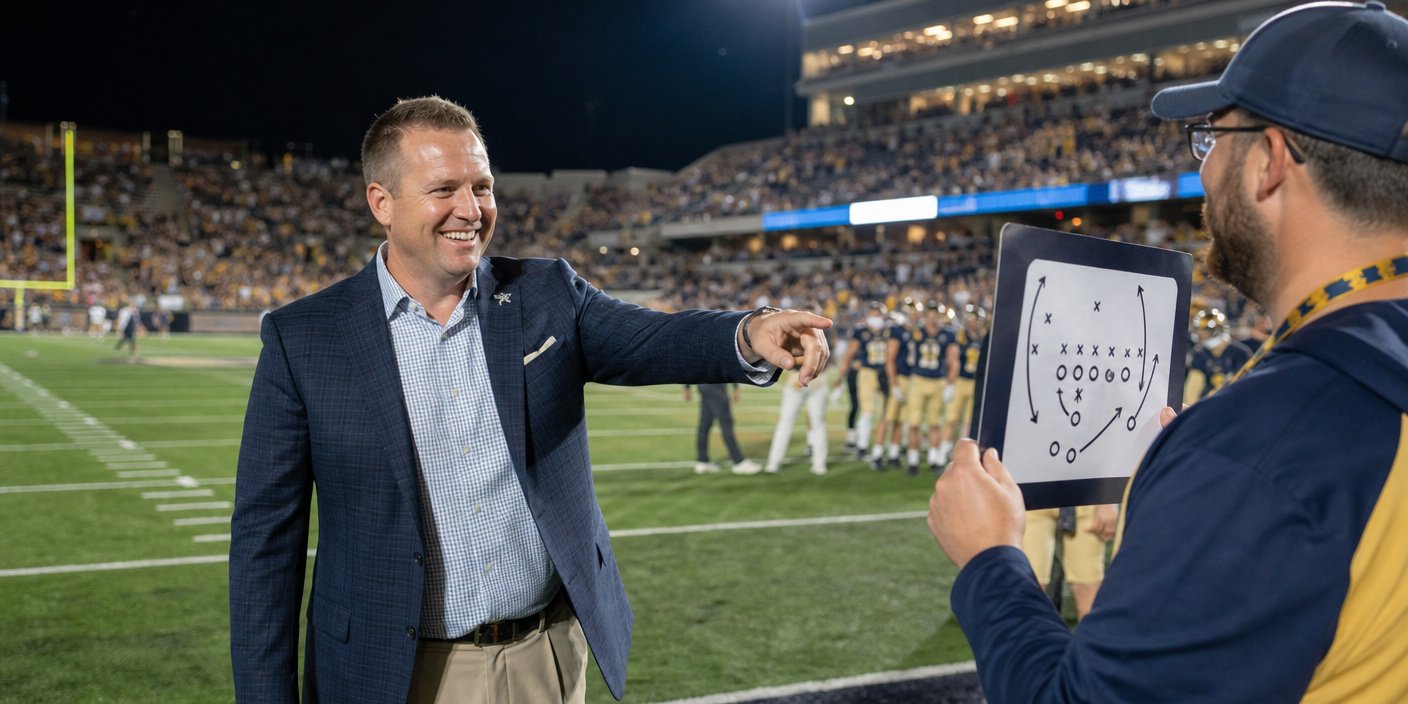
In a landscape where college athletics departments are increasingly fighting for attention against professional leagues and digital entertainment, the University of Akron found a breakthrough in the unlikeliest of places: a “ridiculous” marketing gamble. By launching a campaign to name an “Offensive Coordinator of the Game,” Athletic Director Andrew Goodrich orchestrated a masterful exercise in guerilla marketing that transformed fan engagement metrics and tangible ticket sales. This initiative, which rapidly transcended local interest to achieve 23 million views online, serves as a defining case study on how collegiate programs can leverage low-cost, high-creativity tactics to disrupt the modern sports media cycle.
Key Highlights
- Viral Reach: The “Offensive Coordinator of the Game” campaign exploded to 23 million views, far exceeding traditional localized advertising benchmarks.
- Tangible ROI: The marketing push directly correlated with a significant boost in season ticket sales, proving the conversion power of social media engagement in college sports.
- Strategic Risk: Athletic Director Andrew Goodrich intentionally embraced a “ridiculous” premise to cut through the noise, highlighting the necessity of unconventional thinking in mid-major athletic programs.
- Fan Empowerment: The initiative shifted the dynamic from passive spectatorship to active participation, a core pillar for future sports marketing strategies.
The Playbook for Virality: Inside the Zips Marketing Masterclass
The marketing strategy deployed by the University of Akron represents a pivotal shift in the collegiate athletic business model. Historically, university sports departments relied on traditional media buys, alumni newsletters, and standard promotional schedules. However, the saturation of the sports media market has rendered these methods increasingly ineffective for non-Power Four institutions. The Akron Zips’ decision to embrace the absurdity of a fan calling (or appearing to call) plays illustrates a sophisticated understanding of “pattern interruption”—the psychological principle of stopping a viewer’s scroll with content that feels inherently out of place.
From “Ridiculous” to Revenue
Andrew Goodrich, in his assessment of the campaign, openly categorized the initial ideation as “ridiculous.” This self-awareness was likely the campaign’s greatest strength. It signaled to the fanbase that the University of Akron did not take itself too seriously, effectively humanizing the brand. In an era where corporate sports entities are often viewed as sterile, bureaucratic machines, the Zips’ willingness to poke fun at the intense, often overly serious nature of collegiate football coaching provided a refreshing contrast.
However, the strategy was not merely about being funny; it was about the funnel. By gamifying the experience—offering a contest where fans could vie for the title of “Offensive Coordinator of the Game”—the university created a high-stakes emotional investment. The 23 million views were not just vanity metrics; they represented a massive, qualified audience that was exposed to the Zips’ brand. When conversion is the goal, transforming social media impressions into ticket sales requires a bridge. Akron successfully built this bridge by embedding the contest promotion within their broader digital ticketing campaigns, ensuring that viral interest was immediately monetizable.
The Economics of Engagement
To understand the true impact, one must analyze the cost of customer acquisition in sports. Traditional advertising—billboards, local radio, or digital ads—carries a high cost-per-acquisition (CPA). The “Offensive Coordinator” contest, by contrast, relied on organic reach. The viral nature of the content meant the university effectively outsourced its marketing department to the fans.
When a fan participates in a contest, they are essentially becoming a brand ambassador. They share the content, tag friends, and amplify the message. This organic proliferation lowered the CPA to a fraction of the cost of paid advertising. The resulting boost in season ticket sales indicates that this was not just an exercise in social media vanity; it was a calibrated economic move designed to fill seats in the stadium by turning the act of buying a ticket into an act of community participation.
Collegiate Marketing in the NIL Era
This campaign arrives at a critical juncture in the history of college sports. With the emergence of Name, Image, and Likeness (NIL) legislation, players are now brands in their own right. Universities, however, are struggling to maintain their own institutional brand relevance. The Akron model provides a blueprint for how athletic departments can maintain a distinct identity. It is an acknowledgment that in the NIL era, the university brand must compete for the same attention as the players. By creating interactive, experiential marketing events, universities can reclaim their narrative and ensure that the “institution” remains the home base for the athlete-star, rather than just a backdrop.
The Future of Interactive Sports
Looking forward, the Akron Zips’ success invites questions about the scalability of interactive sports marketing. If a university can make a fan an “Offensive Coordinator for a Day,” what is the next iteration? We are likely to see increased implementation of AR (Augmented Reality) fan experiences, predictive gameplay contests, and digital integration directly within stadium infrastructure. The barrier to entry for these technologies is dropping, and as Akron has demonstrated, the barrier to entry for creative ideas is non-existent. The future of the stadium experience will not be about passive observation; it will be about data-driven, interactive environments where the fan is not just a consumer, but a participant in the outcome.
FAQ: People Also Ask
Q: How did the University of Akron measure the success of the contest?
A: Beyond the 23 million views across social media platforms, the University tracked conversion rates directly from contest entry points to ticket purchase portals, confirming a direct correlation between digital engagement and season ticket sales growth.
Q: Was this campaign criticized by traditional coaching staff?
A: While Athletic Director Andrew Goodrich acknowledged the idea seemed “ridiculous,” the initiative was carefully curated to maintain the integrity of the team while maximizing the fun factor. It was marketed as a fan-engagement novelty rather than a disruption to actual play-calling duties.
Q: Will the Zips repeat this marketing strategy in future seasons?
A: Given the massive viral success and the boost to revenue, it is highly probable that the athletic department will continue to iterate on this model, potentially expanding into new interactive categories to maintain high engagement levels.