Metallica has officially launched their ambitious 24-show residency at the Sphere in Las Vegas, transforming the world’s most technologically advanced venue into a cathedral of heavy metal. By committing to a strictly enforced “no repeat” setlist format, the band is not merely performing; they are curating a sonic archive that prioritizes deep cuts and rarities alongside their global anthems. This residency marks a pivotal moment in the band’s four-decade career, blending their raw, unvarnished intensity with the hyper-modern, immersive capabilities of the Sphere.
Key Highlights
- Unprecedented Residency: A massive 24-show run at the Sphere, designed to utilize the venue’s 16K resolution LED screen and beam-forming audio technology.
- The ‘No Repeat’ Commitment: A guarantee that no song played on any given night will be repeated throughout the entire 24-show engagement, forcing the band to pull from their entire catalog.
- Deep Cut Focus: The setlists are meticulously curated to favor obscure tracks and fan favorites that rarely make it to standard stadium tours.
- Immersive Spectacle: The band’s visual production is tailored specifically for the Sphere’s wraparound screen, moving away from traditional concert screens toward a fully enveloping aesthetic experience.
Inside The Immersive Metal Odyssey
The Architecture of Sound and Vision
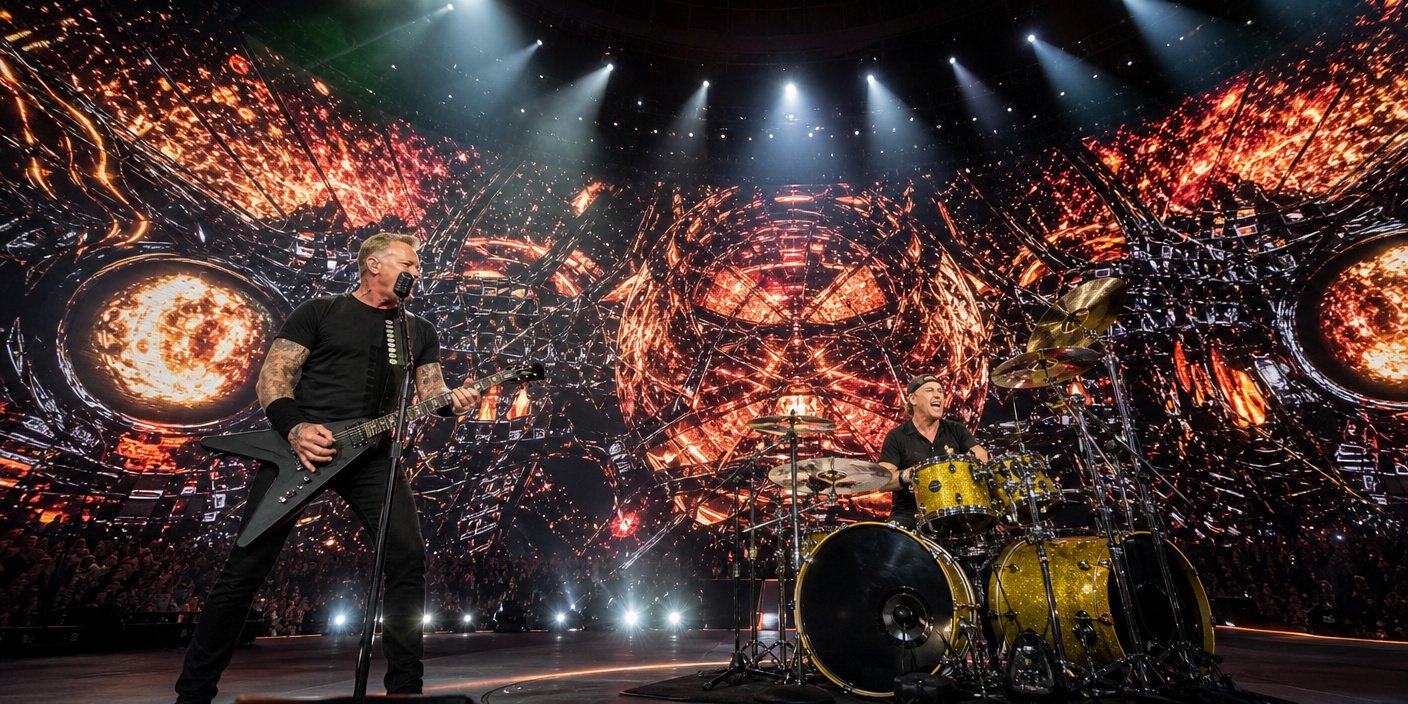
The marriage of Metallica’s high-decibel assault and the Sphere’s acoustic architecture is a revelation. Unlike traditional arenas, which often suffer from muddy acoustics and echo-prone corners, the Sphere employs beam-forming technology that directs sound waves to every seat with pinpoint accuracy. For a band like Metallica—known for James Hetfield’s tight, percussive rhythm guitar and Lars Ulrich’s sprawling drum kits—this clarity is transformative.
During the opening performances, the sonic separation allowed for a level of nuance usually lost in stadium settings. Subtle harmonic textures in the band’s mid-era material were audible, creating a more intimate, albeit massive, listening experience. The visual component, utilizing the Sphere’s 160,000-square-foot interior LED screen, moved beyond simple close-ups of the musicians. Instead, the visuals acted as a thematic extension of the music, with abstract, metallic, and fire-centric imagery that pulsed in rhythm with the band, creating a synesthetic experience that redefined the concept of a live concert.
The ‘No Repeat’ Philosophy: A Deep Cut Resurrection
The central draw of this residency is the promise of a rotating setlist. The “No Repeat” format is not just a marketing gimmick; it is an organizational challenge that keeps the band and the audience engaged. By removing the safety net of a static, tried-and-true “greatest hits” setlist, Metallica is forced to dive into the furthest reaches of their discography. This approach rewards the “super fan” demographic—those who travel across state lines to catch multiple shows in the run.
For the band, this requires immense preparation. The band members are tasked with rotating through songs they may not have played live in years, requiring rigorous rehearsals to maintain their signature precision. For the audience, this creates a “collector’s” dynamic. There is a tangible excitement in the air regarding which rarities will be unearthed each night. It shifts the dynamic from a passive concert-goer experience to an active, shared hunt for musical history.
Historical Context: From Garage Days to High-Tech Titans
To understand the magnitude of this residency, one must look at the trajectory of Metallica. From their inception in the early 1980s as the pioneers of thrash metal, they have consistently defied industry expectations. Whether it was their early resistance to music videos, their pivot toward the mainstream in the 1990s, or their current embrace of high-tech touring, they have navigated longevity through adaptation. This residency at the Sphere is the logical conclusion of that evolution. They are no longer just a band; they are an enterprise capable of filling the most expensive and advanced venue on earth for nearly a month. It is a validation of the enduring power of heavy metal as a viable, premium-tier entertainment product.
The Economic and Cultural Shift in Las Vegas
Beyond the music, this residency highlights the shifting economic model of the Las Vegas strip. Traditionally a destination for static, pop-focused residencies (like Celine Dion or Adele), Vegas has successfully pivoted to attract rock and metal audiences. The 24-show run creates a consistent influx of “metal tourism,” driving revenue into hotels, restaurants, and secondary entertainment venues surrounding the Sphere. This residency is a litmus test for future rock acts; if Metallica can sustain demand for 24 shows with high ticket prices, it opens the door for other legacy rock bands to treat the Sphere as a permanent home for high-concept, limited-run spectacles.
Future Predictions: How This Reshapes Touring
As the music industry continues to wrestle with the decline of physical media revenue, live performance remains the lifeblood of major acts. Metallica’s Sphere residency sets a blueprint that other bands are likely to emulate. We are moving toward an era of “Event Touring,” where bands prioritize long-term, venue-specific residencies over grueling, cross-country bus travel. By staying in one location, bands reduce their carbon footprint, manage their health better, and can implement complex stage designs—like the Sphere’s wraparound screen—that would be impossible to break down and rebuild on a nightly basis in different cities.
FAQ: People Also Ask
Q: How many shows are included in the Metallica Sphere residency?
A: The residency consists of an ambitious 24-show run at the venue.
Q: What does the ‘No Repeat’ format mean for the setlist?
A: It means that the band will not perform the same song more than once across the entire 24-show run, allowing them to showcase deep cuts and rarities.
Q: Why is the Sphere venue considered special for this show?
A: The Sphere offers a 16K resolution LED screen that wraps around the audience and advanced beam-forming audio technology, creating an immersive experience that traditional stadium venues cannot match.
Q: Are these shows focused only on classic hits?
A: No. The focus is on a mix of classic hits and deep cuts, specifically tailored to highlight the band’s extensive catalog and reward long-time fans.