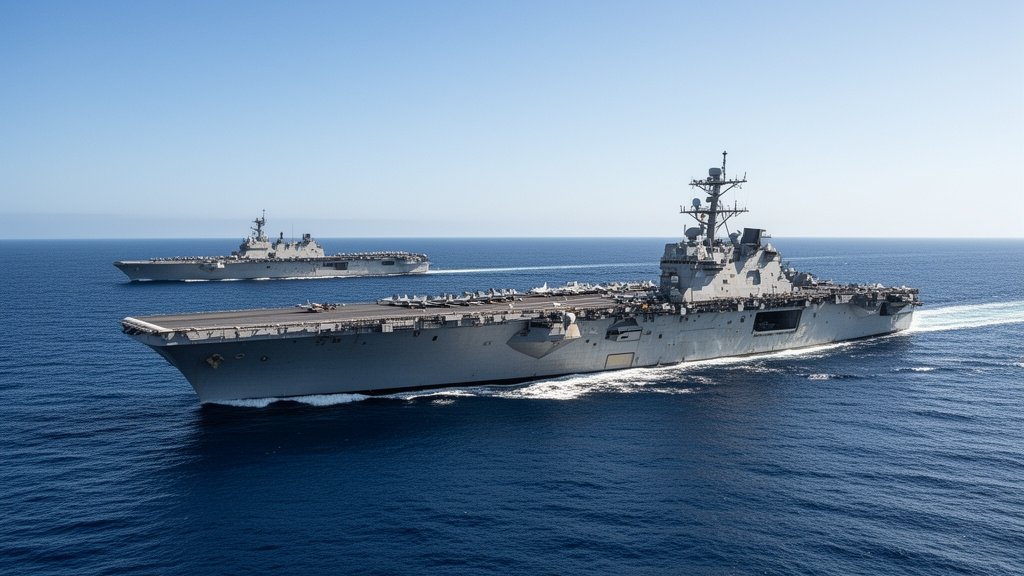
The Pentagon is significantly escalating its military posture in the Middle East, authorizing the deployment of a third aircraft carrier strike group and additional Marine Corps amphibious units. This strategic move, which involves between 9,000 and 10,000 personnel, comes as regional tensions with Iran continue to intensify, marking a critical shift in US force projection within the CENTCOM (US Central Command) area of responsibility.
Key Highlights
- Strategic Reinforcement: The US is deploying a third carrier strike group to the Middle East to bolster deterrence against Iranian-backed aggression.
- Force Composition: The deployment includes massive naval support, air wings, and specialized Marine Corps amphibious ships, totaling 9,000 to 10,000 troops.
- Operational Objective: The primary goal is to provide regional stability and protect US interests amidst escalating volatility.
- CENTCOM Command: All assets will fall under the coordination of CENTCOM, which oversees operations across the broader Middle East region.
Power Projection in an Unstable Region
The decision to move a third carrier strike group into the region is an extraordinary measure of force projection, rarely seen since the height of post-9/11 operations. In modern naval warfare, a Carrier Strike Group (CSG) is not merely a single vessel; it is a self-contained city of war. It typically consists of a Nimitz-class or Ford-class aircraft carrier, accompanied by a guided-missile cruiser, two guided-missile destroyers, and an air wing comprising approximately 65 to 75 aircraft.
The Strategic Role of the CSG
By introducing a third group, the Department of Defense is effectively tripling its organic air power in the region. This allows CENTCOM to maintain a persistent presence in multiple maritime corridors simultaneously, specifically targeting the Strait of Hormuz and the Red Sea. The presence of these strike groups provides the President with a range of options, from surveillance and reconnaissance to rapid-response air strikes and electronic warfare capabilities, without needing to rely on host-nation bases which may be politically sensitive or vulnerable to ballistic missile attacks.
Marine Corps Integration and Expeditionary Force
The integration of Marine Corps amphibious ships—likely including Wasp-class or America-class amphibious assault ships—adds a distinct layer of lethality. These ships serve as the platform for the Marine Expeditionary Unit (MEU). Unlike the Carrier Strike Group, which focuses on power projection through air superiority and long-range cruise missiles, the MEU provides the capability to conduct amphibious landings, rapid humanitarian relief, and the evacuation of embassy personnel. This dual-pronged approach—Carrier air power combined with Marine ground readiness—creates a comprehensive safety net for US interests in the region.
Geopolitical Implications: Deterrence vs. Escalation
Critics and proponents alike are watching closely to see how Tehran reacts. The core tenet of this deployment is ‘deterrence by presence.’ The Pentagon calculates that by visibly demonstrating an overwhelming military advantage, they can discourage Iranian proxies from escalating attacks on US-flagged commercial vessels or regional military installations. However, international relations scholars often note the ‘security dilemma,’ where defensive measures are perceived as offensive by the adversary, potentially triggering a reactive military buildup by Iranian forces and their regional militias.
Secondary Angles: Understanding the Wider Context
Historical Context: The Evolution of Carrier Diplomacy
Historically, ‘Gunboat Diplomacy’ has evolved into ‘Carrier Diplomacy.’ Since the late 20th century, the US has used carrier deployments as a primary signaling tool. During the 1980s Tanker War, and throughout the Iraq and Afghanistan campaigns, the carrier was the centerpiece of US foreign policy. This current deployment mirrors the scale of the 2003 invasion preparations, signaling that the current geopolitical climate is viewed by the Pentagon as reaching a similarly critical threshold.
Logistical Challenges and Operational Fatigue
The logistical tail of such an operation is immense. Maintaining 10,000 personnel at sea for extended periods requires massive refueling operations, rotational supply chain logistics, and maintenance schedules that push the limits of the US Navy’s current surface fleet. Prolonged deployments at this scale often lead to ‘operational fatigue,’ where ships and crews are pushed beyond their scheduled rotations, increasing the risk of mechanical failure and reducing the long-term readiness of the fleet.
Economic Impact: Stability in Global Markets
The Middle East remains the world’s most critical node for energy transport. Increased naval presence is intended to ensure the freedom of navigation in international waters. Global oil markets are notoriously sensitive to regional conflict. By guaranteeing that shipping lanes like the Strait of Hormuz remain open, the US is attempting to prevent the supply shocks that would inevitably occur if commercial traffic were restricted or targeted by state-aligned militias, thus protecting global economic stability from potential Iranian leverage.
FAQ: People Also Ask
1. What is the specific role of a Carrier Strike Group in this region?
The Carrier Strike Group acts as a mobile military base, providing air support, surveillance, and missile defense without the need for static land bases. It acts as a primary deterrent to regional threats against US personnel and commercial shipping.
2. How many troops are involved in this specific deployment?
The deployment involves a total of 9,000 to 10,000 troops, comprising the crews of the carrier strike group, support vessels, and the additional Marine Corps personnel aboard amphibious ships.
3. Why is the US deploying a third carrier group now?
The deployment is a direct response to rising tensions with Iran and its proxy forces. The US aims to deter further aggression against maritime vessels and US assets in the CENTCOM area of responsibility.
4. Does this mean the US is planning an attack?
No. Pentagon officials consistently describe these deployments as defensive in nature, aimed at deterrence and protection of navigation and regional allies, rather than preparation for offensive conflict.