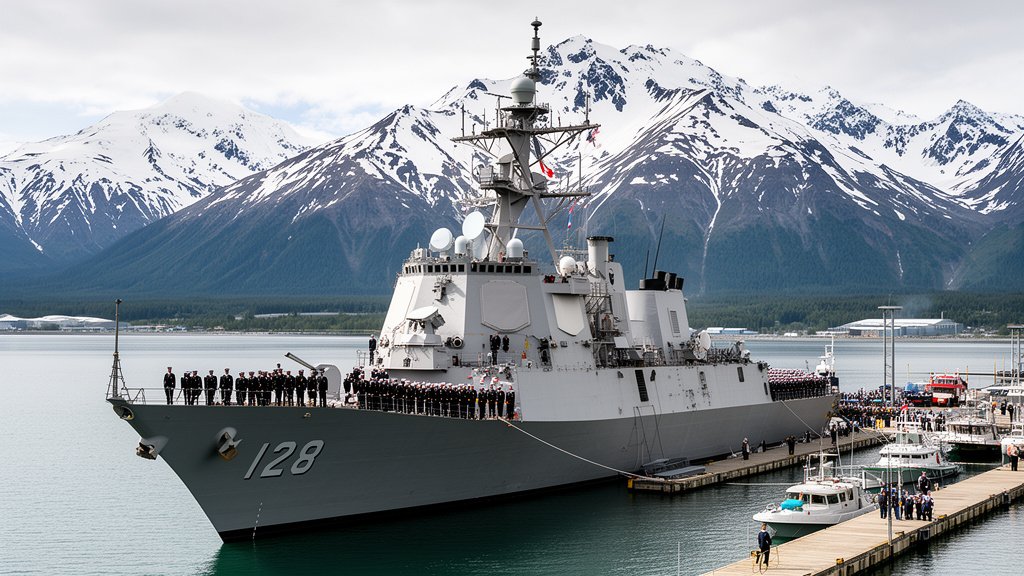
The U.S. Navy officially commissioned its newest Flight III Arleigh Burke-class guided-missile destroyer, the USS Ted Stevens (DDG 128), in a formal and deeply symbolic ceremony held in Whittier, Alaska, on October 3, 2026. The commissioning marks a significant expansion of the Navy’s surface warfare capabilities, placing one of the most technologically advanced warships in the world directly into the strategic theater of the High North. As the vessel entered active service, it not only honored the legacy of the late Alaskan Senator Ted Stevens but also signaled a clear message regarding U.S. resolve in Arctic maritime defense.
Key Highlights:
- Commissioning Location: The ceremony took place in the port city of Whittier, Alaska, highlighting the increasing importance of the Arctic region in U.S. national security strategy.
- Advanced Flight III Tech: The USS Ted Stevens is a Flight III Arleigh Burke-class destroyer, featuring the revolutionary AN/SPY-6(V)1 Air and Missile Defense Radar, providing unparalleled situational awareness.
- Strategic Namesake: The ship honors the late Senator Ted Stevens, a titan of Alaskan politics whose influence shaped both the state and national defense policy for decades.
- Shipbuilding Milestone: Constructed by Huntington Ingalls Industries (HII) in Pascagoula, Mississippi, the vessel represents the culmination of advanced modular shipbuilding techniques and increased power generation capabilities.
The Arctic Vanguard: Inside the USS Ted Stevens Commissioning
The commissioning of the USS Ted Stevens is far more than a routine addition to the Navy’s inventory; it is a tactical evolution. By commissioning a Flight III destroyer in the rugged environment of Whittier, the Navy underscored its commitment to maintaining dominance in high-latitude waters. The Flight III configuration is not merely an incremental upgrade; it is a fundamental shift in how the surface fleet operates, prioritizing radar capabilities and electrical power distribution to counter emerging hypersonic and ballistic missile threats.
The Flight III Advantage: A Radar Revolution
At the heart of the USS Ted Stevens lies the AN/SPY-6(V)1 Air and Missile Defense Radar (AMDR). Unlike the legacy SPY-1 radars that have served as the backbone of the Aegis Combat System for decades, the SPY-6 is a scalable, active electronically scanned array (AESA) radar. This system provides significantly increased sensitivity and range, allowing the destroyer to track multiple complex threats simultaneously—from cruise missiles to ballistic projectiles—at distances previously unimaginable for a ship of this class.
This leap in sensor technology required a corresponding overhaul of the ship’s power plant. The Flight III design includes enhanced power generation and cooling capacity, ensuring that the ship can support the energy-intensive demands of advanced radar systems while maintaining high-speed maneuverability. This combination of sensor range and electrical overhead makes the Ted Stevens a pivotal asset for Integrated Air and Missile Defense (IAMD).
Honoring a Legacy: The Spirit of Senator Ted Stevens
The choice of name for DDG 128 is deeply intertwined with the location of its commissioning. Senator Ted Stevens, who served in the Senate for 40 years, was a champion of Alaskan interests and a fierce advocate for a strong national defense. His influence on the Senate Appropriations Committee ensured that Alaska remained a central hub for U.S. military infrastructure. By commissioning the ship in his home state, the Navy acknowledged that this vessel serves as a protector of the gateway to the Arctic, a region Stevens spent his career integrating into the national consciousness.
Geopolitical Shifts and the High North
The deployment of a Flight III destroyer to the Arctic theater comes at a time of heightened geopolitical competition. Russia and China have both increased their operational tempo in the region, seeking to exploit warming sea lanes and untapped natural resources. The USS Ted Stevens brings a level of multi-mission capability that is essential in this environment. Whether participating in freedom of navigation operations or providing ballistic missile defense for the North American continent, the ship acts as a mobile fortress capable of operating in some of the most unforgiving maritime conditions on earth.
The Industrial Backbone: HII’s Role
The USS Ted Stevens is the product of Huntington Ingalls Industries (HII) Ingalls Shipbuilding division. The construction of a Flight III destroyer is a complex industrial undertaking, requiring precise integration of advanced combat systems into a proven hull design. HII’s successful delivery of the Ted Stevens showcases the resilience of the U.S. defense industrial base. The ship represents a sustained investment in domestic manufacturing capability, supporting thousands of skilled jobs and ensuring that the U.S. Navy maintains its technological edge over near-peer adversaries.
FAQ: People Also Ask
What makes a Flight III Arleigh Burke-class destroyer different from previous flights?
The primary difference is the integration of the AN/SPY-6(V)1 Air and Missile Defense Radar. This system is significantly more powerful than previous radars, requiring substantial upgrades to the ship’s electrical power generation and cooling systems to accommodate the increased energy demand.
Why was the USS Ted Stevens commissioned in Alaska?
The location serves both as a tribute to the ship’s namesake, the late Senator Ted Stevens, and as a strategic statement regarding the U.S. Navy’s focus on the Arctic and High North regions, which are becoming increasingly critical for national security.
What is the primary role of the USS Ted Stevens?
The USS Ted Stevens is a multi-mission platform capable of operating in independent deployments or as part of a carrier strike group. Its core missions include air defense, ballistic missile defense, surface warfare, and anti-submarine warfare, utilizing its advanced Aegis Combat System to project power and protect national interests.