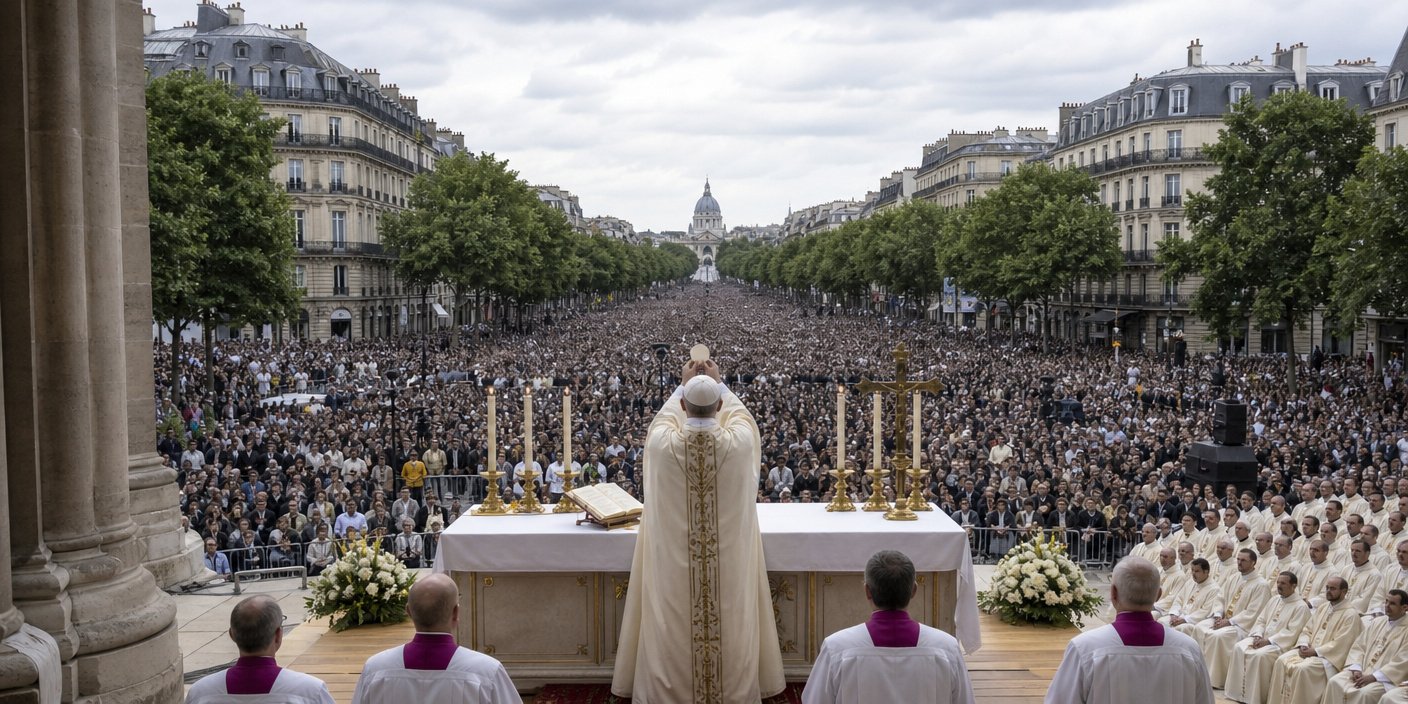
In a momentous display of religious fervor that brought central Paris to a standstill, Pope Leo XIV celebrated an outdoor Mass for an estimated 800,000 faithful, marking the centerpiece of his current four-day apostolic visit to France. The massive assembly, which filled the city’s thoroughfares with a sea of worshippers, serves as the spiritual prelude to the Pontiff’s journey to the Grotto of Massabielle in Lourdes, a site of profound Marian significance. This visit underscores a significant revitalization of traditional public worship in an urban landscape, drawing international attention to the interplay between institutional faith and modern European society.
Key Highlights
- Historic Attendance: An estimated 800,000 people gathered for the Mass, representing one of the largest religious congregations in Paris in recent memory.
- Four-Day Itinerary: The Mass serves as the foundational event of a rigorous four-day apostolic visit aimed at strengthening ties between the Holy See and the French Catholic community.
- Spiritual Transition: Following the urban mobilization in Paris, the Pope is transitioning to a more contemplative phase of the trip at the Grotto of Massabielle in Lourdes.
- Ecumenical Focus: The event featured messages of unity, reconciliation, and peace, echoing the themes the Pope is expected to emphasize throughout his time in Lourdes.
A Moment of Unity in the Heart of Paris
The sheer scale of the gathering in Paris highlights the continued cultural resonance of the Catholic Church within France. Organizers noted that the logistics of the event, which required massive cooperation between the Holy See and municipal authorities, proceeded with remarkable order. The atmosphere in the city was described by attendees as deeply contemplative, characterized by a shared silence that punctuated the liturgical rites, contrasting sharply with the typical ambient noise of a major global capital. This event is not merely a logistical feat but a symbolic statement on the visibility of faith in the public square.
The Logistics of Faith
The Archdiocese of Paris and local authorities deployed an unprecedented security and management plan to accommodate the 800,000 worshippers. Managing such a crowd in the city center required the closure of several major boulevards and a complete overhaul of public transportation patterns for the duration of the event. Security experts pointed to the successful containment of the crowd as a benchmark for future large-scale papal visits in major European metropolises. Beyond the crowd control, the event highlighted the digital connectivity of modern faith, as millions of others followed the proceedings via live-streamed broadcasts, creating a global digital congregation.
The Theological Narrative: From Paris to Lourdes
The transition from the bustling streets of Paris to the serene Grotto of Massabielle is deeply intentional. While the Paris Mass focused on the collective, visible strength of the Church, the Lourdes pilgrimage shifts the focus to the personal, inward, and healing aspects of the faith. The Grotto, famously associated with the 1858 apparitions, represents a pivot toward the contemplative. Vatican observers note that Pope Leo XIV’s itinerary is structured to provide a balance between the outward-facing missionary work of the Church and the inward-facing contemplative spiritual practices that remain the bedrock of the Lourdes tradition.
Impact on the Holy See’s Diplomatic Standing
This apostolic visit comes at a time of nuanced diplomatic relations between the Holy See and the French government. By attracting such a massive, peaceful crowd, the Pope has effectively underscored the relevance of his office in a nation that historically prides itself on its secular identity. Political analysts are already discussing the “Paris Effect” of this visit—the way the sheer volume of attendees forces the state to engage with religious institutions as significant social actors. This visibility provides the Holy See with additional leverage in ongoing dialogues regarding social policy, ethics, and European cooperation.
Secondary Angles: Exploring the Nuance
To fully understand the weight of this visit, one must look beyond the raw numbers. First, the historical context of the Grotto of Massabielle cannot be overstated; it remains one of the most visited pilgrimage sites in the world, and the Pope’s arrival there marks a significant endorsement of its role in Catholic mysticism. Second, the economic impact of such a massive influx of pilgrims into Paris and then Lourdes is substantial, with local businesses in both regions seeing a significant, albeit temporary, surge in activity. Third, the long-term sociological impact of this gathering on French youth—a demographic that is increasingly disconnected from institutional religion—is a key metric that church sociologists will be studying in the coming years. Was the presence of so many young people at the Paris Mass a fleeting experience, or a precursor to a deeper re-engagement with the faith? The answer to that question may well define the legacy of this specific apostolic visit.
FAQ: People Also Ask
Q: Why was the Paris Mass so significant compared to other papal visits?
A: The 800,000-person turnout in Paris represents an unusually large and unified public display of faith in a major European city, which analysts view as a significant cultural and sociopolitical statement by the French Catholic community.
Q: What is the significance of the Pope visiting the Grotto of Massabielle?
A: The Grotto of Massabielle in Lourdes is a globally revered site associated with the apparitions of the Virgin Mary. A papal visit to this specific location is considered a major spiritual event, drawing pilgrims from across the globe seeking healing and reflection.
Q: How long does the Pope’s visit to France last?
A: The current apostolic visit is scheduled for a four-day duration, beginning with the major events in Paris and concluding with the pilgrimage and prayer sessions in Lourdes.
Q: What are the primary themes of Pope Leo XIV’s visit?
A: The central themes include international peace, the role of spiritual contemplation in a secularized society, and the fostering of unity within the global Catholic community.