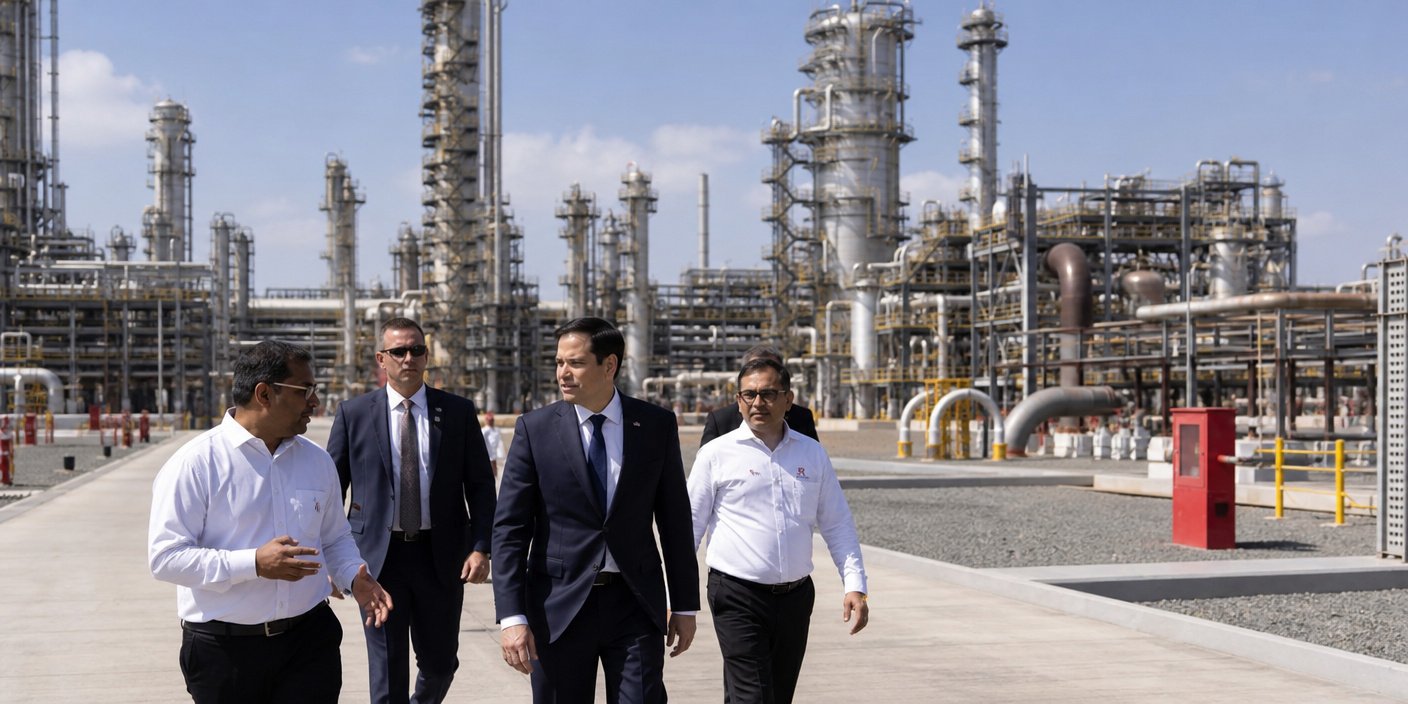
On October 20-21, 2026, US Secretary of State Marco Rubio will arrive in India, but he will not be landing in New Delhi. In a departure from conventional diplomatic protocol that has stunned foreign policy circles, Secretary Rubio’s itinerary is strictly limited to Mumbai and the Jamnagar refinery complex. This deliberate geographical choice serves as a powerful signal that the United States is prioritizing industrial energy cooperation and supply chain resilience over traditional diplomatic pageantry.
The Strategic Significance of the Jamnagar Detour
The decision to bypass the capital highlights a fundamental shift in how the US approaches its relationship with New Delhi. Historically, high-level visits by the US Secretary of State are designed around the ‘Power Center’—the capital city, where bilateral talks, press conferences, and state dinners are the norm. By choosing the Jamnagar refinery in Gujarat, Rubio is making a pragmatic statement: energy security is now effectively synonymous with national security.
Reliance Industries’ Jamnagar refinery is the world’s largest single-site oil refining hub, and it stands at the intersection of critical global energy currents. As the US seeks to stabilize global oil markets while maintaining geopolitical leverage, the refinery’s ability to process diverse crude oil streams has become a strategic asset of interest to Washington. This is not a social visit; it is a working mission to solidify a transactional alignment that benefits both nations.
The Venezuelan Oil Equation
Central to the discussions in Gujarat is the complex issue of Venezuelan oil processing. Under previous administrations, the prospect of Indian refineries processing Venezuelan crude—subject to long-standing US sanctions—was a point of contention. However, the current global energy landscape has forced a pragmatic realignment. The US recognizes that forcing Indian refiners to abandon heavy-crude imports from nations like Venezuela creates a supply vacuum that other geopolitical rivals are all too eager to fill.
By engaging directly with the leadership at the Jamnagar facility, Secretary Rubio is effectively signaling a US ‘tacit acceptance’ of India’s role as a vital energy processing hub. This move allows the US to maintain energy market stability without engaging in the direct purchase of restricted oil, effectively using India’s refining infrastructure as a buffer. For India, this guarantees the consistent supply of affordable feedstock essential for its domestic growth; for the US, it ensures that refined products eventually stabilizing the global market do not originate solely from hostile, state-controlled monopolies.
Geopolitical Signaling: Beyond the Capital
Diplomacy is a language of optics, and skipping New Delhi is a loud subtext. The message is twofold. First, it tells the Indian establishment that the US-India partnership has matured beyond ceremonial visits; it is now defined by heavy industry, technology transfer, and supply chain integration. By foregoing the bureaucratic layers of the capital, Rubio is attempting to expedite tangible outcomes related to energy trade and technological investment.
Second, it addresses the broader Indo-Pacific theater. India’s refinery infrastructure is essential for the region’s long-term independence from reliance on certain energy-exporting blocs. By deepening ties specifically in the energy sector, the US is fortifying an ally that serves as a critical counterbalance to China’s influence in the Indian Ocean. The focus on Mumbai and Jamnagar emphasizes the role of the private sector and industrial hubs as the real engines of the 21st-century strategic partnership.
Economic Impacts and Future Predictions
Looking toward the future, this trip is expected to lay the groundwork for significant investment in energy infrastructure modernization. Experts predict that the outcome of these meetings will involve collaborative ventures in clean energy transition technologies, specifically focusing on hydrogen and carbon capture at refinery sites.
Furthermore, the visit is expected to set a new precedent for ‘Sector-Specific Diplomacy.’ If this model proves successful in energy, observers suggest that subsequent US diplomatic missions may bypass the capital to visit semiconductor manufacturing hubs, tech corridors, or aerospace clusters, prioritizing economic output over formal administrative engagement. The ‘Jamnagar Doctrine’—as some pundits are already calling it—suggests that in an era of heightened global volatility, the most effective diplomatic tool is the one that secures the supply chain.
FAQ: People Also Ask
Why is Secretary Rubio skipping the Indian capital, New Delhi?
Secretary Rubio is skipping New Delhi to prioritize direct, working-level engagement with key industrial infrastructure. The visit is laser-focused on energy cooperation, specifically at the Jamnagar refinery, aiming to bypass bureaucratic delays and signal that the US prioritizes tangible economic and energy outcomes over traditional diplomatic ceremony.
What is the specific importance of the Jamnagar refinery in this visit?
Jamnagar is the largest single-site oil refinery in the world. Its significance lies in its massive capacity to process various grades of crude oil, including heavy Venezuelan crude. The US is interested in how this capacity can be leveraged to stabilize global energy markets while navigating complex international sanctions regimes.
How does this visit affect the broader US-India relationship?
This visit signifies the transition of the US-India partnership from a ceremonial or political alliance to a practical, industrial-focused partnership. It implies a new era of ‘Sector-Specific Diplomacy,’ where the US prioritizes direct engagement with essential infrastructure hubs, such as tech manufacturing or energy refineries, over the traditional diplomatic protocols of the capital city.