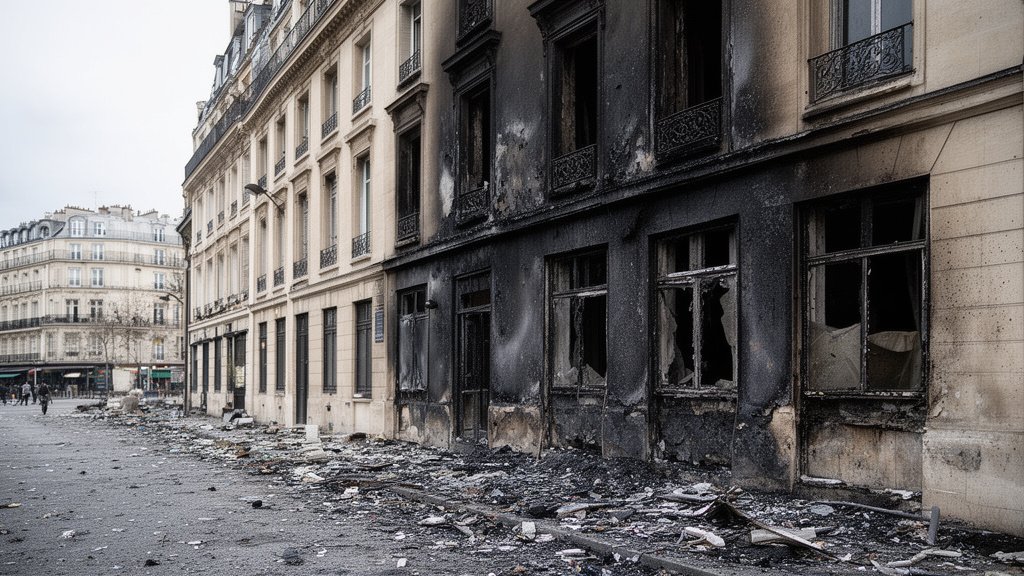
France is currently grappling with a severe wave of anti-government protests and civil unrest that has challenged the nation’s social fabric and tested the current administration’s ability to maintain public order. The events, which have seen large-scale demonstrations escalate into violent riots, have resulted in significant property damage, most notably the burning of the Lyon tourism office. As the situation remains fluid, the Ministry of the Interior has confirmed that the number of arrests has surged past 2,000, underscoring the intensity of the confrontation between demonstrators and state security forces.
Key Highlights
- Over 2,000 arrests have been made across France in connection with the widespread riots and civil disturbances.
- Significant infrastructure has been targeted, including the total destruction of the Lyon tourism office, which serves as a stark symbol of the economic and social impact of the unrest.
- Widespread criticism has been directed at the French National Police and the government for a perceived lack of anticipation and an inability to maintain operational control in key urban centers.
- The unrest has forced a national reckoning regarding social inequality, urban policing, and the effectiveness of current administrative policies.
Anatomy of a National Crisis: The Surge of Civil Disobedience
The recent eruption of violence across French cities represents one of the most significant challenges to civil order in recent years. What began as localized demonstrations quickly spiraled into a nationwide phenomenon, characterized by firebombing, looting, and direct confrontations with law enforcement agencies, including the CRS (Compagnies Républicaines de Sécurité). The intensity of these riots suggests deep-seated grievances that go beyond immediate political catalysts, reflecting a culmination of systemic frustration that has finally reached a breaking point. The burning of the Lyon tourism office—a building of significant local importance—is indicative of how indiscriminate the damage has become, moving from targeted political protest to generalized civil destruction.
The Failure of Anticipation and Policing Strategies
One of the most contentious aspects of the current crisis is the performance of the police forces. Observers, civil rights organizations, and political opposition leaders have leveled heavy criticism at the Ministry of the Interior for what they describe as a profound lack of strategic anticipation. Despite clear indicators of rising tension in the weeks leading up to the riots, the deployment of security forces was, in many instances, reactive rather than preventative. Critics argue that the heavy-handed tactical approach, which relies on crowd control methods that often exacerbate tensions, failed to de-escalate the situation, leading to the rapid spread of violence across major cities.
Economic and Social Repercussions
Beyond the immediate physical damage, the economic impact of these riots is substantial. The destruction of institutional and commercial property, such as the Lyon tourism office, has immediate consequences for local economies that rely on stability to thrive. Tourism is a cornerstone of the French economy, and images of burning city centers and reports of widespread chaos threaten to deter international visitors, potentially impacting national revenue for the upcoming fiscal quarter. Furthermore, the looting of small and medium-sized enterprises (SMEs) has left many business owners in a state of financial ruin, demanding government intervention and long-term support to rebuild infrastructure that was decimated in a matter of hours.
Deepening Social Divides: The Role of Marginalization
Sociological analysts have pointed to the geographic and demographic concentration of the riots as evidence of a deeper issue: the marginalization of specific urban populations. These protests are not merely anti-government; they are an expression of long-standing systemic exclusion within the French republic. The narrative of the ‘forgotten suburbs’ has returned to the forefront of national discourse, with many participants in the riots voicing a sense of abandonment by the central state. This disconnection between the central administration and peripheral urban communities has created a vacuum of trust, which, when coupled with a flashpoint event, creates the perfect conditions for the volatility currently observed.
The Path Forward and Political Stability
As the dust settles, the question facing the current administration is how to restore order without further alienating the very populations at the center of this unrest. The government has signaled an intent to increase security measures, but there is a growing consensus that a purely securitized approach will not suffice. Political stability in France now hinges on the administration’s ability to balance the enforcement of law and order with a credible commitment to structural social reforms. The upcoming legislative sessions will be pivotal, as the government must navigate the pressure to clamp down on ‘lawlessness’ while addressing the socio-economic causes that provided the fuel for this explosion of dissent.
FAQ: People Also Ask
Q: What was the specific trigger for the riots in France?
A: While there are various underlying long-term causes, the immediate trigger was a volatile reaction to high-profile incidents involving law enforcement, which galvanized existing frustrations regarding social inequality and urban policing.
Q: How many people have been arrested during these riots?
A: Authorities have reported over 2,000 arrests nationwide as a direct result of the civil unrest and criminal acts committed during the protest period.
Q: Why was the Lyon tourism office specifically targeted?
A: The burning of the Lyon tourism office was part of a broader pattern of property damage during the riots. While not necessarily a tactical target, its destruction serves as a symbol of the widespread civil disobedience and the lack of state control in urban centers.
Q: What is the government’s response to the police criticism?
A: The government has faced immense pressure to justify its handling of the crisis. While it has defended the police’s right to maintain order, it is currently under intense scrutiny to reform its anticipation strategies and communication tactics during future periods of civil instability.
Q: What are the predicted long-term economic impacts?
A: The long-term impacts include significant costs for public infrastructure reconstruction, potential losses in the tourism sector, and a possible increase in insurance premiums for businesses operating in high-risk urban zones.