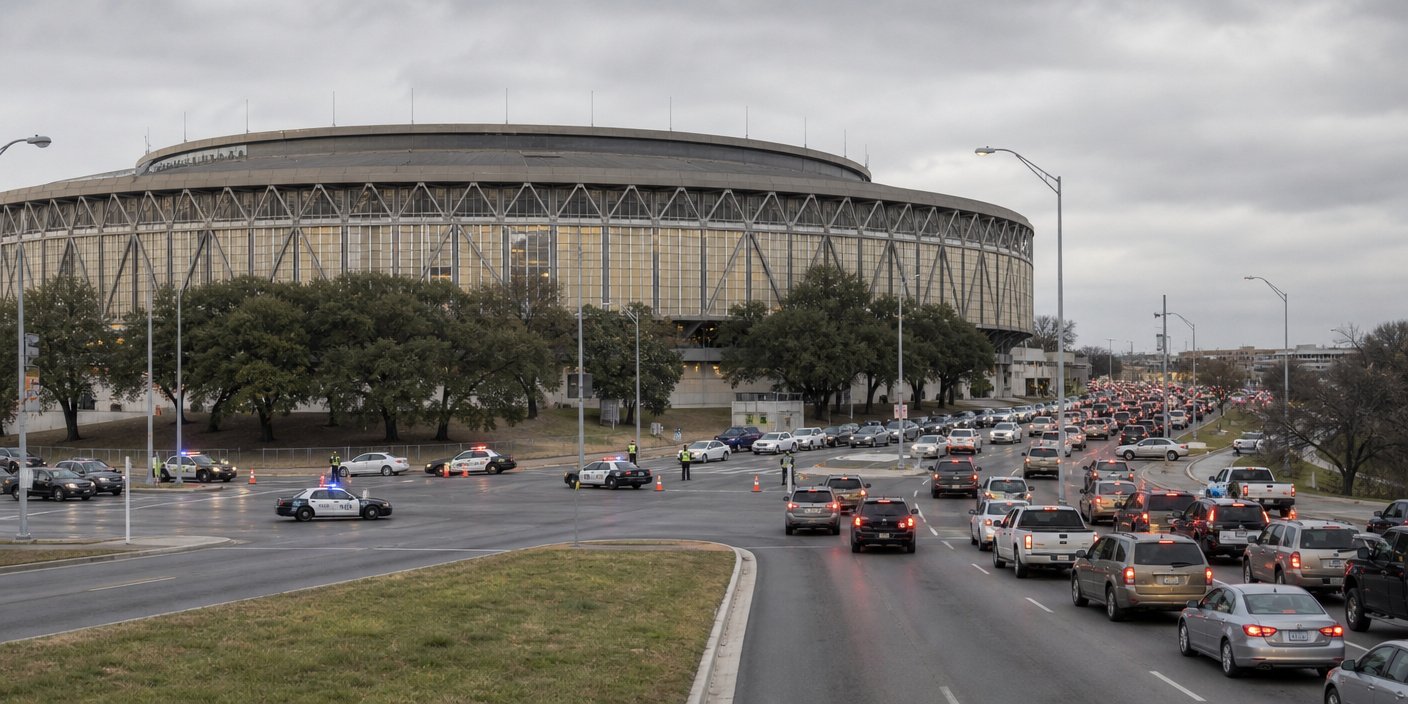
San Antonio residents and commuters are advised to prepare for heavy congestion and significant roadway disruptions today, October 7, as the Freeman Coliseum hosts a high-profile mid-term rally featuring President Donald Trump. Local law enforcement, including the San Antonio Police Department (SAPD) and the Texas Department of Public Safety (DPS), have issued urgent notices regarding potential gridlock and unplanned road closures in the vicinity of the venue.
Key Highlights
- Location Impact: The Freeman Coliseum and surrounding thoroughfares are expected to face peak congestion throughout the afternoon and evening.
- Road Closures: Authorities have authorized temporary closures of streets immediately adjacent to the venue to maintain a security perimeter.
- Commuter Advisory: Officials recommend that commuters avoid the I-10 and I-35 corridors near the coliseum if possible, seeking alternate routes to avoid significant delays.
- Public Safety: Enhanced security protocols are in effect, which may include lane restrictions and temporary traffic diversions.
Managing the Urban Gridlock During Presidential Events
The arrival of a sitting President for a major political rally creates a distinct logistical challenge for municipal infrastructure. In San Antonio, the Freeman Coliseum—while an established venue for large-scale events—sits in a position that necessitates a complex traffic management strategy when security protocols are elevated. The combination of local commuter traffic and the influx of rally attendees creates a localized “perfect storm” for congestion that extends well beyond the venue’s parking lots.
The Anatomy of a Presidential Security Perimeter
When the Secret Service and local law enforcement secure a venue like the Freeman Coliseum, they do not merely focus on the building itself; they must secure the approach. This involves creating a “bubble” of safety that often requires restricting access to arterial roads. For San Antonio drivers, this means that even if they are not attending the event, their daily commute is subject to the ripple effects of these security measures.
Typically, these measures include the total closure of access roads leading to the venue, the restriction of left turns, and the potential for rolling roadblocks on major highways to facilitate the safe arrival and departure of the presidential motorcade. The SAPD has indicated that the closure schedules are subject to change based on real-time crowd size and security assessments, meaning that traffic patterns could shift rapidly with little warning.
Geography and Infrastructure Constraints
The Freeman Coliseum’s proximity to the intersection of major interstate corridors in San Antonio makes it a high-traffic area under normal circumstances. During a high-profile event, the saturation point of these roads is tested. The surrounding neighborhood infrastructure was designed for standard daily flow, not for the sudden surge of thousands of vehicles arriving simultaneously for a single event.
Urban planners often struggle with these “event-based spikes.” The surge in vehicle volume creates a situation where signal timing at traffic lights becomes ineffective, as the sheer volume of cars exceeds the capacity of the intersections. This leads to the phenomenon of “spillback,” where traffic from the event venue backs up onto the highway off-ramps, potentially causing accidents and further delaying non-attendee traffic on the main interstates.
Strategies for Navigating the Congestion
To mitigate the impact of today’s rally on personal transit, residents should adopt a proactive approach. First, the most effective strategy is the avoidance of the area entirely. If you typically commute through the I-10/I-35 interchange near the Freeman Coliseum, consider shifting your departure time to early morning or late evening, or utilizing public transit options that may have more flexibility in navigating surface streets.
Secondly, leverage real-time traffic data applications. While authorities are managing the physical traffic, the digital traffic grid will be updating in real-time. Apps that utilize crowdsourced data are often the most reliable method for identifying which side streets are currently functioning as viable detours. However, keep in mind that many residential streets near the coliseum may have temporary “local traffic only” restrictions enforced by police to prevent neighborhood cut-throughs.
Long-Term Implications for City Infrastructure
Events like the October 7 rally highlight the critical need for resilient urban planning in growing cities like San Antonio. When a city hosts national political figures, it tests the limitations of its road network. Policymakers often look at the data collected during these massive public events—specifically, the average delay times and the effectiveness of detour routes—to inform future infrastructure projects.
The logistics of this event also serve as a reminder of the interdependence of local and federal operations. The coordination between the Texas Department of Public Safety and federal protective services requires a level of communication that is highly advanced. For the average citizen, understanding this coordination helps explain why a road might be closed even when the venue appears empty, or why traffic is being diverted miles away from the rally site itself.
As the afternoon progresses, the influx of rally-goers is expected to peak approximately two hours prior to the event’s start time. During this “ingress window,” the capacity of the parking facilities at the Freeman Coliseum will likely be exhausted, leading to overflow parking efforts that can further complicate traffic flow in the immediate vicinity. Commuters are urged to exercise patience, remain alert for emergency vehicles, and follow the directions of traffic control officers, whose instructions override standard signage and signalization.