
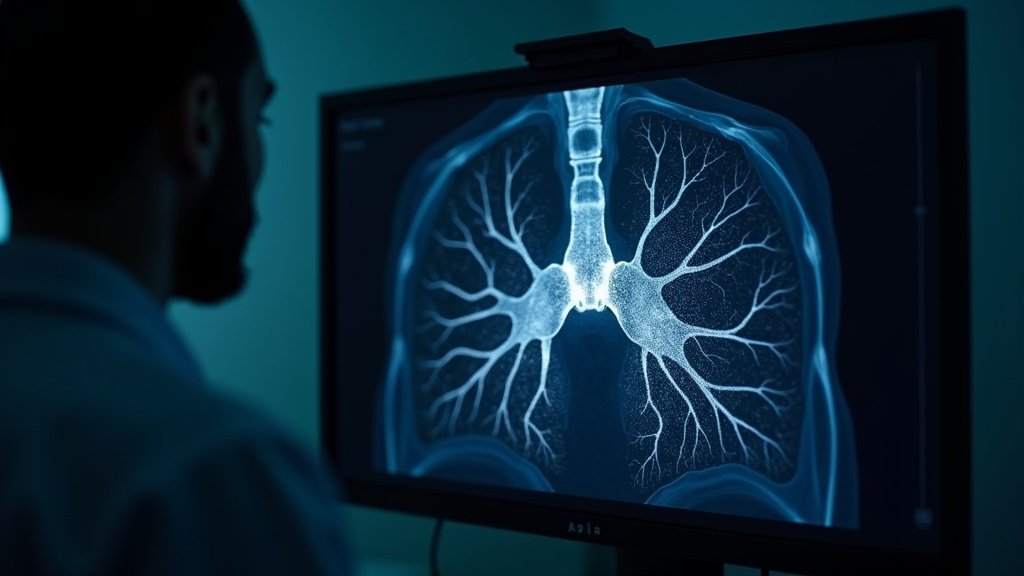
Artificial intelligence has demonstrated a remarkable ability to detect lung cancer at earlier stages than human radiologists, potentially revolutionizing cancer screening and patient outcomes. This breakthrough technology promises to improve diagnostic accuracy and speed, offering new hope in the fight against one of the deadliest forms of cancer.
Key Highlights:
- AI algorithms can identify subtle patterns in CT scans indicative of early-stage lung cancer.
- Early detection significantly increases the chances of successful treatment and survival.
- This technology could augment the capabilities of human radiologists, not replace them.
- Further research and clinical validation are underway to integrate AI into standard screening protocols.
AI’s Edge in Early Lung Cancer Detection
Lung cancer remains a major global health concern, often diagnosed at advanced stages when treatment options are limited and survival rates are low. The ability to detect the disease in its nascent phases is crucial for improving patient prognosis. Recent advancements in artificial intelligence, particularly in machine learning and deep learning, are showing immense promise in this area. These AI systems are trained on vast datasets of medical images, learning to recognize the complex visual signatures of cancerous nodules that might be imperceptible to the human eye, especially in the early, more ambiguous stages.
The Power of Pattern Recognition
AI’s strength lies in its unparalleled ability to process and analyze intricate patterns within medical imaging data, such as CT scans. Unlike human radiologists who may face fatigue or rely on subjective interpretation, AI models can maintain consistent performance and detect minute anomalies. Studies have shown that AI can flag suspicious lesions with a high degree of accuracy, sometimes even outperforming experienced clinicians in identifying early-stage lung cancer. This doesn’t diminish the role of radiologists but rather empowers them with a powerful assistive tool, allowing them to focus on complex cases and confirm AI-identified findings.
Improving Screening and Accessibility
The integration of AI into lung cancer screening programs could lead to more systematic and potentially more accessible diagnostic processes. For high-risk individuals, such as long-term smokers, regular screening is vital. AI can help streamline the analysis of these screenings, potentially reducing the time it takes to receive results and enabling earlier intervention. Furthermore, as AI technology becomes more sophisticated and widely adopted, it could help alleviate the workload on healthcare systems, particularly in regions with a shortage of specialized radiologists. The goal is to make early lung cancer detection a more routine and effective part of preventative healthcare.
Challenges and Future Directions
Despite the exciting potential, challenges remain. Ensuring the reliability and generalizability of AI models across diverse patient populations and imaging equipment is paramount. Regulatory approval and seamless integration into existing clinical workflows require rigorous testing and validation. Ethical considerations, such as data privacy and algorithmic bias, must also be addressed. The future of AI in lung cancer detection likely involves a synergistic approach, where AI acts as a sophisticated co-pilot for human experts, enhancing diagnostic capabilities and ultimately saving lives. Continued research into AI’s ability to predict treatment response and monitor disease progression also holds significant promise.
FAQ: People Also Ask
What is the earliest sign of lung cancer?
Early lung cancer often shows no symptoms. When symptoms do appear, they can include a persistent cough, shortness of breath, chest pain, wheezing, and unexplained weight loss. Subtle changes in CT scans are often the earliest indicators detected by AI and radiologists.
Can AI really detect cancer?
Yes, AI, particularly deep learning algorithms, can be trained to detect various types of cancer, including lung cancer, by analyzing medical images like CT scans, X-rays, and MRIs. It excels at identifying subtle patterns and anomalies that may be missed by the human eye.
How accurate is AI in detecting lung cancer?
Studies have shown AI to be highly accurate in detecting lung cancer, with some systems demonstrating performance comparable to or even exceeding that of experienced radiologists in identifying early-stage disease. However, accuracy can vary depending on the specific AI model, the dataset it was trained on, and the complexity of the case.
Will AI replace radiologists?
It is highly unlikely that AI will completely replace radiologists. Instead, AI is expected to serve as a powerful assistive tool, augmenting radiologists’ capabilities by handling routine tasks, improving diagnostic accuracy, and allowing them to focus on more complex cases and patient interaction.