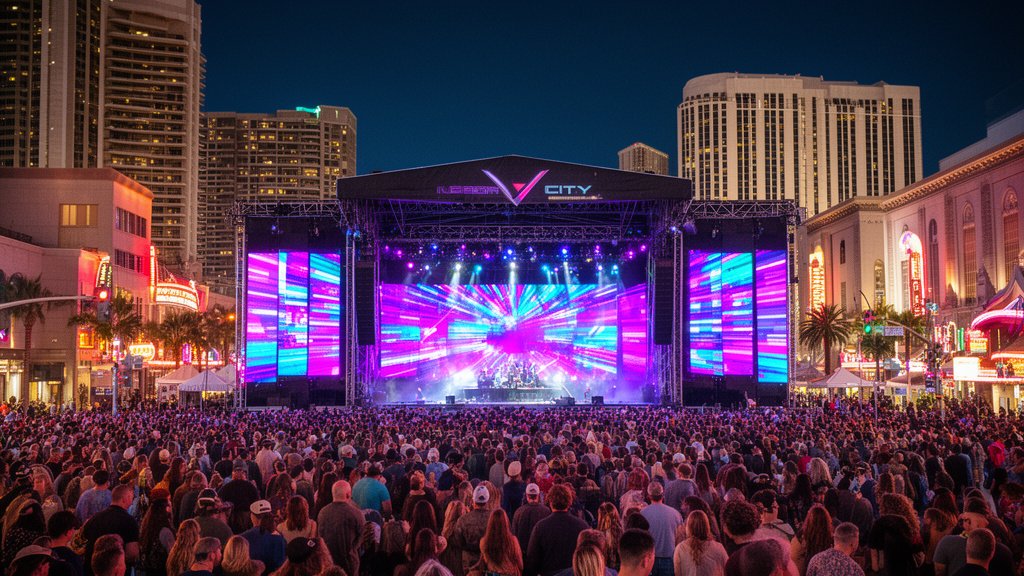
The inaugural Neon City Festival officially concluded its three-day run in downtown Las Vegas on November 22, 2026, marking a pivotal shift in the city’s entertainment strategy by offering a high-production, free-access music experience to the public. As the final notes faded, the event left behind a clear message: the future of Las Vegas tourism may no longer be confined to the luxury confines of The Strip, but rather expanded into the vibrant, walkable streets of the city center.
Key Highlights
- Historic Inauguration: The Neon City Festival served as a groundbreaking free, three-day event held in the heart of downtown Las Vegas.
- Massive Public Turnout: The festival concluded on November 22, 2026, successfully demonstrating the viability of large-scale music programming outside traditional venues.
- High-Production Standards: Despite the free-entry model, the festival maintained premium staging, audio-visual excellence, and a diverse artist lineup that rivaled ticketed competitors.
- Urban Economic Catalyst: The event acted as a test case for bringing foot traffic to local downtown businesses and diversifying the city’s economic appeal.
The Decentralization of Vegas Entertainment
For decades, the monolithic model of Las Vegas entertainment has been anchored firmly within the boundaries of the Las Vegas Strip. Massive, ticketed residencies and exclusive arena shows have historically defined the region’s cultural output. However, the conclusion of the Neon City Festival on November 22, 2026, represents an aggressive pivot in urban planning and cultural programming. By intentionally staging an event of this magnitude in the downtown sector, organizers moved beyond the binary of ‘casino versus street’ and introduced a ‘festival as public infrastructure’ model.
The Logistics of Free Access at Scale
One of the most significant challenges identified by industry analysts regarding the Neon City Festival was the financial and logistical tightrope walk of providing high-production value without traditional ticket revenue. Traditional festivals rely heavily on high entry fees to offset the costs of staging, lighting, and artist booking. The success of the Neon City Festival suggests that a hybrid funding model—likely incorporating municipal grants, corporate sponsorships, and increased ancillary revenue from surrounding local businesses—is not only viable but highly effective.
Technically, the festival utilized state-of-the-art staging technology that allowed for rapid load-in and teardown, minimizing disruption to the downtown traffic grid while maximizing the visual spectacle. The lighting design, which integrated the existing neon-heavy aesthetic of the downtown area with modern, responsive LED arrays, effectively created a ‘living’ environment that required minimal additional set decoration. This ‘context-aware’ production design is likely to become a blueprint for future city-center events, as it integrates the city’s existing infrastructure into the artistic output rather than hiding it.
Downtown Renaissance and Economic Catalysts
Beyond the auditory and visual experience, the economic impact of the three-day festival was immediate. Local business owners reported a surge in patronage that exceeded typical weekend benchmarks. For downtown Las Vegas, which has been fighting to establish itself as a destination independent of the Strip’s gravity, the Neon City Festival functioned as a massive, organic marketing campaign.
By drawing thousands of attendees into the historic streets, the event forced a interaction between the modern festival-goer and the legacy establishments of downtown. This creates a feedback loop: visitors who came for the free music are statistically more likely to return for the dining, nightlife, and unique atmosphere they discovered while navigating the festival grounds. This is the ‘New Vegas’ era: a move toward a more permeable city where entertainment acts as the lure, but the local economy acts as the anchor.
Analyzing the ‘New Vegas’ Blueprint
Looking forward, the success of this inaugural weekend prompts a critical question: is this sustainable? If the city continues to back public-access events of this scale, it risks ‘festival fatigue’ or, conversely, it could spark a cycle of perpetual development. The consensus among urban planners is that the Neon City Festival has established a proof-of-concept that will attract private-public partnerships eager to capture the same audience.
However, the challenge remains in maintaining the delicate balance between crowd control and open-access freedom. The city’s ability to manage large crowds without relying on the restrictive security measures of traditional casinos is a testament to the effective planning of the 2026 event. As other cities watch this experiment closely, Las Vegas has effectively positioned itself not just as a hub for gambling or residency shows, but as a leader in the global movement toward the ‘democratization of the live experience.’ Whether this becomes a recurring staple or remains a singular landmark event will depend on the sustained support of the local municipality and the adaptability of the downtown business community to cater to a demographic that values experience over exclusivity.
FAQ: People Also Ask
Q: Will the Neon City Festival become an annual event in Las Vegas?
A: While organizers have not issued an official statement regarding a 2027 date, the overwhelming success of the inaugural weekend makes a recurring annual festival a high-probability outcome. The event effectively demonstrated a self-sustaining model that would likely encourage city officials to approve future installments.
Q: How did the festival impact traffic and accessibility in downtown Las Vegas?
A: The festival utilized a phased closure strategy for downtown streets, which local authorities deemed successful. While there were localized traffic delays, the implementation of dedicated shuttle services and clear signage mitigated significant gridlock, setting a standard for future downtown event planning.
Q: Was the festival truly free, or were there hidden costs for attendees?
A: The core festival experience, including access to all stages and performance zones, was entirely free. While vendors, food, and beverages were available for purchase, there were no entry fees or hidden ‘service’ costs for the primary programming, adhering strictly to the ‘free-access’ promise made by the organizers.
Q: How does this festival differ from events held on the Las Vegas Strip?
A: The primary difference lies in the setting and exclusivity. The Neon City Festival leveraged the historic, open-street aesthetic of downtown, whereas Strip events are usually held in enclosed, ticketed, or private-resort venues. This event prioritized a fluid, public-space experience over the contained, luxury-focused model of the Strip.