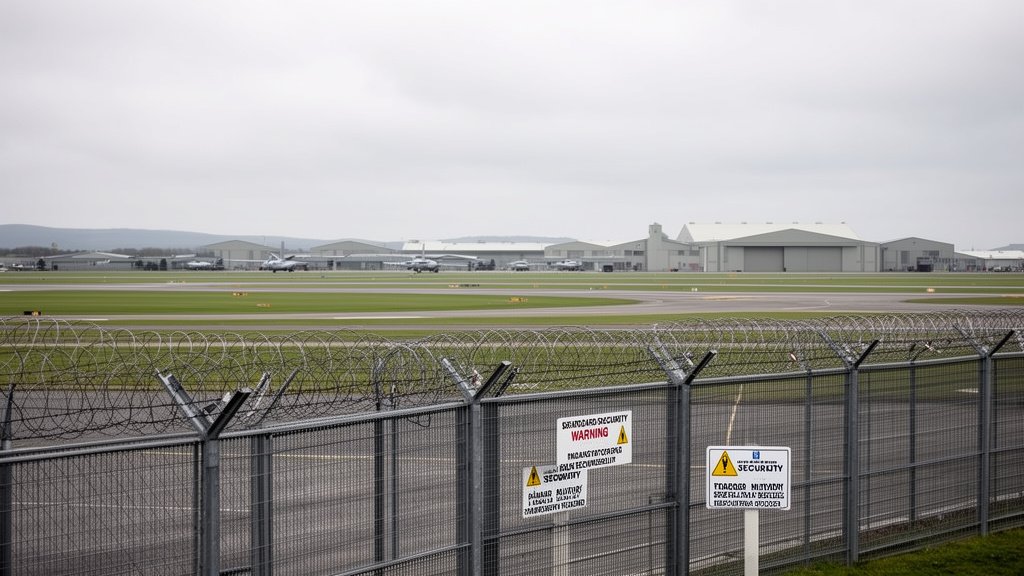
Counterterrorism investigators have released five individuals on bail following a major security probe at RAF Fairford, the US Air Force base in Gloucestershire that serves as a critical hub for global strategic operations. While officials confirmed that no explosive materials were discovered during the operation, the investigation into potential links to foreign state actors remains highly active, underscoring ongoing concerns regarding espionage and tactical surveillance against Western military assets.
Key Highlights
- Five suspects previously detained during the RAF Fairford security operation have been released on bail pending further inquiries.
- Forensic sweeps of the area and associated sites confirmed that no explosive devices were present at the scene.
- The ongoing investigation is being led by specialist counter-terrorism units, specifically focusing on potential coordination with foreign state intelligence services.
- RAF Fairford continues to function as a vital, high-security installation for US strategic bombers, maintaining its role as a cornerstone of NATO’s European deterrence strategy.
Intelligence and Deterrence: Analyzing the Fairford Security Breach
The decision to release the five individuals on bail marks a significant development in a case that has highlighted the acute vulnerabilities facing high-profile military installations in the United Kingdom. RAF Fairford, long known for its role in hosting B-52 Stratofortress and B-1B Lancer deployments, is one of the most sensitive locations in the British defense ecosystem. The intrusion or suspicious activity that triggered this investigation has sent ripples through the defense community, raising urgent questions about how foreign actors are attempting to map, monitor, or disrupt NATO’s operational readiness.
The Strategic Value of RAF Fairford
To understand the gravity of this investigation, one must look at the unique function of RAF Fairford. Unlike many other UK-based assets, Fairford functions as a forward-operating hub for the United States Air Force’s strategic bomber fleet. It is the only European base equipped with the specific infrastructure required to maintain and deploy these heavy, long-range aircraft. In the current geopolitical climate, characterized by heightened tension in Eastern Europe and the Indo-Pacific, the ability to rapidly project power from the Cotswolds is an essential deterrent. Any compromise of perimeter security is not merely a local criminal matter; it is a potential national security breach that could influence the strategic calculus of foreign adversaries.
Understanding the “Foreign State” Threat Vector
Counter-terrorism authorities have explicitly noted that the investigation is delving into links involving foreign state interests. This nomenclature is significant in the intelligence community. It suggests that the suspects were not operating as isolated criminals or protest actors, but rather within the framework of organized state-sponsored espionage. Modern ‘gray zone’ warfare often involves utilizing proxies—individuals who are not uniformed military personnel—to conduct reconnaissance or surveillance on sensitive sites. By employing non-state actors, foreign intelligence agencies can maintain plausible deniability while probing the physical, digital, and surveillance defenses of military bases. The objective is rarely immediate violence, but rather the gathering of ‘pattern of life’ data, infrastructure layouts, and reaction times of local security forces.
The Legal Framework of Counter-Terrorism Detention
The legal process surrounding this case is governed by the Terrorism Act 2000 and subsequent updates to British counter-terrorism legislation. When individuals are detained under suspicion of threats to national security, the burden of proof required for continued incarceration is high, yet the threshold for investigation remains rigorous. Releasing the five men on bail does not indicate innocence; rather, it reflects a transition in the investigation. Police often utilize the bail period to conduct exhaustive forensic analysis on seized digital devices—such as encrypted phones, drones, and camera equipment—which are frequently the primary objective in modern espionage cases. The state is essentially buying time to parse through gigabytes of data that could reveal the true scope of the network behind the suspects.
Technological Threats and Perimeter Security
Beyond the individuals themselves, this incident highlights the escalating challenge of perimeter security in the drone age. High-resolution imaging, thermal cameras, and portable signal interception devices have made it easier than ever for small, agile groups to gather intelligence without breaching physical fences. If the suspected activity at Fairford involved unmanned systems or unauthorized sensing equipment, it represents a wider trend in how hostile states are challenging the exclusivity of military airspace. The Ministry of Defence and US forces are currently engaged in a massive upgrade of electronic countermeasures (ECM) and physical surveillance systems at key sites, a process that this incident has almost certainly accelerated.
FAQ: People Also Ask
1. Why is RAF Fairford considered a top-tier security site?
RAF Fairford is one of the few bases in Europe capable of supporting heavy, long-range strategic bombers like the B-52. It is a critical component of NATO’s deterrent force, often serving as the primary launch point for operations in the European theater. Its strategic value makes it a high-priority target for foreign intelligence gathering.
2. What does ‘released on bail’ mean in this context?
It means the police have determined that, at this stage, the suspects do not need to be held in pre-charge detention, though the investigation continues. They are typically subject to strict conditions, such as travel restrictions and reporting to local stations, while authorities analyze evidence seized during the initial arrest.
3. Why would foreign states be interested in a UK military base?
Foreign states, particularly those adversarial to NATO, seek to understand the operational capabilities, deployment schedules, and security protocols of Western forces. By monitoring base activity, they can better understand how the US and UK might respond to geopolitical crises, effectively ‘mapping’ the military’s strategic behavior.