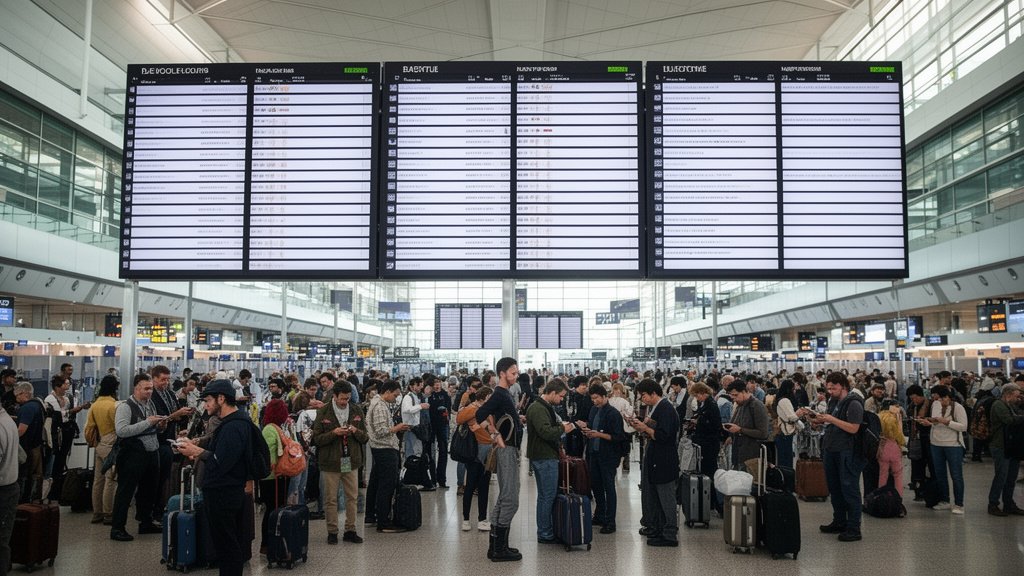
The digital world ground to a shuddering halt on Friday as a massive, synchronized global Microsoft outage disrupted critical infrastructure across every continent. The chaos, which began in the early morning hours, stemmed not from a malicious cyberattack or external hack, but from a deeply flawed software update deployed by cybersecurity firm CrowdStrike. The incident, which affected approximately 8.5 million Windows devices, exposed the fragility of global supply chains and the profound, concentrated risk inherent in modern cloud-based computing ecosystems.
The Anatomy of a Global Blackout
At the heart of the crisis was the CrowdStrike Falcon sensor—a ubiquitous cybersecurity tool installed on millions of enterprise Windows machines worldwide. A routine configuration update, intended to enhance security, instead contained a logic error that caused an immediate, fatal conflict with the Windows operating system kernel. The result was the infamous ‘Blue Screen of Death’ (BSOD), rendering the affected machines entirely unusable.
Because the failure occurred at the kernel level—the deepest, most protected layer of the operating system—the computers were unable to boot into a functional state. This effectively locked out millions of employees across various sectors, from front-line airline staff to hospital administrators. While Microsoft worked alongside CrowdStrike to mitigate the fallout, the sheer scale of the deployment meant that many IT departments were forced to manually reboot and ‘patch’ individual machines—a process that is historically slow and labor-intensive.
Aviation and Logistics in Stasis
The most visible impact of the outage occurred within the global aviation sector. Major carriers, including Delta, United, and American Airlines, were forced to ground flights, creating a cascading delay effect that rippled through international airports. Thousands of passengers found themselves stranded as check-in systems, flight management software, and booking databases failed simultaneously. Beyond the immediate frustration of travelers, the ripple effect hit logistics companies and cargo handlers, with shipment tracking systems stalling and supply lines stalling in a tangible, economic slowdown.
Impact on Essential Services and Healthcare
While the commercial impact dominated headlines, the consequences for critical infrastructure were more severe. In the United Kingdom, hospitals reported that the ‘EMIS’ patient record system, used by the majority of GP surgeries to manage appointments and medical records, was offline. This meant that healthcare providers were forced to revert to pen and paper, delaying critical care and increasing the workload on medical staff already operating under pressure. Similarly, 911 dispatch centers in parts of the United States experienced connectivity issues, highlighting the life-critical nature of the systems that were rendered dormant by the outage.
The Fragility of Concentrated Tech Ecosystems
Industry analysts have pointed to this event as a massive wake-up call regarding the consolidation of critical IT services. When a single update from a single provider can effectively take down a significant percentage of the global economy, it raises existential questions about redundancy. Many organizations rely on a ‘monoculture’ of software—using the same operating systems and the same security tools—which, while efficient for scaling, creates a single point of failure that is unprecedented in the analog world.
The ‘Not a Cyberattack’ Verification
Amidst the initial confusion, there was immediate concern that the outage might be a sophisticated cyber-warfare operation or a state-sponsored attack on Western infrastructure. However, Microsoft and CrowdStrike quickly confirmed that the event was entirely self-inflicted—a software engineering failure rather than a security breach. This distinction is vital; it shifts the conversation from cybersecurity defense to software quality assurance (QA) and deployment pipeline safety. Experts are now calling for a re-evaluation of ‘canary deployments,’ where updates are rolled out in small, isolated batches before being pushed to the entire global fleet.
Looking Forward: The Recovery Timeline
Restoring systems at this scale is not instantaneous. Even with a fix available, the requirement for human intervention in many instances means that a full return to normalcy will likely take days, not hours. Businesses are now entering a ‘recovery phase’ that involves extensive system checks, data integrity validation, and the clearing of massive backlogs. For many, the incident serves as a poignant reminder that in a digitally integrated world, the ‘cloud’ is not an abstract ether, but a vast network of physical machines that requires rigorous, multi-layered oversight.
FAQ: People Also Ask
What caused the Microsoft outage?
The outage was caused by a faulty software update issued by CrowdStrike, a cybersecurity firm, to its ‘Falcon’ sensor. This update caused a conflict with the Windows operating system, leading to widespread ‘Blue Screen of Death’ errors on millions of computers.
Was this a cyberattack?
No, officials and the involved companies confirmed that this was not a malicious cyberattack, state-sponsored disruption, or hack. It was a technical failure resulting from an internal software quality control issue during an update deployment.
How long will it take for systems to recover?
While the fix was released quickly, many machines cannot update automatically because they are stuck in a reboot loop. This necessitates manual intervention by IT teams, meaning recovery will be a staggered process that could take several days to fully resolve globally.
Which industries were hardest hit?
The aviation industry faced the most visible disruption, with mass flight groundings. However, healthcare, banking, retail, and public sector government services also experienced significant, widespread downtime.