Elon Musk has officially unveiled “Terafab,” a colossal $25 billion chip manufacturing venture involving Tesla, SpaceX, and xAI, slated for construction in Austin, Texas. This ambitious undertaking aims to vertically integrate chip design, fabrication, and production, a move Musk states is essential to meet the burgeoning demand for advanced semiconductors required for artificial intelligence, robotics, and space-based computing.
The “Terafab” facility is projected to be the largest semiconductor fabrication plant ever built, with an initial output target of 100,000 wafer starts per month, scaling up to a staggering 1 million wafer starts per month at full capacity. Musk’s ultimate goal is to achieve an annual output of one terawatt of computing power, a feat that would represent a significant portion of global semiconductor production.
Strategic Vision and Dual Production Lines
The strategic rationale behind Terafab stems from Musk’s concerns about the current global chip supply chain’s inability to keep pace with the rapid advancements in AI and robotics. He indicated that existing suppliers, such as Samsung and Micron, have a “maximum rate at which they’re comfortable expanding,” which falls short of Tesla and SpaceX’s projected needs.
The facility will reportedly produce two main types of chips: inference chips for Tesla’s vehicles, the Optimus humanoid robot, and robotaxi programs, as well as high-power chips designed for SpaceX’s AI data centers in space. This dual-pronged approach underscores Musk’s vision for integrating advanced computing across his diverse business interests, from terrestrial autonomous systems to orbital infrastructure.
Ambitious Goals and Timeline Uncertainties
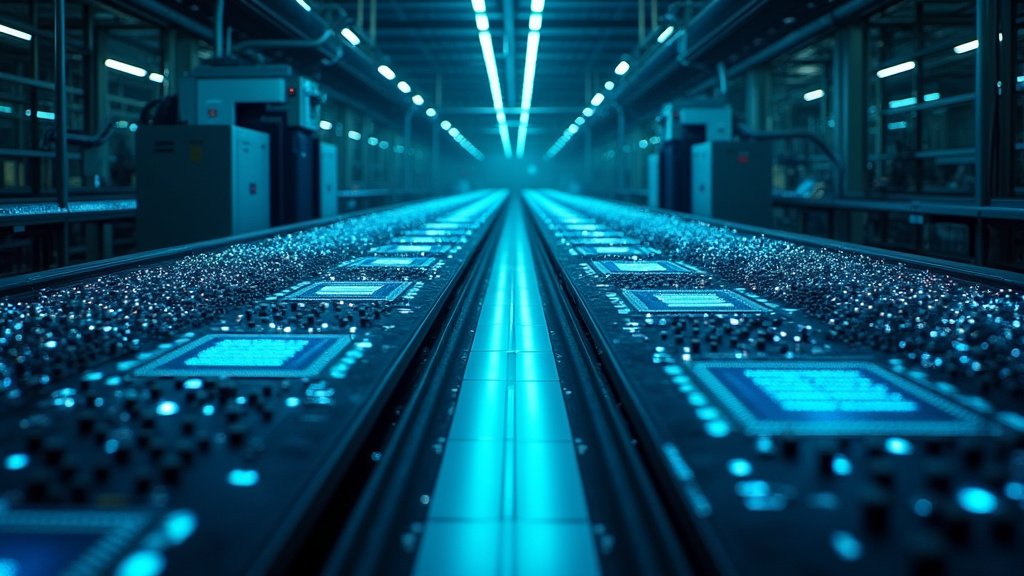
Musk has described Terafab as “the most epic chip building exercise in history by far,” highlighting its pivotal role in his companies’ future growth. The project is designed to handle every stage of semiconductor production, from chip design and lithography to fabrication, memory production, advanced packaging, and testing, all under one roof. While Musk has previously stated that production could begin as early as 2027, specific timelines for the facility’s completion and full operational capacity remain largely unspecified.
Concerns have been raised regarding Musk’s history of ambitious project timelines and the sheer complexity and cost associated with establishing a leading-edge semiconductor manufacturing facility. The project’s estimated cost ranges from $20 billion to $25 billion, with some analysts suggesting it could reach $40 billion.
FAQ: People Also Ask
What is Terafab?
Terafab is a planned $20-25 billion chip manufacturing facility jointly developed by Tesla, SpaceX, and xAI. It aims to produce advanced semiconductors for AI and robotics, with an ambitious goal of generating one terawatt of computing power annually.
Why are Tesla and SpaceX building their own chip factory?
Elon Musk cited the inability of current global semiconductor manufacturers to produce chips quickly enough to meet the escalating demands of Tesla’s AI and robotics initiatives, as well as SpaceX’s future space-based computing needs.
What kind of chips will Terafab produce?
Terafab is expected to produce two types of chips: inference chips for use in Tesla vehicles, Optimus robots, and robotaxis, and high-power chips designed for AI data centers in space for SpaceX and xAI.