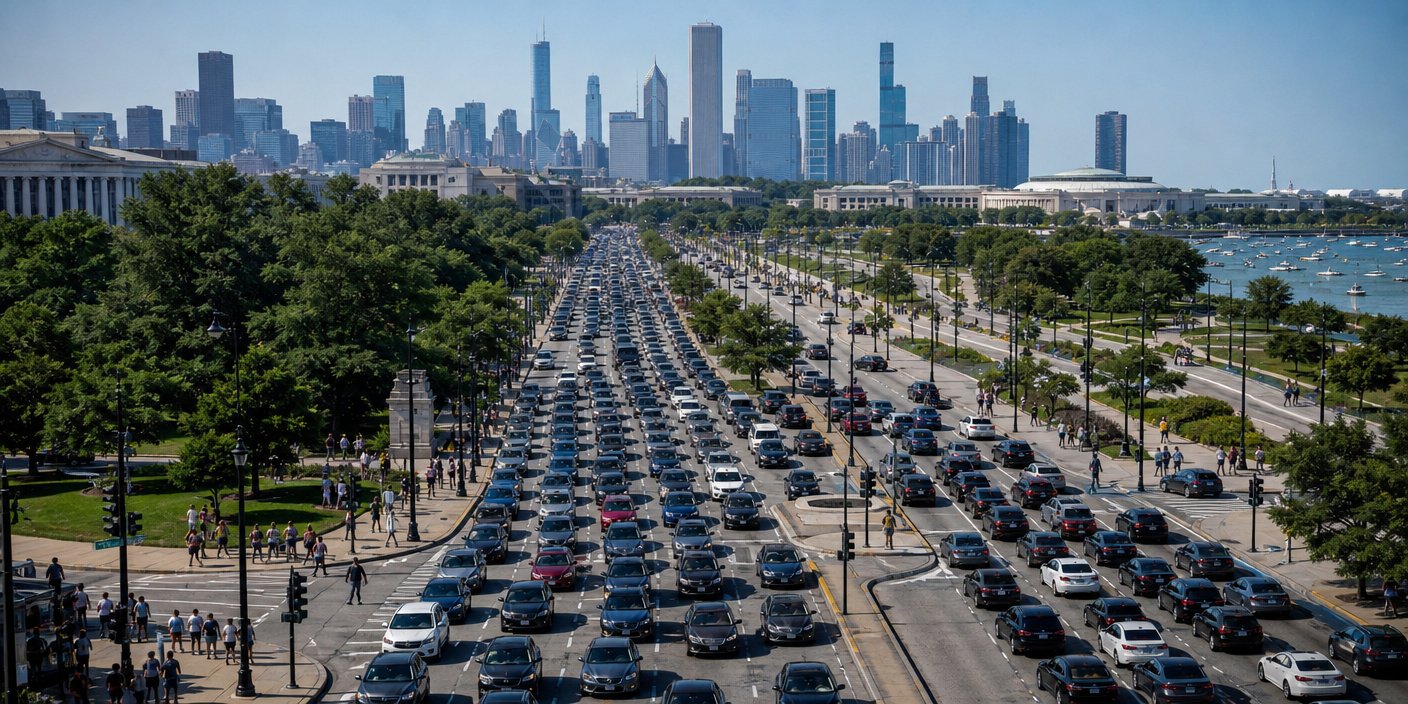
Chicagoans are bracing for an unprecedented logistical challenge this weekend as a convergence of high-profile events threatens to bring downtown traffic to a standstill. From the physical demands of the Chicago Triathlon to the massive crowds expected at Soldier Field for the Usher and Chris Brown concert, the city’s infrastructure will be tested to its limits. Residents and visitors alike are advised to avoid driving downtown entirely, as significant portions of DuSable Lake Shore Drive and key arterial streets will be shuttered to accommodate these competing events.
Key Highlights
- Massive Traffic Disruption: The Chicago Triathlon necessitates the closure of major roadways, including long stretches of DuSable Lake Shore Drive, creating a bottleneck for north-south travel.
- Soldier Field Capacity: The Usher and Chris Brown concert is expected to draw a near-capacity crowd to the Museum Campus, overwhelming local parking facilities and ride-share availability.
- Neighborhood Congestion: Beyond the downtown core, the West Loop Art Fest and Bulls Fest at the United Center are expected to clog secondary streets, making local navigation difficult.
- Transit Advised: Chicago Department of Transportation (CDOT) officials strongly urge attendees and commuters to utilize CTA trains and buses, warning that ride-share pricing will likely surge due to high demand and limited access.
The Perfect Storm: Chicago’s Event-Driven Traffic Crisis
The phenomenon of “event stacking” in Chicago has reached a fever pitch this weekend, creating a unique set of challenges for city planners and commuters. When major athletic endurance events, professional sports games, and massive cultural festivals overlap within a 48-hour window, the result is not merely an inconvenience but a significant disruption to urban mobility. The city is currently managing a complex web of road closures, parking restrictions, and crowd control measures designed to keep the city functioning while thousands of visitors flood the core.
Navigating the Triathlon Path
The Chicago Triathlon remains the most significant logistical hurdle for the city’s traffic flow. The event, which spans multiple days, requires the closure of the city’s most critical thoroughfare: DuSable Lake Shore Drive. For those attempting to transit from the North Side to the South Side, these closures effectively bisect the city’s primary highway corridor. Historically, this forces a diversion of thousands of vehicles onto surface streets such as Michigan Avenue and State Street, which are already struggling to handle peak summer volume. Cyclists and runners will dominate the lakefront, effectively cutting off east-west access at key intersections for much of the morning.
Stadium Logistics and the Museum Campus
Concurrent with the athletic events, the concert at Soldier Field introduces a different kind of traffic pressure. Unlike festivals that span the entire day, stadium concerts create “spike” traffic—a massive surge of vehicles entering the downtown area in the late afternoon and an equally chaotic exodus following the event’s conclusion. The Museum Campus is notorious for limited ingress and egress; adding a high-profile concert to an already congested weekend ensures that the parking lots will reach capacity hours before the doors open. Officials have noted that ride-share drop-off zones will likely be moved further away from the stadium to reduce gridlock, forcing concert-goers to walk significant distances.
Neighborhood Impacts: Bulls Fest and West Loop Art Fest
While the downtown core struggles with major infrastructure closures, Chicago’s vibrant neighborhoods face their own unique pressures. The West Loop Art Fest and Bulls Fest at the United Center bring thousands of pedestrians into areas already dense with foot traffic. These events require intermittent closures of streets like Randolph Street and Madison Street. For residents, this means noise levels, trash accumulation, and the potential for blocked driveways. Economically, these festivals are a boon for local businesses, providing a much-needed revenue spike, but the lack of adequate parking infrastructure in these dense neighborhoods often leads to frustrated visitors and local friction.
Secondary Angles: The Hidden Cost of Urban Events
1. The Economic Efficiency of Crowd Management: Beyond the immediate disruption, there is a burgeoning analysis regarding the economic impact of “event stacking.” While hotels and restaurants see record-breaking revenues, the cost to the city for overtime police services, sanitation, and traffic management often narrows the net profit margin. Is Chicago maximizing its revenue or merely exhausting its public resources?
2. The Evolution of the “Car-Free” Commuter: This weekend serves as a brutal litmus test for the city’s public transit capabilities. As Chicago pushes toward a more pedestrian-friendly urban model, the failure of ride-share apps to provide reliable service during such weekends highlights a critical gap in the city’s mobility infrastructure. Reliance on private vehicles is becoming increasingly untenable.
3. Historical Patterns and Future Planning: Comparing this weekend to similar events in the early 2000s reveals a significant shift: event organizers are now required to submit far more rigorous traffic mitigation plans. However, the data suggests that despite better planning, the sheer volume of attendees has outpaced the city’s capacity to reroute them, suggesting that future events may require a “cluster” strategy to prevent this kind of overwhelming concentration of people.
FAQ: People Also Ask
Q: What are the best ways to get around downtown Chicago this weekend?
A: Avoid driving at all costs. The best strategy is to utilize the CTA ‘L’ train system, which bypasses the road-level gridlock. If you must use a car, prepare for significant delays and prioritize parking in structures well outside the immediate event perimeters (such as the Millennium Park garage) and walking the final mile.
Q: Which streets are definitively closed for the Chicago Triathlon?
A: DuSable Lake Shore Drive is generally closed in both directions between Hollywood Avenue and downtown for significant portions of the weekend. Check the official city traffic portal for hour-by-hour updates, as ramp closures often start early on Saturday morning.
Q: Are there designated parking areas for the Bulls Fest and West Loop Art Fest?
A: Both events are located in high-density areas with extremely limited street parking. Attendees are highly encouraged to use public transit. For Bulls Fest, the United Center parking lots are available but will fill up extremely quickly. Use SpotHero or similar apps to reserve parking in advance if you must drive.
Q: How will the Mets vs. White Sox game affect traffic?
A: While Guaranteed Rate Field is geographically separated from the downtown chaos, it adds another layer of “event traffic” to the South Side, particularly on the expressways leading into the city. Expect heavy traffic on the Dan Ryan Expressway near 35th Street.