
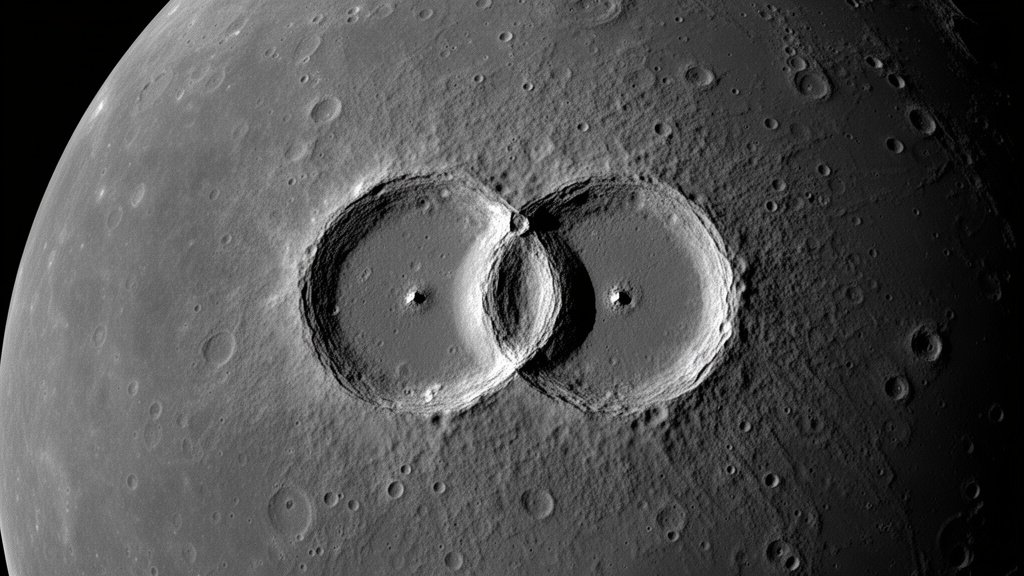
In a unique intersection of modern space debris and lunar geology, NASA’s Lunar Reconnaissance Orbiter (LRO) has successfully located and imaged the impact site of a SpaceX Falcon 9 second-stage rocket body. The object, which struck the Moon’s far side on March 4, 2022, left behind a distinct double-crater—a signature that has surprised researchers and provided a rare, controlled data point for studying high-velocity impacts in low-gravity environments. This observation marks a critical moment in planetary science, as it allows researchers to study the impact mechanics of a man-made object with a known trajectory and structural composition, effectively turning a piece of space debris into an unintentional scientific experiment.
Key Highlights
- The Double-Crater Anomaly: Unlike natural meteoroids that typically create a single, circular impact feature, the Falcon 9 remnant created a double crater, suggesting significant mass distribution at both ends of the rocket body.
- The DSCOVR Origin: The rocket stage was part of the 2015 Deep Space Climate Observatory (DSCOVR) mission, a collaborative project between NASA, NOAA, and the U.S. Air Force.
- Precise Impact Location: The impact occurred within the Hertzsprung crater complex on the lunar far side, a remote region rarely accessible to landers.
- LRO’s Role: The Lunar Reconnaissance Orbiter’s Narrow Angle Camera (NAC) was instrumental in resolving the feature, capturing imagery from orbit that confirmed the impact’s unique topography.
Deciphering the Falcon 9 Lunar Impact
The impact on March 4, 2022, was the culmination of a seven-year drift through the cislunar environment. After successfully launching the Deep Space Climate Observatory (DSCOVR) into a Lagrange point 1 (L1) orbit in February 2015, the second stage of the SpaceX Falcon 9 rocket found itself in a chaotic orbit. Lacking the fuel to return to Earth or escape the Earth-Moon system, it tumbled through space, eventually succumbing to lunar gravity and striking the surface at an estimated velocity of approximately 2.58 kilometers per second (about 5,770 miles per hour).
The Physics of the Double Crater
Perhaps the most compelling aspect of this event is the resulting topography. Standard impact physics dictates that solid rock meteorites create single, clean, bowl-shaped craters. However, the Falcon 9 impact created a double crater—two overlapping impact sites roughly 28 meters and 29 meters in diameter. Planetary scientists posit that this geometry is a direct reflection of the rocket’s structural design. A spent rocket body is effectively a metal shell with heavy, concentrated mass components at opposite ends: the Merlin 1D engine assembly on one side, and the avionics, tanks, and other hardware on the other, with a relatively empty, lightweight cylindrical body connecting them. This distribution of mass is the primary hypothesis for why the crater formed as two distinct events—one for each end of the rocket—rather than a singular, unified impact site. This provides a rare “test case” for researchers to calibrate models of how man-made objects interact with planetary surfaces compared to natural impactors like asteroids.
DSCOVR and the Cislunar Debris Problem
While the science gained from the crater is invaluable, the event has reignited conversations regarding the management of debris in deep space. The DSCOVR mission was a milestone for Earth observation, providing crucial real-time space weather data and images of Earth’s sunlit face. However, the long-term trajectory of the second stage serves as a stark reminder of the “cislunar” problem. As missions to the Moon—both public and private—increase in frequency, the potential for collisions and uncontrolled impacts grows. Understanding the specific impact dynamics of this Falcon 9 body helps NASA and other agencies develop better orbital disposal protocols for future missions, ensuring that spent rocket stages are either de-orbited safely into Earth’s atmosphere or placed in “graveyard” orbits that avoid interference with lunar assets.
The LRO’s Observational Power
The Lunar Reconnaissance Orbiter, which has been circling the Moon since 2009, proved once again why it is the workhorse of lunar exploration. To locate the crater, scientists had to use sophisticated trajectory modeling to narrow down the potential impact site. Once the LRO was maneuvered into position, the Narrow Angle Camera (NAC) captured high-resolution images of the site within the Hertzsprung crater. Because the impact was on the lunar far side, the crater was not visible from Earth, making the LRO the only viable tool for confirming the event. The images not only confirmed the location but also allowed for the analysis of “ejecta” patterns—the debris thrown out during impact—which provides further clues about the rocket’s angle of approach and the composition of the lunar regolith at the site.
Future Implications for Lunar Science
This event has catalyzed a new branch of study: identifying “artificial” craters on the Moon. With the Artemis program on the horizon, the Moon is set to become a busy hub of human activity. NASA scientists are now looking at existing orbital data to see if they can identify craters from previous historical missions, such as the Apollo-era S-IVB boosters. By building a catalog of known artificial impacts, researchers can further refine their understanding of how these impacts differ from natural ones, aiding in the identification of potential threats to future lunar habitats. Furthermore, the ability to predict and verify these impacts demonstrates a level of situational awareness that is crucial for future lunar navigation and safety, particularly as the frequency of landings and orbital insertions increases.
FAQ: People Also Ask
1. Why did the Falcon 9 impact the Moon?
The Falcon 9 second stage did not have enough remaining fuel to complete its original mission trajectory and return to Earth, nor enough to escape the Earth-Moon system. It remained in a chaotic orbit for years before being captured by lunar gravity.
2. Is there a risk of more rocket bodies hitting the Moon?
Space agencies and private companies are increasingly aware of space debris management. While historic missions often left boosters in unplanned orbits, modern protocols focus on “disposal maneuvers” to move spent stages into controlled entry orbits or stable graveyard orbits to prevent future collisions.
3. Why is the double crater significant to scientists?
It is significant because it provides a unique control variable. Natural meteoroids are dense rocks. A rocket stage is a “hollow” object with specific mass distributions at either end. Seeing how this shape produces a specific impact pattern helps geologists better understand impact cratering physics in low-gravity environments.
4. Where exactly is the crater located?
The crater is located within the Hertzsprung crater, which is a massive impact basin on the lunar far side. This location was confirmed through trajectory modeling and subsequent imaging by the Lunar Reconnaissance Orbiter (LRO).