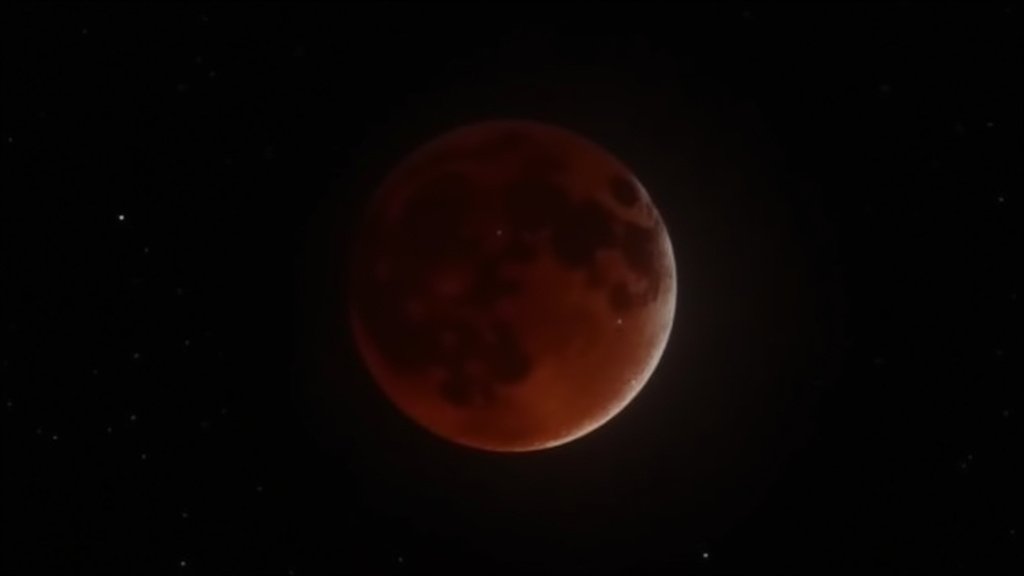
In the early hours of August 28, 2026, the night sky over North America, Europe, and Africa became the stage for a profound astronomical event. A significant partial lunar eclipse occurred, with the Earth’s umbra—the darkest part of its shadow—obscuring a staggering 96% of the lunar disk. Unlike a total lunar eclipse where the moon is completely swallowed by the Earth’s shadow, this partial event offered a unique high-contrast spectacle, leaving only a sliver of the moon illuminated by direct sunlight.
Key Highlights
- Date and Timing: The eclipse reached its maximum magnitude on August 28, 2026, during the early morning hours, providing prime viewing conditions for observers in the Western Hemisphere.
- Shadow Magnitude: The Earth’s umbra covered 96% of the moon’s surface, resulting in a deep, near-total darkening of the lunar face.
- Global Visibility: The event was observable across North America, major parts of South America, Europe, and western Africa, making it one of the most widely watched celestial events of the year.
- Scientific Significance: Astronomers leveraged the event to study the Earth’s atmosphere, as the light filtering through the atmosphere onto the moon provided data on global particulate levels.
The Anatomy of a 96% Eclipse: Why This Event Mattered
The partial lunar eclipse of August 28, 2026, was more than just a beautiful sight; it was a masterclass in orbital mechanics and atmospheric physics. To understand the magnitude of this event, one must look at the concept of syzygy—the straight-line configuration of the Sun, Earth, and Moon. While lunar eclipses are not exceedingly rare, a 96% magnitude event occupies a distinct “sweet spot” between a subtle penumbral eclipse and a total blood moon.
The Mechanics of the Umbra and Penumbra
During the event, the moon passed through the penumbra (the outer, lighter shadow) before entering the umbra (the inner, darker core). As the moon moved deeper into the umbral cone, the 96% coverage ensured that the moon did not simply disappear. Instead, observers witnessed a dramatic gradient, with the portion of the moon immersed in the umbra turning a deep, charcoal grey or dark copper, while the remaining 4% slice remained bright and brilliant. This contrast created a “crescent moon” effect that was entirely caused by the shadow of our own planet, rather than the sun’s illumination angle.
Geographical Reach and Observation Data
The visibility of the August 28 event was particularly favorable for North American populations. Because the moon was positioned high in the sky during the peak hours of the eclipse, there was minimal interference from the horizon haze. Organizations like the National Aeronautics and Space Administration (NASA) and various astronomical societies noted that the timing allowed for high-resolution amateur photography, contributing to a global repository of crowd-sourced scientific data. This data is critical for researchers analyzing lunar albedo and the composition of the Earth’s shadow-casting atmosphere.
Historical Context: From Omens to Science
Historically, events like the 2026 eclipse were viewed with superstition and fear. In many ancient civilizations, a darkening moon was interpreted as a celestial creature attempting to devour the satellite. However, today’s understanding of the event is rooted firmly in physics. The shift from fear to fascination highlights humanity’s progress in understanding our place in the cosmos. By predicting these events years in advance, modern science has transformed potential sources of existential dread into opportunities for global education and engagement.
The Rise of Astrotourism
The August 28 eclipse also served as a catalyst for the growing “astrotourism” sector. With many observers traveling to rural locations to escape light pollution, local economies in designated “Dark Sky Parks” saw a notable uptick in visitors. This secondary economic angle highlights how astronomical events can drive tourism and support conservation efforts, as cities and protected lands work together to minimize artificial light interference. The ability to witness a 96% coverage event is a major draw for educational travel, encouraging families and students to engage with STEM fields through direct observation.
Future Implications and Data Collection
Beyond the aesthetic beauty, the 2026 partial eclipse provided vital information for climate and planetary scientists. During an eclipse, the moon acts as a screen that reflects sunlight passing through Earth’s atmosphere. By analyzing the color and brightness of the moon during the 96% eclipse phase, scientists can estimate the amount of aerosols, ozone, and volcanic dust present in Earth’s stratosphere. This comparative analysis helps refine climate models, proving that even a simple partial eclipse has tangible, modern-day utility beyond mere curiosity.
FAQ: People Also Ask
Q: Why was this eclipse 96% and not 100%?
A: A lunar eclipse only becomes ‘total’ if the Moon enters the Earth’s umbra completely. In this specific orbital alignment, the Moon’s path missed the full center of the Earth’s shadow by a small margin, resulting in a partial eclipse where only 4% of the surface remained in direct sunlight.
Q: Is it safe to watch a lunar eclipse with the naked eye?
A: Yes. Unlike solar eclipses, which require specialized protective eyewear to avoid retinal damage, lunar eclipses are perfectly safe to view directly. The reflected sunlight from the moon is not intense enough to harm human vision.
Q: What is the difference between a penumbral and partial eclipse?
A: A penumbral eclipse occurs when the moon passes through the lighter, outer part of Earth’s shadow, causing only a slight dimming that is often hard to notice. A partial eclipse involves the moon entering the darker umbral shadow, creating a distinct, visible “bite” taken out of the lunar disk.