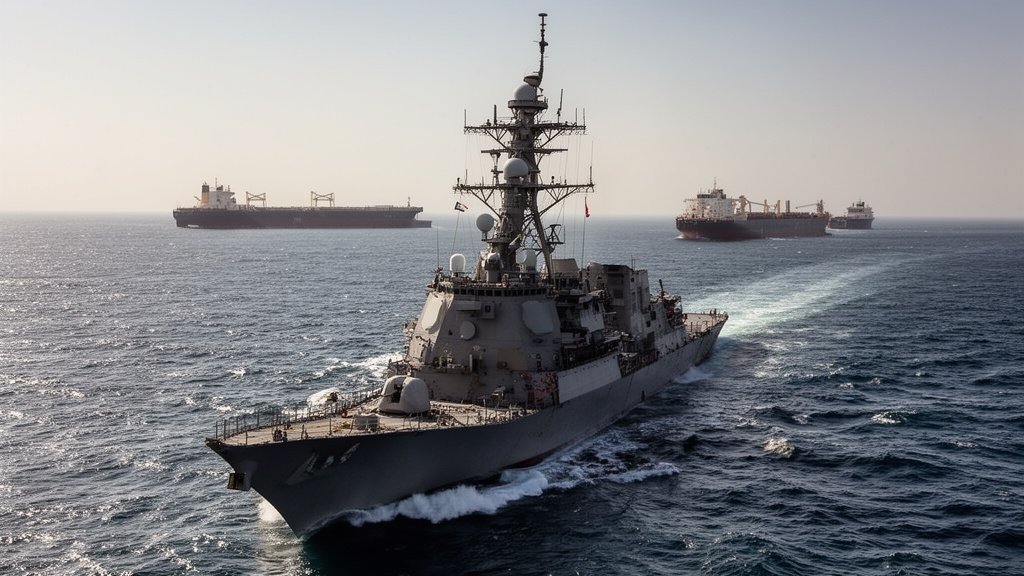
As of October 15, 2026, the geopolitical landscape in the Middle East has shifted into a critical phase of escalation, with U.S. officials confirming they are actively evaluating the deployment of the GBU-43/B Massive Ordnance Air Blast (MOAB) bomb as a strategic deterrent against Iranian aggression. This development comes in the wake of the sinking of two commercial vessels within the Strait of Hormuz, an event that has effectively throttled one of the world’s most vital energy arteries. The Pentagon is reportedly weighing the necessity of this high-yield, non-nuclear conventional ordnance to re-establish deterrence and ensure the freedom of navigation in the region, signaling a massive departure from standard containment protocols.
Key Highlights
- Strategic Escalation: The U.S. is considering the GBU-43/B (MOAB) for strike plans following the sinking of two ships in the Strait of Hormuz.
- Critical Chokepoint: The ongoing conflict has created an immediate blockage in the Strait, threatening global energy supply chains.
- Deterrence Strategy: The potential use of the MOAB serves as a psychological signal to the Islamic Revolutionary Guard Corps (IRGC) regarding the security of maritime traffic.
- Pentagon Oversight: CENTCOM and the Joint Chiefs are coordinating with regional allies to monitor Iran’s maritime maneuvers in real-time.
The Strategic Shift in Iranian Waters and the MOAB Option
The Strait of Hormuz has long been recognized as the world’s most critical oil chokepoint, with approximately 20% of the world’s petroleum consumption passing through its narrow waters daily. The events of the last 48 hours, culminating in the confirmed sinking of two commercial vessels, have forced the hand of U.S. planners. The GBU-43/B, often referred to as the ‘Mother of All Bombs,’ represents a psychological and tactical lever that the United States is now openly discussing.
The Tactical Capability of the GBU-43/B
The GBU-43/B is not a weapon typically deployed in routine skirmishes. It is a thermobaric weapon that creates a massive blast wave, capable of destroying hardened subterranean tunnels, command centers, and naval assets without the radioactive fallout associated with tactical nuclear weapons. By elevating this specific asset to the ‘planning’ phase, the U.S. Department of Defense is sending a kinetic message to Tehran that the ‘gray zone’ warfare tactics—specifically the targeting of commercial shipping—have crossed a red line. Analysts suggest that the intent is to shock Iranian command structures, forcing a recalibration of their maritime harassment strategy.
Maritime Chokepoints and Global Economic Fallout
The economic implications of the current naval stand-off are immediate and severe. Marine insurance premiums for tankers operating in the Persian Gulf have spiked by 400% in the last 24 hours. Global commodity markets, particularly Brent Crude, are exhibiting extreme volatility as traders price in the potential for a complete closure of the strait. The U.S. Navy’s Fifth Fleet, operating out of Bahrain, is reportedly increasing its surveillance, yet the sinking of the two vessels suggests that Iran’s current asymmetric capability—likely utilizing mines and small fast-attack boats—is successfully bypassing conventional naval screening.
Escalation Dynamics and Regional Security
This crisis is distinct from previous naval tensions. In the past, Iran utilized ‘swarm’ tactics to harass vessels; however, the actual destruction of ships represents an act of kinetic warfare that requires a proportional and decisive response. U.S. intelligence suggests that the IRGC is attempting to force a bargaining position by holding the global economy hostage. By introducing the MOAB into the public discourse, the U.S. is attempting to flip the script, moving from a defensive posture to one of credible, existential threat. This approach is fraught with risk, as any miscalculation could lead to a rapid expansion of the conflict into a full-scale regional war. Military historians note that such brinkmanship has historically led to two outcomes: a swift de-escalation by the aggressor, or a catastrophic failure of deterrence that necessitates the very strike being discussed.
FAQ: People Also Ask
What is the GBU-43/B and why is it significant?
The GBU-43/B, or Massive Ordnance Air Blast (MOAB), is the largest non-nuclear weapon in the U.S. arsenal. It is significant because of its psychological impact and its ability to destroy deeply buried infrastructure, serving as a ‘message’ weapon to signal extreme resolve to adversarial regimes.
How does the Strait of Hormuz impact the global economy?
The Strait of Hormuz is the world’s most important oil transit chokepoint. Any threat to its passage can lead to instantaneous spikes in oil prices, disruptions to global energy supply chains, and significant inflationary pressure on the global economy.
Is the sinking of ships in the Strait of Hormuz considered an act of war?
International legal experts generally classify the unprovoked sinking of civilian commercial vessels in international waters as a major escalation, frequently cited as a casus belli. While the threshold for ‘war’ is complex, such actions are widely viewed as direct acts of state-sponsored aggression in the context of the current Iran-U.S. tensions.