
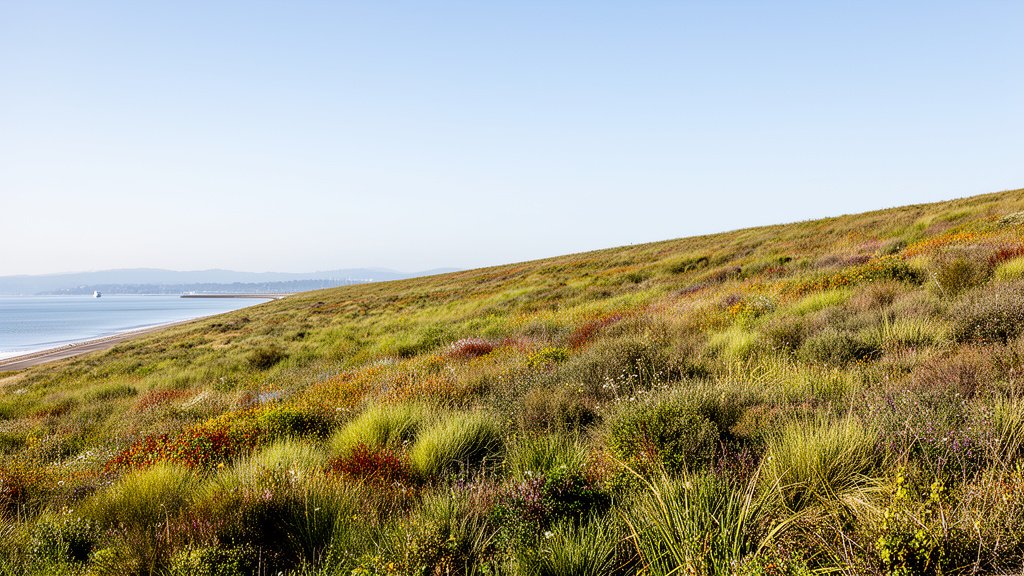
As sea levels rise and climate uncertainty looms, urban planners in the San Francisco Bay Area are moving away from traditional, rigid ‘grey’ infrastructure. Instead, they are increasingly implementing horizontal levees—a form of nature-based green infrastructure that utilizes sloped, native plant-covered buffers to mitigate flooding while actively restoring wildlife habitats.
Key Highlights
- Defining the Tech: Horizontal levees are wide, gently sloped embankments engineered to mimic natural transition zones, acting as a buffer between the Bay and developed areas.
- Multifunctional Benefits: Beyond flood protection, these systems provide critical water filtration by removing excess nitrogen and nutrients from treated wastewater before it enters the ecosystem.
- Pioneering Examples: The Oro Loma Sanitary District project, launched in 2015, serves as the benchmark for this technology, demonstrating significant success in habitat restoration.
- Ecological Impact: These sites are specifically designed to support endangered species, such as the salt marsh harvest mouse and the Ridgway’s rail, by expanding vital wetland acreage.
Engineering the Living Shoreline
The traditional approach to flood management has long relied on vertical concrete sea walls. However, these structures often fail to adapt to rising water levels and destroy the very coastal ecosystems they are meant to protect. Horizontal levees represent a paradigm shift in civil engineering. By creating a wide, vegetated slope that stretches from the shoreline into the upland areas, engineers can dissipate wave energy more effectively than a vertical wall.
Research from the San Francisco Estuary Institute (SFEI) underscores that these sloped buffers do more than just block water. They act as a sophisticated treatment plant. By slowly filtering highly treated wastewater through layers of soil and native vegetation, horizontal levees naturally sequester carbon and strip away nitrate contaminants that typically fuel algal blooms in the Bay.
The Oro Loma Blueprint
Since its inception in 2015, the Oro Loma Sanitary District horizontal levee has become the standard-bearer for this technology. The site takes highly treated wastewater and distributes it across a transitional slope designed to replicate historic wetland conditions. The results have been measurable: the site has seen a massive increase in biodiversity and has successfully proven the capability of soil microbes and plants to perform nutrient removal. This pilot project, backed by partnerships with the California State Coastal Conservancy, has provided the data necessary to justify wider implementation across the region.
Economic Resilience and Habitat Restoration
From an economic standpoint, horizontal levees offer a compelling return on investment. While the upfront land requirement is significantly higher than that of a concrete sea wall, the long-term maintenance costs and environmental ‘ecosystem services’ provided—such as water purification and storm surge absorption—often outweigh the initial capital.
Furthermore, the restoration of these transition zones is critical for the survival of local wildlife. In a fragmented landscape like the Bay Area, where development has historically pushed up against the water’s edge, these levees provide a necessary ‘high tide refuge’ for the salt marsh harvest mouse. When extreme high tides occur, these mammals have nowhere to escape unless they have access to the higher, vegetated ground provided by these artificial slopes.
Future Scaling and Challenges
Despite the clear advantages, scaling the horizontal levee concept across the entire San Francisco Bay presents significant challenges. Land availability is the most pressing constraint; much of the shoreline is already developed or owned by private entities. Additionally, the regulatory process for permitting nature-based infrastructure can be cumbersome, as agencies often default to tried-and-true, hard-engineering standards.
However, the momentum is shifting. Future urban planning initiatives in the Bay Area are increasingly viewing horizontal levees not just as a defensive necessity against sea-level rise, but as an opportunity to ‘re-green’ the urban fabric. By integrating these systems into larger climate adaptation strategies, planners hope to ensure that the San Francisco Bay remains both habitable for its residents and resilient for its native species.
FAQ: People Also Ask
1. What is the primary difference between a vertical levee and a horizontal levee?
A vertical levee is a hard, concrete wall designed only to block water. A horizontal levee is a wide, sloped embankment covered in native vegetation that absorbs wave energy, filters water, and provides a gradual transition between the water and the land.
2. Do horizontal levees actually help with wastewater treatment?
Yes. By directing treated wastewater through the vegetation and soil of the levee, the natural ecosystem helps remove nitrogen and other nutrients before the water reaches the Bay, preventing harmful algal blooms.
3. Are these levees effective against extreme sea-level rise?
They are highly effective at mitigating storm surges and high tides. While they cannot stop sea-level rise alone, they provide a flexible, adaptive solution that can be modified or expanded as climate conditions change, unlike static concrete walls.
4. Where can I see a horizontal levee in the Bay Area?
The most prominent and successful demonstration project is located at the Oro Loma Sanitary District in the East Bay, which has been operational since 2015 and serves as a model for regional planning.