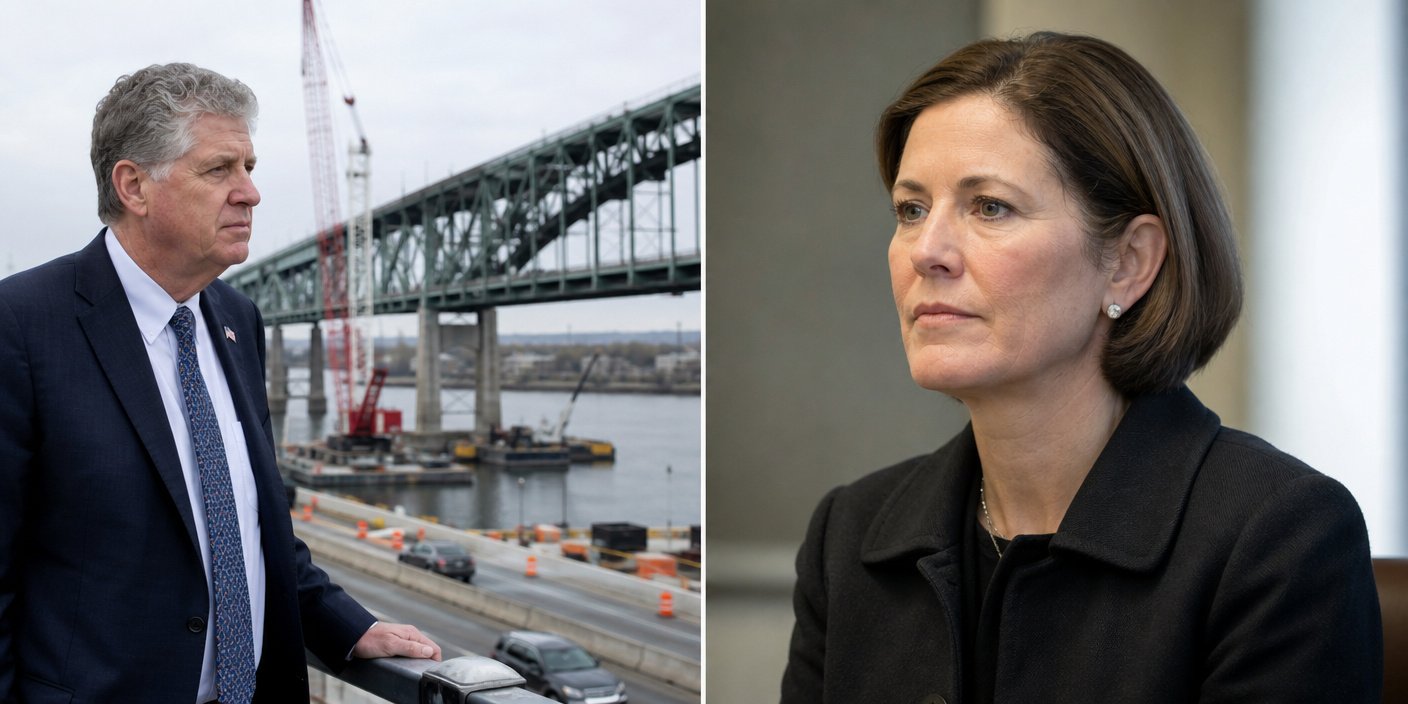
Rhode Island Governor Dan McKee finds his administration’s competence under the microscope as he prepares for a high-stakes gubernatorial rematch against former challenger Helena Foulkes, with the chaotic failure of the Washington Bridge serving as the primary flashpoint in the looming 2026 campaign. The abrupt closure of the I-195 bridge in December 2023 has evolved from a transit nightmare into a defining political crisis, providing a tangible narrative for the opposition to challenge the incumbent’s management of state agencies.
Key Highlights
- The sudden closure of the westbound span of the Washington Bridge due to critical structural rod failures has paralyzed traffic and triggered widespread economic disruption in the Providence metropolitan area.
- Helena Foulkes, leveraging her background in corporate leadership, is framing the infrastructure crisis as a systemic failure of state oversight under the Rhode Island Department of Transportation (RIDOT).
- Governor Dan McKee is struggling to balance the aggressive repair schedule with public frustration, attempting to pivot the conversation toward economic development and job growth.
- Political analysts anticipate the Washington Bridge debacle will be a central theme in the 2026 election, as voters weigh the incumbent’s steady-hand approach against calls for structural administrative reform.
The Infrastructure Catalyst: A Crisis of Oversight
The Washington Bridge, a vital artery carrying roughly 96,000 vehicles daily across the Seekonk River, became the centerpiece of Rhode Island’s political discourse the moment it was shuttered in late 2023. The discovery of “critical” rod failures forced the Rhode Island Department of Transportation (RIDOT) to implement a traffic pattern that quickly decimated local commerce and infuriated commuters. For Helena Foulkes, the failure was not merely a matter of engineering; it was a symptom of an administration that had grown complacent.
Foulkes has moved to position the bridge collapse as the ultimate evidence of “business as usual” failing the citizens of Rhode Island. Her campaign arguments draw heavily on the premise that the state’s agencies, particularly RIDOT, lacked the necessary internal checks to prevent such a catastrophic maintenance oversight. By contrasting the current administrative gridlock with the need for corporate-style efficiency, Foulkes is attempting to build a coalition of frustrated suburban commuters and small business owners who feel the McKee administration has failed to prioritize the state’s functional core.
The Political Stakes of the Rematch
The 2022 gubernatorial race was defined largely by post-pandemic recovery and character narratives. In 2026, the playing field has shifted to basic government service. Governor McKee, having successfully navigated a crowded primary and general election in 2022, now faces the burden of incumbency. The bridge, quite literally, blocks his path to a seamless re-election campaign. Every traffic jam and delayed repair timeline serves as an implicit advertisement for the opposition.
McKee’s defensive strategy has centered on rapid mobilization and full accountability. His administration has aggressively sought federal funding and streamlined contract procurement to hasten the demolition and replacement of the structure. He contends that his leadership is essential for continuity during a time of crisis, suggesting that a transition in leadership would only introduce further instability during the reconstruction phase. However, the optics of the situation remain difficult. The longer the construction barriers remain, the more the “bridge narrative” cements itself in the minds of the electorate, making it difficult for the Governor to pivot to his preferred talking points regarding education reform or offshore wind development.
Economic and Social Ripple Effects
The economic impact of the Washington Bridge closure cannot be overstated. East Providence businesses, reliant on the flow of traffic from Providence, reported significant revenue losses in the months following the closure. This economic pain has created a new demographic of voters who are not necessarily aligned with any specific ideology but are profoundly motivated by the tangible failure of state services.
Furthermore, the technical failures underlying the bridge’s collapse have invited increased scrutiny from the General Assembly. Questions regarding procurement transparency, the selection of engineering contractors, and the long-term maintenance of the I-195 corridor have forced Governor McKee onto the defensive. Foulkes, utilizing her former executive experience, is adept at translating these complex technical failures into accessible “accountability” soundbites. She is tapping into a broader sentiment that the state’s political machinery is inefficient, using the bridge as the perfect, immovable proof point for her platform of reform.
As the 2026 election cycle approaches, the bridge will likely serve as a metaphorical and literal hurdle. If the project remains unfinished or plagued by delays, the McKee campaign faces an uphill battle to regain public trust. Conversely, if the administration successfully manages the transition and restores full capacity, it could provide a “comeback” narrative of resilience and efficiency. For now, the political tension in Rhode Island remains as rigid and stressed as the infrastructure in question.
FAQ: People Also Ask
Is the Washington Bridge expected to be fully replaced before the 2026 election?
While the McKee administration has accelerated demolition and reconstruction timelines, the project is a massive, multi-year civil engineering endeavor. Public expectations remain cautious, and it is likely to remain a significant topic of debate throughout the 2026 election season regardless of the construction status.
What are the main criticisms Helena Foulkes has leveled against Governor McKee regarding this issue?
Foulkes has primarily criticized the administration’s oversight of the Rhode Island Department of Transportation, arguing that the failure to identify and address the structural risks sooner demonstrates a lack of executive accountability and professional management.
How does the current rematch differ from the 2022 election?
The 2022 election was heavily influenced by the aftermath of the COVID-19 pandemic and general political polarization. The 2026 cycle is uniquely shaped by a “service delivery” crisis, where the state’s inability to maintain critical infrastructure has become the central issue for voters.
What role did the federal government play in the bridge crisis?
The McKee administration has actively coordinated with the Federal Highway Administration (FHWA) to secure disaster relief funding and technical oversight to expedite the replacement process, as the bridge is a critical component of the regional interstate network.