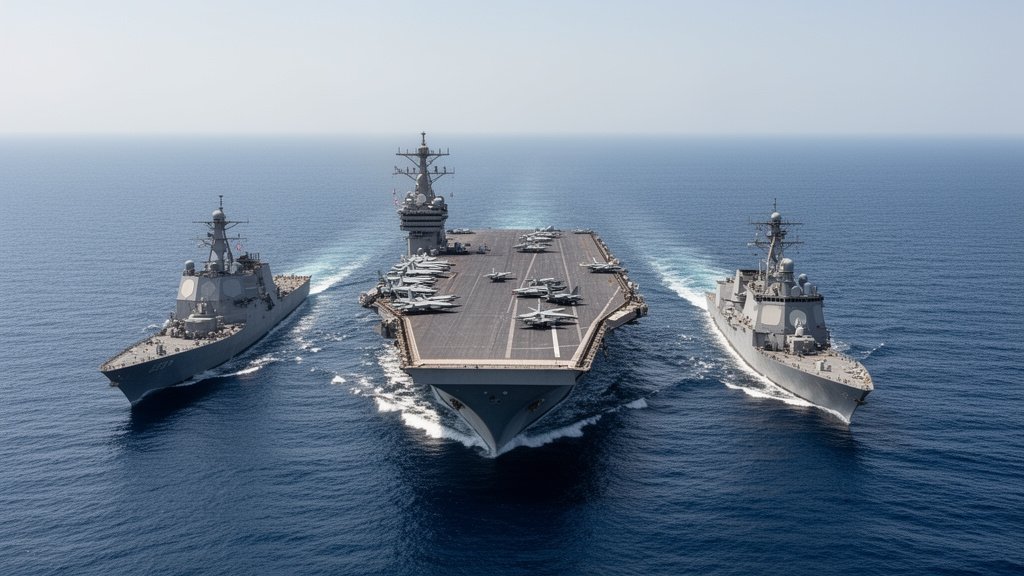
The Pentagon has initiated plans to deploy a third aircraft carrier strike group to the Middle East, a significant escalation in naval presence intended to deter regional aggression and manage the fallout of rising tensions with Iran. This strategic reinforcement, involving the deployment of thousands of additional personnel and advanced naval assets, underscores the United States’ commitment to maintaining maritime security in one of the world’s most vital geopolitical chokepoints. With an estimated 9,000 to 10,000 additional troops being moved into the theater, the maneuver signals a shift toward a more robust posture, directly challenging the influence of regional actors and ensuring the protection of international shipping lanes. This deployment serves as a clear, unmistakable message of resolve from the Department of Defense, aimed at neutralizing potential threats before they escalate into open conflict.
Key Highlights
- The Pentagon is authorizing the deployment of a third carrier strike group, significantly increasing the US naval footprint in the Middle East.
- The operation involves an influx of 9,000 to 10,000 additional troops, including specialized Marine Corps units.
- The deployment is a direct response to increasing hostilities and intelligence reports indicating heightened risk regarding Iranian military posturing.
- Beyond carriers, the deployment includes support ships, enhancing the US Navy’s ability to conduct rapid response, reconnaissance, and strike operations.
- This move serves as a deterrent to state and non-state actors, aiming to stabilize regional corridors for global commerce.
Geopolitical Storm: The US Naval Surge in the Middle East
The decision to shift a third carrier strike group into the Middle East is not merely a logistical exercise; it is a calculated geopolitical maneuver. By clustering these massive platforms of mobile air power—which function as sovereign US territory—the Department of Defense is effectively creating a floating shield across the Persian Gulf and surrounding waters. The primary objective is deterrence, a strategy predicated on the idea that the physical presence of overwhelming force will compel Tehran to temper its actions.
The Strategic Rationale Behind the Deployment
Military analysts identify three primary pillars driving this deployment. First, the maintenance of Freedom of Navigation (FON). As the Middle East remains the world’s most critical energy transit region, any disruption to the Strait of Hormuz or surrounding waterways could trigger catastrophic global economic consequences. A carrier strike group provides constant monitoring of these sea lanes, with the ability to neutralize threats—such as fast-attack craft or drone swarms—before they can disrupt commercial traffic.
Second, the surge is designed to counter the asymmetric warfare capabilities of the Islamic Republic of Iran. Iranian strategy has long relied on proxy forces and missile technology to challenge Western hegemony. By increasing the carrier density, the US simplifies its own response times, ensuring that interceptors and fighter jets are within striking distance of any flashpoint 24 hours a day.
Third, the deployment facilitates the rapid mobilization of Marine Corps assets. These additional 9,000 to 10,000 troops are not merely infantry; they represent specialized expeditionary capabilities, including air-ground task forces and amphibious readiness groups. This gives the Pentagon the flexibility to conduct humanitarian operations, evacuations, or targeted counter-terrorism missions without needing to rely on often-tenuous local basing agreements.
The Iran Factor: Calculating Risks and Deterrence
For the Islamic Republic of Iran, the arrival of a third US strike group changes the regional calculus. While Tehran has historically pushed back against US presence through proxies across Syria, Iraq, and Yemen, a more visible US naval presence makes a direct or high-intensity response significantly more difficult. The intelligence community monitors Iranian military posturing constantly, and this deployment is partly a response to reports of increased weapon shipments and intelligence-gathering by the Islamic Revolutionary Guard Corps (IRGC).
The presence of three carrier groups allows for constant, overlapping reconnaissance. The E-2D Advanced Hawkeye radar planes, which fly from these carriers, can track multiple targets in a 360-degree radius, effectively turning the entire Persian Gulf into a transparent environment for US command centers. This surveillance capability forces regional powers to operate under constant scrutiny, limiting the scope for covert operations.
Inside the Strike Group: Military Assets and Capabilities
What exactly does a carrier strike group bring to the table? A typical strike group is a self-contained force of immense destructive and defensive power. It is centered around a Nimitz-class or Ford-class aircraft carrier, which carries an air wing of roughly 60 to 75 combat aircraft, including F/A-18 Super Hornets, E-2D Hawkeyes, and EA-18G Growler electronic warfare planes.
Supporting this centerpiece are several Ticonderoga-class guided-missile cruisers and Arleigh Burke-class destroyers. These vessels are equipped with the Aegis Combat System, the gold standard in missile defense. They can track and intercept ballistic missiles while simultaneously engaging surface and subsurface threats. When three such groups are concentrated in a single region, the density of defensive and offensive weaponry creates an ‘anti-access, area-denial’ environment that would be nearly impossible for most regional militaries to penetrate without incurring catastrophic losses.
Secondary Angles: Examining the Broader Impact
To fully understand this development, we must look beyond the immediate military theater to three secondary areas of concern:
1. The Energy Markets and Global Stability: As news of the deployment circulates, energy markets often exhibit volatility. However, by securing the region, the US is attempting to reassure investors and global markets that the supply of oil and liquefied natural gas will not be interrupted by Iranian-backed disruptions in the Gulf. The economic cost of this deployment is high, but it is weighed against the potentially higher cost of a major energy supply shock.
2. Diplomatic Channels in Parallel: Military movements are almost always accompanied by ‘backchannel’ diplomacy. While the public posture is one of force, the deployment provides the administration with increased leverage in ongoing negotiations. Historically, US carrier deployments have been used to create a ‘position of strength’ from which to conduct high-level diplomacy, ensuring that Iran recognizes the consequences of escalating its current activities.
3. Historical Context of Persian Gulf Deployments: This is not the first time the US has surged naval power into the Middle East. From the ‘Tanker War’ of the 1980s to the post-9/11 buildup, the US has repeatedly demonstrated that it considers the Persian Gulf a ‘vital interest.’ This current deployment echoes previous eras of high tension, signaling that the US is shifting away from its prior focus on ‘over-the-horizon’ deterrence toward a more permanent, visible presence in the region.
FAQ: People Also Ask
Q: How many total troops is the US moving to the Middle East?
A: The latest Pentagon directive involves adding an estimated 9,000 to 10,000 troops, including personnel supporting the third carrier strike group and additional Marine Corps elements.
Q: Why does the US send carrier strike groups to the Middle East?
A: Carrier strike groups are deployed to provide rapid, versatile, and mobile air and sea power. They act as a deterrent against aggression, ensure freedom of navigation for commercial vessels, and provide the US military with immediate response capabilities to protect interests and allies.
Q: Is this deployment specifically directed at Iran?
A: While the Pentagon officially frames this as a regional stability effort, it is explicitly in response to rising tensions with Iran, including concerns over proxy militia activity and threats to international maritime shipping lanes.
Q: What is a ‘Carrier Strike Group’ exactly?
A: It is a naval formation comprising one aircraft carrier, at least one guided-missile cruiser, and two or more guided-missile destroyers. It also includes carrier-based aircraft, helicopters, and potentially a nuclear-powered submarine, functioning as a complete self-contained fighting force.