
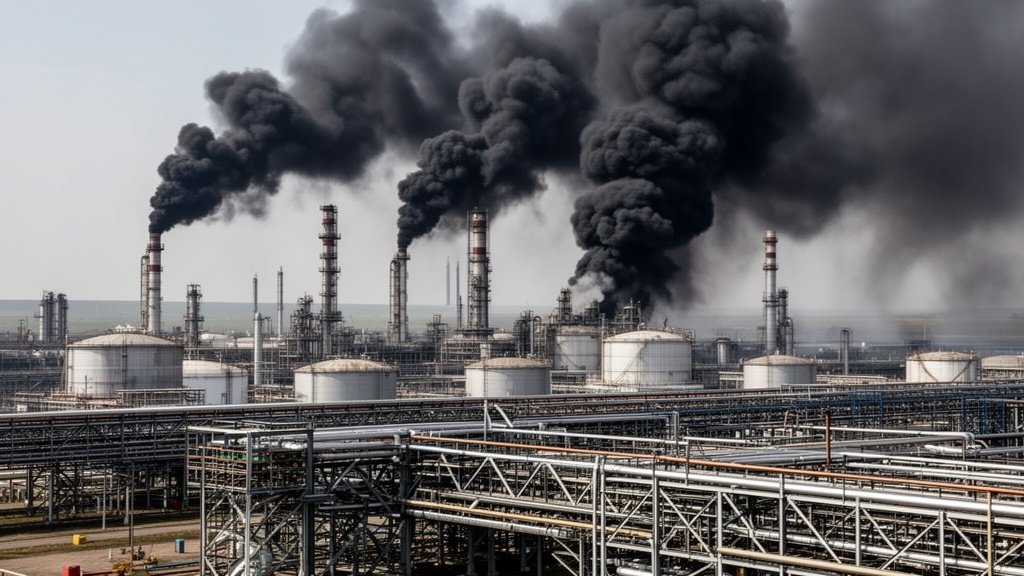
A devastating drone strike has struck the Permnefteorgsintez oil refinery in the Perm region, triggering a massive, uncontrollable blaze and resulting in at least one confirmed fatality. The incident, which occurred amidst a coordinated, large-scale drone offensive across several Russian regions, has caused significant damage to one of the country’s critical energy processing facilities. Local authorities have scrambled to contain the fire, which sent plumes of thick black smoke over the industrial city, while surrounding infrastructure—including regional air transport hubs and nearby manufacturing plants—remains under heightened alert following the breach of regional airspace.
Key Highlights:
- Strike Location: The Permnefteorgsintez refinery, a critical asset in the Ural energy sector, sustained a direct hit.
- Casualties: Local emergency services confirmed one fatality resulting from the attack.
- Infrastructure Damage: Beyond the refinery, the strike caused spillover disruptions to regional infrastructure, including nearby airport operations.
- Emergency Response: Regional authorities and Ministry of Emergency Situations teams are engaged in a high-stakes effort to suppress the fire and mitigate environmental hazards.
- Tactical Escalation: The attack signifies a shift in the range and precision of recent drone operations, targeting deep-territory industrial assets.
The Siege of Perm: Unpacking the Refinery Attack
The assault on the Permnefteorgsintez refinery is a stark demonstration of the shifting dynamics in regional industrial security. As one of the largest and most significant oil refining enterprises in the Russian Federation, the facility plays a pivotally important role in the processing and distribution of petroleum products. The strike has not only resulted in a tragic loss of life but has also forced a total operational halt at the site, creating immediate ripple effects throughout the local energy supply chain.
Incident at Permnefteorgsintez
Reports indicate that the early morning strike penetrated deep into the Perm Krai region, evading local detection systems. The resulting impact ignited a massive conflagration, primarily affecting the distillation and storage sectors of the plant. Footage from the scene circulating in the immediate aftermath showed towering flames and dark, industrial-grade smoke, characteristic of hydrocarbon fires. Emergency crews from the Ministry of Emergency Situations arrived shortly after the detonation, but the sheer scale of the fire and the volatility of the materials involved have complicated firefighting efforts. The fatality, confirmed by regional health authorities, occurred within the plant’s perimeter, marking a somber milestone in the ongoing series of infrastructure attacks.
Ripple Effects Across the Region
The attack was not isolated to the refinery. The drone offensive appeared to target a spectrum of regional infrastructure, causing temporary paralysis in nearby transport hubs. Regional airports were forced to implement emergency protocols, delaying or diverting flights to ensure passenger safety as airspace security was recalibrated. Simultaneously, other industrial plants in the Perm industrial zone reportedly entered precautionary lockdowns. This cascade effect illustrates the profound vulnerability of regional urban planning, where critical energy infrastructure and civilian transport hubs are frequently co-located or share identical regional security perimeters.
Economic and Strategic Vulnerability
From an economic standpoint, the damage to Permnefteorgsintez is significant. As a Lukoil-affiliated facility, it is a massive cog in the Russian fuel market. Prolonged downtime at this facility risks creating regional fuel shortages, potentially driving up costs for localized transport and agricultural machinery. Beyond the immediate fuel prices, this event underscores a deeper, more troubling trend for industrial operators: the ‘safety’ of deep-territory facilities is increasingly relative. Historically, such infrastructure was considered geographically secure due to its distance from active borders. This recent breach effectively rewrites the risk assessment playbook for oil and gas conglomerates operating in central and eastern Russia.
Analysts are now pointing to the sophisticated nature of the drone technology employed—often utilizing advanced navigation and stealth capabilities—that allows for long-range penetration without early detection. The failure to intercept the strike raises questions about the density and effectiveness of current air defense ‘bubbles’ around key strategic sites. Moving forward, we anticipate a massive influx of capital directed toward hardening these facilities. This likely entails the installation of localized electronic warfare (EW) suites, increased reliance on point-defense anti-aircraft systems (like Pantsir-S1 variants), and a restructuring of logistical redundancy to ensure that a single point of failure does not collapse the entire regional energy supply grid.
FAQ: People Also Ask
1. What is the status of the Permnefteorgsintez refinery operations?
Operations at the refinery have been suspended due to the massive fire and subsequent structural damage caused by the drone strike. Authorities have indicated that investigations and safety assessments are ongoing before any timeline for operational resumption can be established.
2. Is there a risk to regional fuel supplies?
Yes. Given the refinery’s scale as a major processing hub for the Ural energy sector, local analysts expect temporary supply chain volatility. Efforts are being made to reroute fuel supplies from other refineries to mitigate potential shortages.
3. How did the drones reach the Perm region?
While specific flight paths and launch origins are currently under investigation by security services, the incident highlights the expanding range capabilities of modern long-range drones, which are increasingly capable of bypassing standard regional airspace detection grids.
4. What measures are being taken to prevent future attacks?
Following the incident, security protocols have been tightened across Perm Krai. There is an expectation of increased deployment of electronic warfare assets and anti-aircraft systems around critical energy and industrial infrastructure to create a more robust defense perimeter.