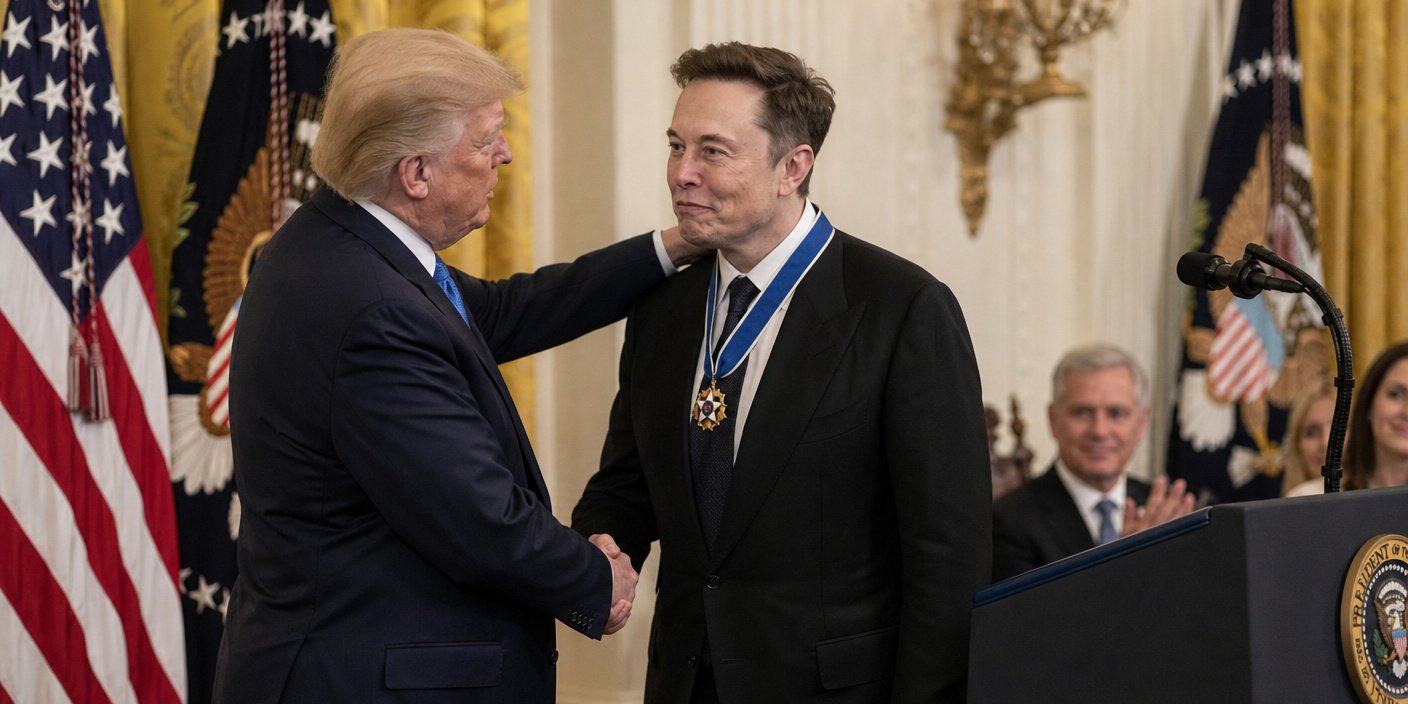
President Donald Trump has officially conferred the National Medal of Science and the National Medal of Technology and Innovation upon a select cohort of America’s most influential tech industry executives. This high-profile recognition highlights the strategic importance of private-sector innovation in securing American technological sovereignty. Among the distinguished recipients honored for their transformative contributions to engineering, computing, and space exploration are Elon Musk, Sergey Brin, Jensen Huang, Lisa Su, Satya Nadella, and Michael Dell.
Key Highlights
- Prestigious Recognition: The National Medal of Science and the National Medal of Technology and Innovation stand as the highest honors bestowed by the United States government upon scientists, engineers, and inventors.
- Industry Leaders Honored: The list of recipients includes titans of the tech sector, specifically Elon Musk (SpaceX/Tesla), Jensen Huang (NVIDIA), Lisa Su (AMD), Satya Nadella (Microsoft), Michael Dell (Dell Technologies), and Sergey Brin (Google/Alphabet co-founder).
- Strategic Focus: The awards underscore the critical intersection between American public policy and the rapid advancement of artificial intelligence, semiconductor manufacturing, and private aerospace capabilities.
- Broad Impact: From the democratization of high-performance computing to the expansion of commercial spaceflight, the recipients represent the infrastructure upon which the modern digital economy is built.
The Architects of Modern Innovation
The National Medal of Science and the National Medal of Technology and Innovation have long served as a barometer for what the American government deems critical to the nation’s progress. By honoring this specific group of executives, the current administration is signaling a shift toward recognizing the architects of the modern digital industrial complex—leaders whose corporate outputs have effectively become national assets in the race for technological dominance.
Semiconductors and the AI Revolution
The inclusion of Jensen Huang and Lisa Su represents a decisive acknowledgement of the “silicon age.” As the CEOs of NVIDIA and AMD respectively, Huang and Su have steered their organizations through the explosive demand for high-performance computing and generative artificial intelligence. Their work in GPU architecture and semiconductor design has not only generated billions in market value but has fundamentally altered the global geopolitical landscape. The reliance on advanced chips for both consumer electronics and defense applications makes their engineering contributions essential to national security.
Space and Sustainability
Elon Musk’s recognition acknowledges his role in revitalizing the American space program through the commercialization of low-Earth orbit. His work with SpaceX has reduced the cost of access to space, fundamentally changing the logistical capabilities of government agencies and private entities alike. Simultaneously, his efforts in electric vehicle manufacturing with Tesla have accelerated the transition of the automotive industry, impacting domestic manufacturing capabilities and energy policy.
The Software and Systems Ecosystem
The awards also extend to the software and hardware infrastructure that sustains the global information economy. Satya Nadella’s leadership at Microsoft has been pivotal in the shift toward cloud computing and the integration of AI into enterprise software, tools that are now ubiquitous in both government and business sectors. Similarly, Michael Dell’s decades of consistency in the hardware space—transforming how corporations acquire and manage computing assets—has provided the reliable, scalable backbone for modern digitization. Sergey Brin, a pioneer of the early internet era, represents the foundational engineering that enabled the information age, with his influence on search algorithms and early-stage AI research cementing his role as a central figure in American technological history.
Technological Sovereignty and Economic Policy
The decision to award these specific individuals reflects a growing trend of integrating business leadership into the national dialogue on progress. In an era of intense global competition, particularly regarding the development of AI and quantum computing, the administration appears to be fostering a closer alignment between state interests and the R&D pipelines of Silicon Valley giants.
The Impact of Private-Sector Engineering
Historically, the National Medal of Science was heavily focused on academic research. By emphasizing private-sector leaders, the government is highlighting the shift of “frontier science” into the corporate domain. Modern scientific breakthroughs in AI and aerospace now require capital expenditures and production capabilities that often exceed those available to university laboratories. This pivot to honoring corporate leaders reflects the reality that the next era of American scientific advancement will be heavily driven by commercial enterprises that successfully scale theoretical innovation into practical, real-world solutions.
Looking Ahead: The Future of American Engineering
As these industry titans continue to steer the direction of global technology, their recognition serves as a marker of the current administration’s support for aggressive innovation. Critics might point to the concentration of power within these firms, but proponents argue that in the current international landscape, having world-leading companies headquartered on American soil is a strategic imperative. The question for the coming years will be how these organizations balance their newfound closeness to federal recognition with the need to maintain the independence and agility that drove their initial successes.
FAQ: People Also Ask
What are the National Medal of Science and the National Medal of Technology and Innovation?
These are the highest honors awarded by the United States government to scientists, engineers, and inventors. The Medal of Science recognizes contributions to the physical, biological, mathematical, engineering, or social and behavioral sciences, while the Medal of Technology and Innovation honors those who have made lasting contributions to America’s technological competitiveness.
Why were these specific tech executives chosen?
They were chosen for their foundational roles in critical sectors that drive the modern economy, including artificial intelligence, semiconductor design, commercial space exploration, cloud computing, and hardware infrastructure. Their work is considered vital to both economic growth and national security.
Does this award imply an official government endorsement of their companies?
While the award is a personal honor bestowed upon the individual for their lifetime contributions, it is frequently viewed as an endorsement of the technological direction and national strategic importance of the organizations they lead. It signifies that the administration views their work as being in the best interest of the United States’ long-term technological and economic future.
How are recipients selected for these awards?
Recipients are typically selected through a rigorous nomination process involving the National Science and Technology Medals Foundation and various scientific and engineering societies, with final approval by the President of the United States. The process is designed to vet the long-term impact and scientific merit of the candidates’ work.