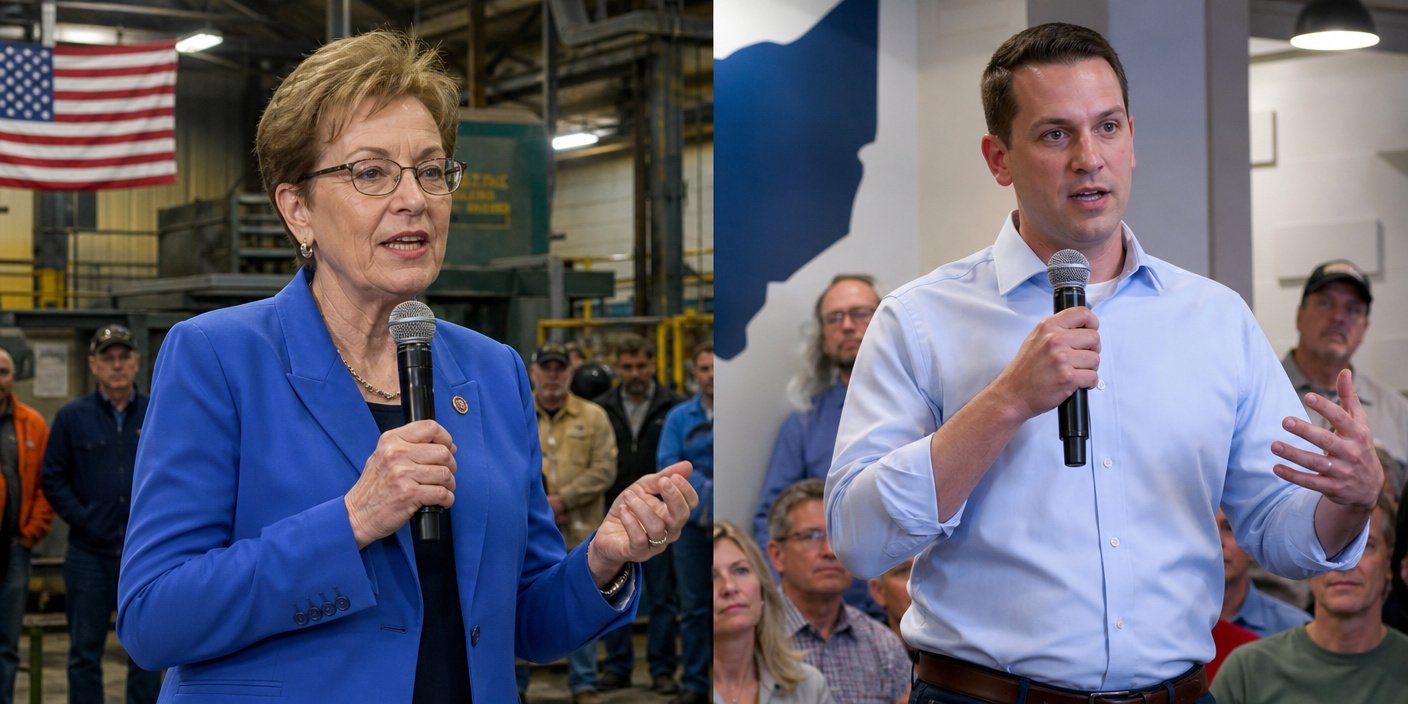
The political landscape of Ohio’s 9th Congressional District has become the ultimate litmus test for the 2024 election, drawing millions in national spending and intense scrutiny from party strategists in both Washington D.C. and Columbus. As the nation watches, this race stands as one of the most competitive contests in the country, embodying the broader struggle for control of the U.S. House of Representatives. With the district’s recent history of competitive margins and its bellwether status, the clash between incumbent Representative Marcy Kaptur and state representative Derek Merrin has evolved into a high-stakes referendum on economic policy, regional identity, and the future of the Rust Belt electorate.
The Redistricting Factor and the ‘Toss-Up’ Designation
To understand the intensity of this race, one must look at the structural changes that reshaped the map. Following the 2020 census and subsequent redistricting battles in Ohio, the 9th District underwent significant geographic realignment. Traditionally anchored in the industrial heart of Toledo, the district now encompasses more of the surrounding conservative-leaning suburbs and rural areas. This transformation altered the partisan lean of the district, moving it from a solid Democratic stronghold to a fiercely contested battlefield. National political handicappers, including The Cook Political Report and Sabato’s Crystal Ball, have repeatedly categorized the race as a “toss-up,” signaling that neither candidate holds a statistically significant lead as election day approaches. This classification triggers massive resource allocation from the DCCC and the NRCC, turning local airwaves into a deluge of attack ads and competing messaging strategies.
Candidate Profiles: Experience vs. The Populist Wave
Incumbent Marcy Kaptur, a fixture in Ohio politics for over four decades, is leveraging her unparalleled name recognition and seniority. First elected in 1982, Kaptur is currently the longest-serving woman in the history of the U.S. House. Her campaign strategy is anchored in a “Toledo-first” approach, emphasizing her ability to bring federal infrastructure dollars back to the region and her consistent focus on the manufacturing workforce. For Kaptur, the campaign is a defense of her legislative record, arguing that her experience is essential for navigating the complexities of congressional budget negotiations and constituent services.
Conversely, Derek Merrin represents the modern, populist wing of the Ohio Republican Party. A former member of the Ohio House of Representatives, Merrin has centered his campaign on contrasting his voting record with Kaptur’s long tenure, positioning himself as a change agent who aligns with the current party leadership. Merrin’s platform heavily focuses on economic inflation, energy independence, and border security—issues that Republican polling data indicates are top-of-mind for the district’s newly incorporated suburban voters. His ability to mobilize the base while peeling away voters concerned about the national economic trajectory is the linchpin of his strategy to flip the seat.
Key Issues Shaping the Electorate
While national issues like the economy, healthcare, and immigration dominate the dialogue, the 9th District is uniquely sensitive to industrial policy. The region’s reliance on manufacturing and the auto industry makes trade policy a recurring theme in the debate. Kaptur often points to her support for union-backed legislation and worker protections, while Merrin argues that Democratic-led economic policies have exacerbated inflation, specifically targeting the cost of living and fuel prices.
Furthermore, the issue of reproductive rights has introduced a complex layer to the campaign. Following the overturning of Roe v. Wade and the subsequent Ohio constitutional amendment regarding abortion access, the electorate is highly mobilized. Democratic operatives believe this issue is a key driver for voter turnout in urban centers like Toledo, potentially offsetting Republican gains in the rural outskirts of the district. The collision of these nationalized issues with the specific localized interests of the Great Lakes region ensures that neither candidate can afford to take a single precinct for granted.
The National Stakes: A Path to 218
Beyond the local dynamics, this race is inseparable from the broader fight for the House majority. With the margins for control currently razor-thin, every single seat like Ohio’s 9th takes on outsized importance. Strategists in Washington view this district as a “must-win” for those aiming to secure the speaker’s gavel. The heavy spending reflects this urgency, with independent expenditure groups pouring millions into media buys, digital targeting, and grassroots operations. This influx of capital has transformed the 9th District into a hyper-polarized environment, where the outcome will likely be decided by a narrow sliver of undecided, independent voters who are weighing the appeal of Kaptur’s institutional experience against Merrin’s vision for a legislative pivot.
Ultimately, the outcome of the race in Ohio’s 9th District will serve as a bellwether for the broader 2024 political landscape. It is not just about the representation of Toledo and its surrounding counties; it is about the fundamental direction of a nation grappling with economic shifts, partisan divides, and the search for leadership that resonates across the heartland. As election day draws near, the intensity of the campaigning is expected to reach a fever pitch, confirming this race’s position as one of the most critical contests in the nation.