
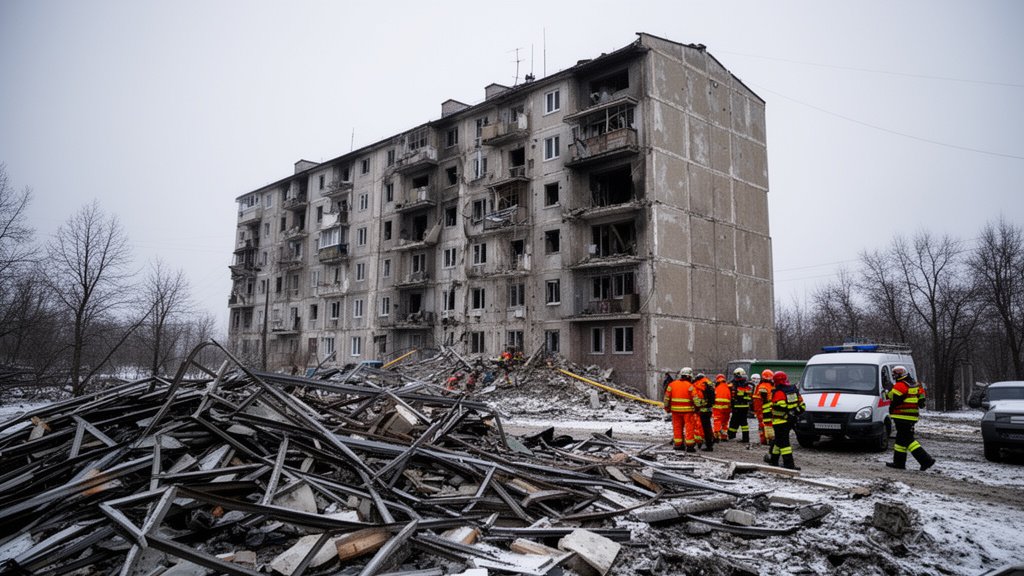
A devastating series of Russian aerial strikes across the Kyiv region has claimed the lives of at least 15 civilians, with a five-story residential building in the settlement of Dymer suffering a direct hit. The tragedy marks a grim escalation in Moscow’s intensified winter bombardment campaign, which continues to target critical infrastructure and population centers alike.
Key Highlights
- 15 fatalities confirmed following Russian strikes in the Kyiv region.
- A critical strike occurred on a five-story residential apartment block in Dymer.
- The attack underscores the intensifying nature of Russian winter bombardment strategies.
- Local authorities and emergency services have launched large-scale rescue operations amid freezing conditions.
The Escalating Conflict: Winter Strikes and the Siege of Kyiv Oblast
The recent bombardment of the Kyiv region represents a strategic shift in the ongoing conflict, as Russian forces increasingly utilize aerial assets to target the civilian infrastructure and population centers surrounding the Ukrainian capital. The strike on Dymer, a settlement located within the Vyshhorod Raion of the Kyiv Oblast, serves as a stark example of the vulnerability of residential areas to high-yield munitions. Reports from local officials confirm that the five-story residential building was effectively compromised, resulting in significant structural collapse and the loss of life among residents who were likely seeking shelter or navigating their daily routines.
This incident is not an isolated event but rather part of a broader pattern of escalation observed throughout the winter months. Military analysts note that the Russian Aerospace Forces have intensified their long-range missile and drone campaigns, aiming to stretch the operational capacity of the Ukrainian Air Defense systems. By oscillating between infrastructure-focused strikes—intended to destabilize the power grid and heating systems—and direct kinetic strikes on residential areas, Russian command is attempting to maximize psychological impact and physical attrition simultaneously.
The Strategic Impact of Winter Bombardment
Winter warfare introduces unique variables that complicate both offensive and defensive operations. For Ukraine, the immediate challenge is two-fold: the protection of critical energy facilities to prevent widespread blackouts and the defense of civilian residential zones. The strike in Dymer highlights the difficulty of achieving comprehensive air coverage across the expansive Kyiv Oblast. While the General Staff of the Armed Forces of Ukraine has bolstered defenses around key strategic nodes, the dispersed nature of Russian attack vectors—often utilizing a mix of loitering munitions and cruise missiles—creates persistent gaps.
These strikes serve a dual purpose. Tactically, they force the Ukrainian military to deploy precious interceptors to protect population centers, potentially diverting them from frontline defensive needs. Strategically, they aim to cultivate an atmosphere of pervasive uncertainty and fear, placing immense strain on the humanitarian response framework. The 15 casualties reported in this single event illustrate the high human cost of these tactics, reinforcing the reality that modern conflict in the region is increasingly defined by the destruction of the civilian-military boundary.
Humanitarian Consequences and Civil Resilience
The human impact of the Dymer incident extends beyond the immediate casualty count. For the residents of the Kyiv region, these strikes disrupt the fragile sense of normalcy that had been partially restored in the aftermath of earlier phases of the invasion. Emergency responders have been working under hazardous conditions, often clearing rubble in freezing temperatures while remaining at risk of secondary strikes. The psychological toll on the population is significant, as the repeated nature of these aerial alerts forces civilians into a state of constant, heightened vigilance.
Furthermore, the economic impact of such strikes is profound. When residential housing is destroyed, it creates a displacement crisis, necessitating emergency housing solutions and long-term reconstruction efforts that divert funds from other critical sectors. The local administration in the Vyshhorod Raion, along with regional authorities in Kyiv, must now manage the immediate relief efforts while simultaneously assessing the extent of damage to the surrounding infrastructure. This cycle of destruction and recovery is a defining feature of the current stage of the war, reflecting a brutal reality where civilian life is caught in the crossfire of strategic bombardment.
Future Predictions and Defense Adjustments
Looking ahead, it is highly probable that these winter strikes will continue as long as weather conditions permit, or until Ukraine receives significant upgrades in air defense capabilities. International partners have signaled a willingness to provide additional Patriot, NASAMS, and IRIS-T systems, yet the deployment and integration of these complex technologies take time. Until these defenses are fully operational, the Kyiv region remains a high-priority target.
Analysts predict that the coming weeks may see an even higher density of drone strikes as Moscow attempts to exhaust Ukrainian ammunition reserves. The success of Ukrainian defense efforts will depend heavily on the rapid replenishment of interceptor missiles and the continued efficacy of mobile air defense groups tasked with hunting low-altitude cruise missiles. Ultimately, the resilience of the local population and the efficiency of the emergency services will remain the final line of defense against the ongoing aerial campaign.
FAQ: People Also Ask
Q: What is the current casualty count from the Dymer strike?
A: Official reports confirm that at least 15 people have been killed as a direct result of the Russian aerial strike on the five-story residential building in Dymer.
Q: Why is the Kyiv region being targeted so heavily?
A: The Kyiv region is a strategic center of government, logistics, and population. Targeting this area is aimed at disrupting infrastructure, testing air defenses, and exerting psychological pressure on the Ukrainian leadership and public.
Q: What weapons are typically used in these winter bombardment campaigns?
A: The campaigns frequently employ a combination of long-range cruise missiles, ballistic missiles, and ‘kamikaze’ loitering munitions (such as the Shahed-series drones) to overwhelm defensive systems.
Q: How are local authorities responding to the residential destruction?
A: Local emergency services, including the State Emergency Service of Ukraine, are engaged in continuous search and rescue operations, debris removal, and providing emergency medical and psychological support to the affected civilians.