The passing of Yayoi Kusama, the avant-garde matriarch of the polka-dot and the world’s most successful living artist prior to this transition, marks a seismic shift for the global art market. For decades, the Japanese icon navigated the intersection of obsession and commercial success, transforming her hallucinations into a multi-million-dollar empire. As collectors and institutions now grapple with the transition from living legend to historical giant, the finite nature of her output invites immediate speculation on asset appreciation, provenance, and the sustained demand for her iconic “Infinity Mirror Rooms.”
Key Highlights
- Market Peak: Kusama’s auction market performance consistently outperformed projections, with total sales frequently exceeding $200 million annually in peak years.
- Scarcity Premium: The limitation on the production of her large-scale, immersive installations is expected to drive exponential demand among private foundations and international museums.
- Institutional Canonization: Analysts anticipate a shift toward “Blue Chip” consolidation, where secondary market values stabilize as speculation gives way to historical preservation.
The Economics of the Infinite: Asset Volatility and Scarcity
The immediate aftermath of Yayoi Kusama’s passing has triggered a flurry of activity across major auction houses like Sotheby’s and Christie’s. Unlike artists whose market value plummeted post-mortem due to over-saturation, Kusama’s market is characterized by a carefully curated supply. Her long-standing representation by blue-chip galleries such as David Zwirner and Victoria Miro has historically acted as a stabilizer, preventing the market flooding that often destroys the value of high-output contemporary artists.
The “Infinity” Premium
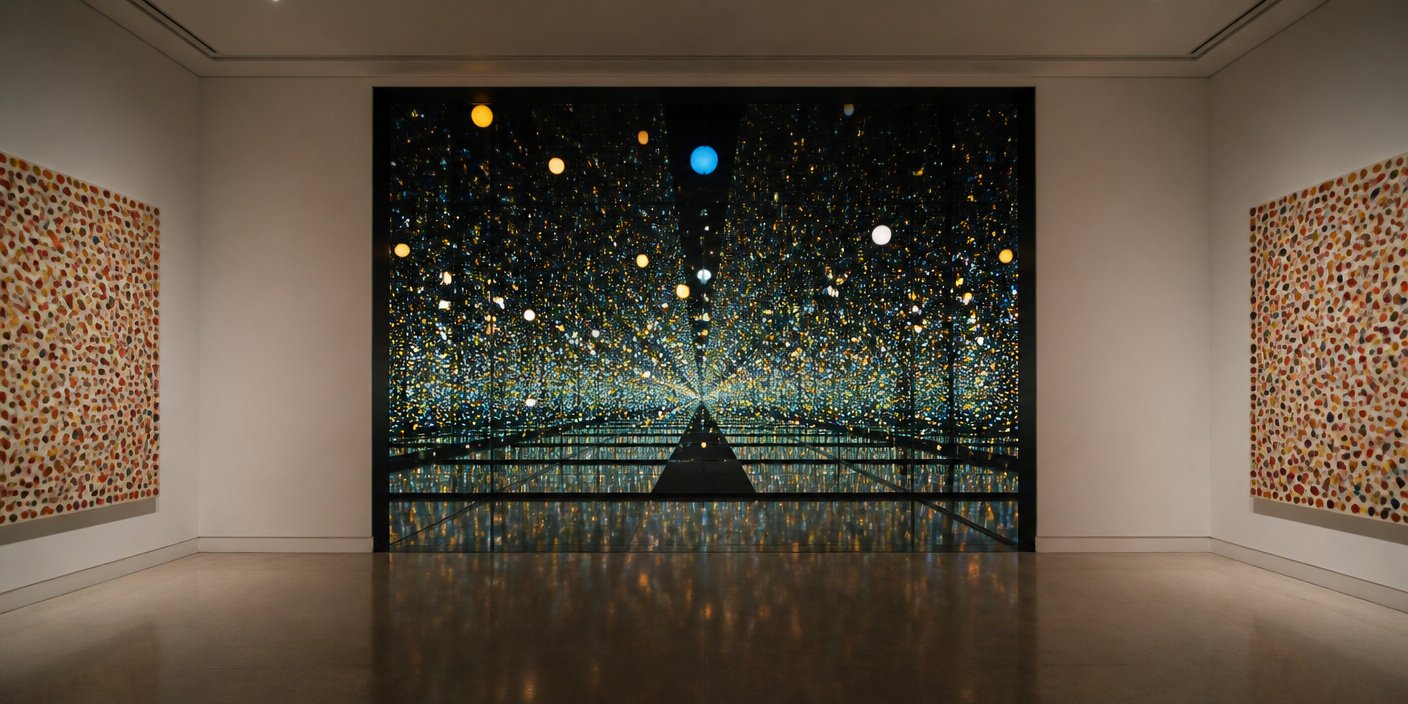
At the heart of the valuation discourse are her “Infinity Mirror Rooms.” These immersive environments, which defined her late-career renaissance, represent the pinnacle of her market value. Private collectors are already maneuvering to secure these installations, knowing that the primary market is now permanently closed. Market analysts estimate that the scarcity of these works will trigger a 20-30% appreciation in secondary market valuations over the next 24 months. The transition from a living artist, who could theoretically authorize a new installation, to an estate-managed legacy effectively locks the supply, turning existing works into finite assets.
The Institutional Arms Race
While private collectors seek to hold, the most significant movement will likely come from public institutions. Museums that previously hesitated to acquire large-scale Kusama works due to acquisition costs are now facing a “now or never” realization. The legacy of her work—spanning from her 1960s New York avant-garde beginnings to her modern-day global ubiquity—is being cemented in real-time. Expect a surge in museum acquisitions, which will further restrict supply and drive prices higher for the works that remain in the hands of private speculators.
Authentication and the Foundation’s Role
As is common with high-value estates, the management of the artist’s brand and the authentication of works will become a primary market driver. The oversight provided by her estate will be the gatekeeper of value. Investors are currently paying close attention to how the estate manages the release of remaining inventory. If the foundation chooses to release works slowly, it will signal confidence; if they flood the market, it could destabilize the “Blue Chip” pricing tier that she worked so hard to establish.
FAQ: People Also Ask
Q: Will Kusama’s market value drop now that she has passed?
A: Historically, for top-tier “Blue Chip” artists, values do not drop; they stabilize and often increase. Because her estate and primary galleries have tightly controlled her output, there is no risk of a market crash due to over-saturation.
Q: Are her smaller works, like the pumpkin paintings, still a good investment?
A: Her iconic pumpkin motifs remain high-liquidity assets. While less rare than her large installations, they serve as the entry point for most collectors and are expected to maintain steady growth.
Q: How do galleries like David Zwirner influence the post-mortem market?
A: These galleries act as market stabilizers. By controlling provenance and authentication, they prevent the market from being flooded with fakes or excessive inventory, ensuring long-term price stability.
Q: Is it harder to acquire a Kusama work now?
A: Significantly. With the primary market for new works effectively ended, demand will shift entirely to the secondary market, likely leading to more competitive bidding at auction houses.