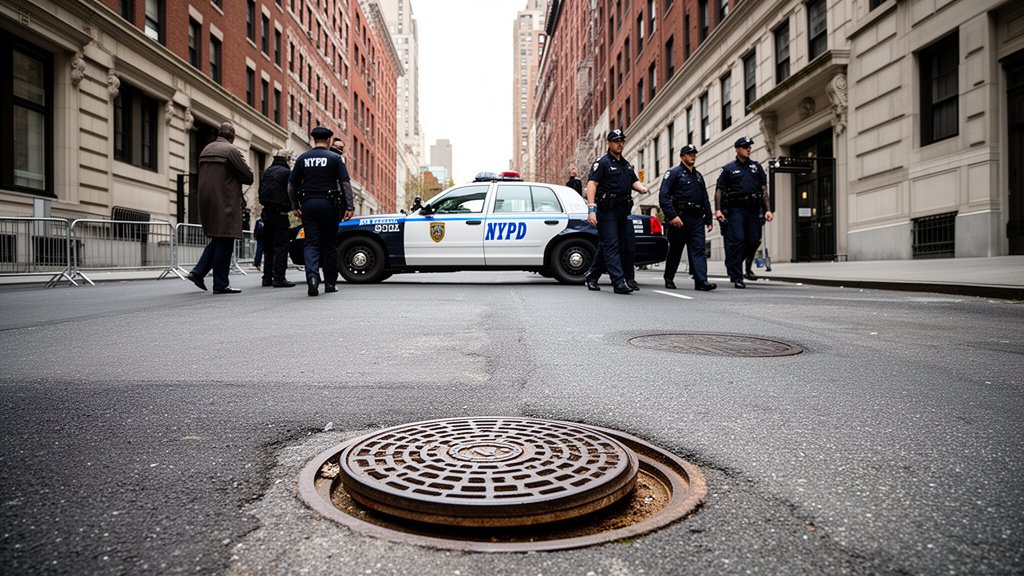
Security protocols were pushed to the brink in New York City this September during the United Nations General Assembly (UNGA), as a bizarre and unnerving incident occurred just blocks from where Israeli Prime Minister Benjamin Netanyahu was staying. The NYPD was forced to launch a rapid, high-stakes security sweep after reports emerged of three unidentified individuals exiting a manhole on the Upper East Side. While local authorities have since downplayed the incident as a potential security breach, the event underscored the extreme fragility of protecting high-profile world leaders within the dense, labyrinthine infrastructure of Manhattan.
Key Highlights
- Incident Context: The event occurred in late September 2024 on the Upper East Side, in close proximity to the Loews Regency Hotel, which was serving as the base for Prime Minister Netanyahu’s delegation.
- The Security Response: NYPD officers and specialized anti-terrorism units initiated immediate sweeps of the surrounding infrastructure, including subterranean utility passages, following witness reports of three men emerging from a manhole.
- Official Status: NYPD officials have publicly characterized the incident as non-threatening, likely involving utility or maintenance workers, though the timing—coinciding with the heightened security state of the UNGA—rendered it a significant cause for concern.
- Heightened Awareness: The incident serves as a stark reminder of the security “theater” and genuine vulnerabilities present when hosting global dignitaries in an urban center like New York.
Subterranean Anxiety: The Reality of Urban Protection
The incident on the Upper East Side represents a specific archetype of security fear: the infiltration of the “unseen” layer of the city. Manhattan is built upon a sprawling, complex network of steam pipes, fiber-optic lines, electrical conduits, and sewage systems. To the average pedestrian, a manhole cover is a trivial piece of urban furniture. To the New York Police Department (NYPD) and the United States Secret Service, which provided protective detail for Prime Minister Netanyahu, these covers represent potential vectors for tactical insertion, surveillance, or sabotage.
The Timeline of the September Breach
During the UN General Assembly, the security posture in Midtown and the Upper East Side is elevated to the highest level, often classified as a ‘Level A’ event. When the report surfaced regarding the three individuals, the reaction was instantaneous. NYPD officers, already on high alert due to the geopolitical tensions surrounding the Israeli delegation, treated the report with maximum seriousness. The immediate concern was whether the individuals were utility workers who had bypassed the rigorous vetting process required for access to secure zones, or if they were bad actors exploiting the city’s infrastructure.
The swift mobilization of police teams to seal the area and investigate the individuals highlights the “Zero Trust” model currently employed by federal and local law enforcement. In the hours following the discovery, authorities cross-referenced the individuals against legitimate utility work orders. The official downplaying of the incident suggests that while the men were likely legitimate, the lack of transparency or coordination with local beat cops created an unnecessary spike in stress for the security detail.
The Infrastructure Paradox
One of the most persistent secondary angles of this story involves the vulnerability of New York City’s infrastructure to high-profile security needs. Protecting a head of state is not merely about physical barriers at street level; it involves securing the ground beneath the streets. The city’s underground utility networks are operated by a disjointed array of private contractors, city agencies, and municipal departments.
This fragmentation creates a major security blind spot. When a foreign leader is in town, security protocols often dictate that all non-essential utility work must be paused in a multi-block radius. The fact that three individuals were able to emerge from a manhole suggests a breakdown in communication between the logistical agencies and the security detail. It raises the question: In an era of heightened global terror threats, can a city as porous as New York truly secure itself, or is it always one miscommunicated work order away from a false-positive security crisis?
Security Theater vs. Genuine Threat
Perhaps the most significant aspect of this event is the psychological toll it takes on both the public and the protective services. The “Security Theater”—the visible, heavy-handed presence of police—is designed to deter threats. However, when incidents like the ‘Mystery Men’ appear, it highlights the limitations of this theater. The public narrative immediately jumps to terrorism, while the law enforcement narrative attempts to maintain calm.
This gap in communication is intentional. During the UNGA, maintaining an atmosphere of controlled stability is critical to diplomatic efficacy. However, as global conflicts become more polarized, the threshold for what constitutes a ‘credible threat’ has lowered. Future predictions for urban protection involve the integration of smart-infrastructure monitoring—using sensors and AI to track access to subterranean systems in real-time, removing the human element that allows for these unnerving, if ultimately harmless, misunderstandings.
FAQ: People Also Ask
1. Was the Prime Minister ever in danger during the manhole incident?
No. The NYPD confirmed that there was no credible threat to Prime Minister Netanyahu. The incident was treated as a security anomaly rather than an attempted breach.
2. Why do utility workers need to access manholes during UNGA?
Critical infrastructure maintenance cannot be paused indefinitely, even during high-security events. However, strict protocols are supposed to govern access. The investigation centered on whether these specific individuals had followed those protocols.
3. Is there a history of security breaches involving NYC manholes?
While direct security breaches are rare, the NYC underground is frequently monitored by federal agencies as part of standard counter-terrorism assessments, given the city’s dense and interconnected subterranean network.
4. What is the standard security protocol for an UNGA visitor like Netanyahu?
Standard protection for a visiting Head of State involves a ‘hardened’ perimeter, aerial surveillance, bomb-sniffing sweeps of the surrounding infrastructure, and constant liaison between the Secret Service and the NYPD’s Counterterrorism Bureau.