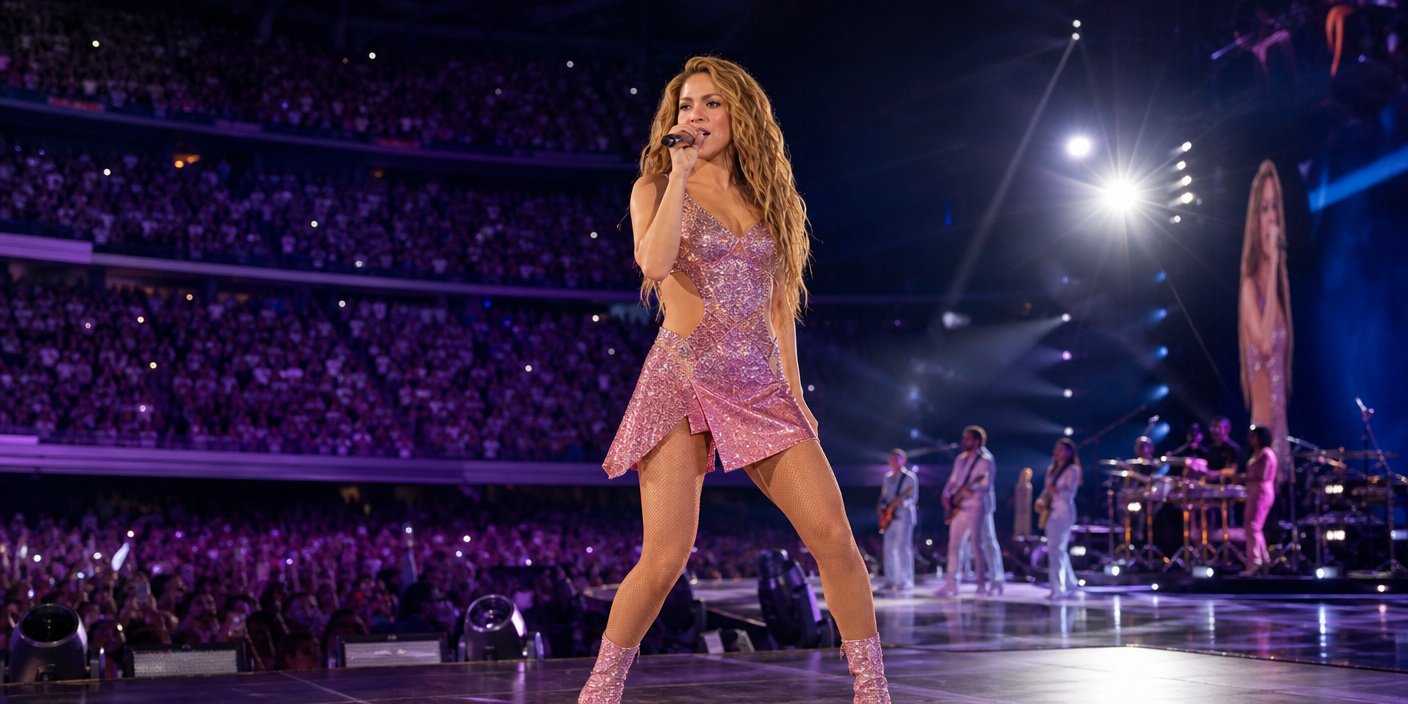
Shakira has cemented her status as a global touring juggernaut, officially crossing the $500 million threshold in total tour revenue. This monumental financial achievement, bolstered by a historic 13-show residency in Madrid, serves as a testament to her enduring influence and the explosive demand for Latin music on the global stage. By balancing massive stadium scale with intimate, city-specific residencies, the Colombian superstar has rewritten the playbook for how top-tier artists engage with their audience while maximizing economic impact.
Key Highlights
- $500 Million Milestone: Shakira’s career touring revenue has officially eclipsed the $500 million mark, solidifying her position among the highest-grossing touring acts in music history.
- 13-Show Madrid Residency: A record-shattering 13 consecutive sold-out shows in Madrid have created a cultural phenomenon, drawing fans from across Europe and the Americas.
- Economic and Cultural Shift: This tour represents more than just ticket sales; it highlights a major pivot in the live entertainment industry toward long-term residencies in key cultural hubs.
The Golden Standard: How Shakira Redefined Global Touring
The music industry is currently witnessing a paradigm shift, and at the center of this transformation is Shakira. Crossing the $500 million mark in touring revenue is not merely a financial statistic; it is a clear indicator of the massive, untapped market potential for Latin American artists on a global scale.
Beyond the Numbers: The $500M Milestone
To understand the significance of the $500 million figure, one must consider the trajectory of Shakira’s career. From her breakout in the 1990s to her modern dominance, her touring capacity has grown exponentially. The current revenue surge is attributed to a sophisticated blend of massive stadium dates and strategic residencies. Financial analysts in the entertainment sector note that the $500 million milestone places Shakira in an elite tier of performers. This revenue is driven not just by ticket sales, but by a high-conversion merch strategy and premium VIP experience tiers that fans are increasingly willing to pay for.
Unlike traditional tours that rely on a ‘one-night-per-city’ model, Shakira’s approach has been to plant roots. By spending extended time in key markets, the operational overhead decreases while the fan experience increases. This creates a feedback loop: the longer she stays, the more the ‘event’ status of the residency grows, driving up secondary market value and global media attention.
The Madrid Mastery: 13 Nights of History
Perhaps the most audacious move of the recent cycle has been the 13-show residency in Madrid. Securing a venue of that magnitude for 13 consecutive dates is a logistical and commercial feat that few artists—regardless of genre—can execute. The demand for these tickets was unprecedented, with sell-out status achieved almost instantly for each show.
This residency was more than a series of concerts; it was a cultural takeover of the city. Local Madrid hospitality, tourism, and retail sectors saw a measurable spike during the run of the shows. For fans, these 13 nights became a pilgrimage, with thousands flying in from Latin America and other European countries, effectively turning the Madrid engagement into an international tourist destination event. This underscores a shift in how concert-goers prioritize their spending, favoring travel-worthy, ‘once-in-a-lifetime’ musical events over local, smaller-scale gigs.
Cultural Resonance and Economic Impact
Shakira’s recent tour success serves as a lens through which we can view the broader ‘Latin Explosion 2.0.’ The normalization of Spanish-language music in mainstream global charts has paved the way for these staggering revenue numbers. However, Shakira has done more than just ride the wave; she has acted as the vanguard, ensuring that the economic power of Latin music is respected by promoters, venue owners, and corporate sponsors globally.
Furthermore, the tour’s success has had significant implications for the infrastructure of live music. Venues are now looking to emulate the Madrid model, prioritizing artists who can sustain a ‘residency’ footprint over those who only pass through for a single evening. This provides stability for venues and creates a more cohesive marketing narrative for the artists involved. Shakira has proven that when you combine a deep catalog of hits with a high-production-value show, the ceiling for success is significantly higher than previously estimated.
As we look to the future, the $500 million milestone is likely just a waypoint. With the integration of high-end technology, immersive stage design, and a global fanbase that continues to expand, Shakira’s ability to generate revenue is only matched by her capacity to influence the culture of live entertainment. Whether it is through her charitable foundations or her savvy business partnerships, she continues to demonstrate that artistic integrity and commercial dominance are not mutually exclusive—they are, in her case, inextricably linked.
FAQ: People Also Ask
Q: How does the $500M revenue figure compare to other major touring acts?
A: The $500M figure places Shakira in the upper echelon of global touring artists. While historical charts are often dominated by legacy rock acts, her consistent performance and ability to sell out residencies allow her to compete directly with the highest-earning pop icons of the modern era.
Q: Why was the Madrid residency significant for her career?
A: The 13-show Madrid residency was significant because it proved the viability of a ‘residency’ model in Europe for a pop star of her caliber. It consolidated her fan base, created a ‘must-attend’ media moment, and demonstrated massive operational efficiency compared to traditional touring.
Q: What is the main driver behind the recent spike in her tour revenue?
A: The primary drivers are high-demand ticket pricing, massive global reach following her recent successful album releases, and a strategic shift toward extended, high-occupancy residencies in major global capitals, which reduces logistical overhead while maximizing fan engagement.