
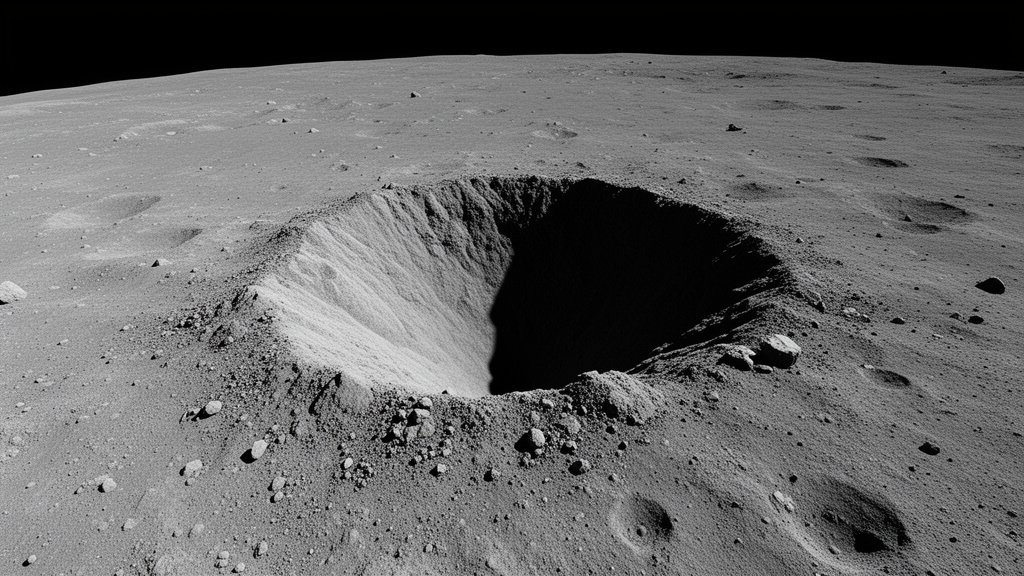
A massive four-ton fragment from a SpaceX Falcon 9 rocket plummeted into the lunar surface on August 5, 2026, traveling at 5,400 mph and carving out a new, 60-foot-wide crater, reigniting global debate over orbital debris management. The collision, which occurred on the far side of the Moon, serves as a high-velocity wake-up call for agencies monitoring the growing density of human-made objects in deep-space transit orbits.
Key Highlights
- Impact Event: On August 5, 2026, a four-ton SpaceX Falcon 9 second-stage fragment made violent contact with the lunar regolith.
- Velocity: The object struck the lunar surface at a staggering 5,400 mph.
- Damage Assessment: The collision resulted in a distinct new crater measuring 60 feet in diameter and 12 feet in depth.
- Scientific Implications: The impact provides new data on lunar soil density and the long-term consequences of uncontrolled deep-space trajectories.
The Mechanics of the Lunar Impact: An Orbital Autopsy
The incident on August 5, 2026, was not merely a random accident; it was the culmination of orbital dynamics that have remained largely under-regulated since the beginning of the commercial space age. The fragment in question, a remnant of a SpaceX Falcon 9 second stage, had been in a high-eccentricity orbit for years, slowly being nudged by the gravitational perturbations of the Earth, Sun, and Moon. While space debris in Low Earth Orbit (LEO) is meticulously tracked by the U.S. Space Command and other international agencies, objects in ‘cislunar’ space—the region between Earth and the Moon—remain significantly harder to monitor.
The Physics of a 5,400 MPH Collision
When a four-ton object impacts the Moon at 5,400 mph, the energy release is equivalent to several tons of TNT. Unlike the atmosphere of Earth, which would incinerate smaller debris, the Moon possesses no such protective shield. Consequently, the kinetic energy of the SpaceX fragment was transferred entirely to the lunar surface. The resulting crater, measured at 60 feet across and 12 feet deep, offers geologists and planetary scientists a unique opportunity to study the sub-surface composition of the Moon.
However, this scientific opportunity is overshadowed by the operational failure. The object, an un-deorbited second stage, essentially became a rogue projectile. Analysts point out that at these velocities, even relatively small masses can cause significant disruption, potentially damaging future lunar base sites or sensitive instrumentation placed by international space agencies.
Regulatory Gaps and The ‘Wild West’ of Cislunar Space
For years, space lawyers and orbital mechanics experts have warned about the ‘Cislunar Traffic’ problem. Current international frameworks, such as the Outer Space Treaty of 1967, are largely silent on the disposal of rocket stages in deep space. While the United Nations Office for Outer Space Affairs (UNOOSA) encourages best practices for space sustainability, these are non-binding guidelines.
This incident highlights a critical flaw in current commercial space operations: the assumption that deep space is an infinite dumping ground. As SpaceX continues to increase the cadence of its launches, the statistical probability of these ‘dead’ stages colliding with celestial bodies rises. The lack of active removal missions for deep-space debris means that we are effectively ‘littering’ the Moon’s orbital path.
Future Consequences for Artemis and Lunar Missions
NASA’s Artemis program and various international lunar exploration initiatives depend on the safety of the lunar environment. An uncontrolled debris field, or even random high-speed impacts, creates a hazard for future human outposts. If we cannot predict when or where a four-ton booster will impact, how can we guarantee the safety of astronauts or autonomous rover missions? This event serves as a concrete data point for advocates calling for mandatory deorbiting or ‘parking’ protocols for all stages launched into high-energy trajectories.
Furthermore, this impact provides a baseline for understanding the ‘background noise’ of human exploration. If we continue to strike the Moon with our own hardware, we are effectively modifying the very environment we are trying to study, potentially contaminating seismic and geological data with artificial impact signatures. The scientific community is now calling for a new registry of deep-space hardware to ensure that future mission planners can calculate the trajectory of spent stages with higher precision.
FAQ: People Also Ask
1. Was the collision intentional?
No. The collision was a result of an uncontrolled orbital decay of a discarded SpaceX Falcon 9 second stage. It was not a planned maneuver or a scientific experiment.
2. Is this the first time a rocket has hit the Moon?
No, but it is one of the most significant and well-documented recent events. Previous missions, such as the Apollo program’s S-IVB stages, were intentionally crashed into the Moon to create seismic signals for study, but uncontrolled impacts by commercial debris are a growing concern.
3. Will this affect future SpaceX launches?
SpaceX has not announced a change to their mission profile based on this specific event, but it has certainly intensified pressure from regulatory bodies like the FAA and international space organizations to improve disposal protocols for upper-stage rockets.
4. How do scientists know the crater was caused by this specific fragment?
Orbital tracking data leading up to the impact allowed researchers to triangulate the trajectory of the fragment. By matching the predicted arrival time and location with the actual detection of the impact flash and subsequent visual confirmation of the crater size, scientists confirmed the source.