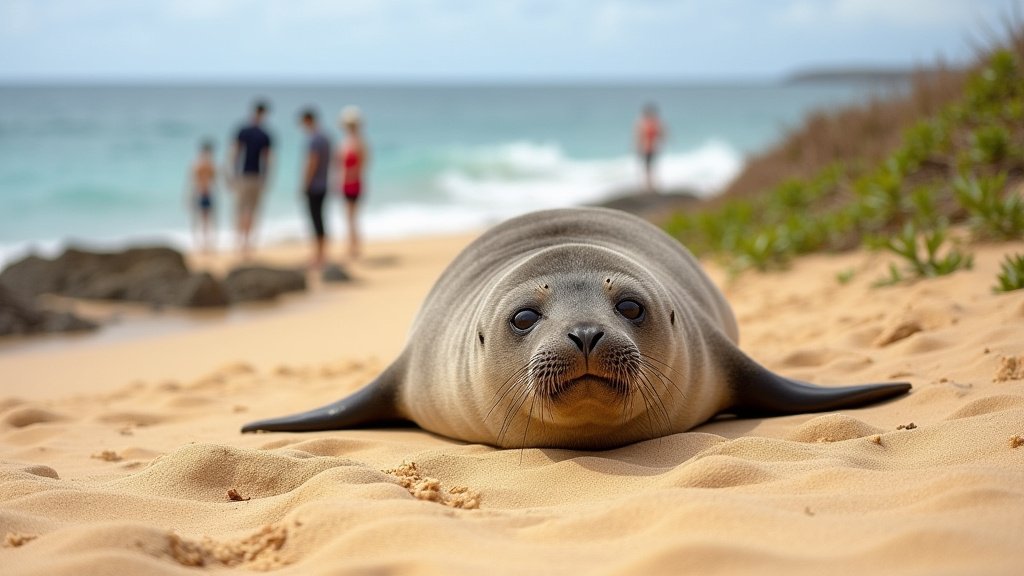
The appearance of a Hawaiian monk seal on the shores of Molokaʻi—an event that quickly permeated social media channels and local conversation—has served as an unlikely bridge between polarized groups. For years, the island of Molokaʻi has maintained a complex, often fraught relationship with federal conservation mandates, particularly those concerning the Endangered Species Act (ESA). However, this viral moment has evolved beyond a simple social media trend, becoming a catalyst for a sophisticated dialogue regarding subsistence fishing, cultural responsibility, and the recovery of one of the world’s most endangered marine mammals.
The Historical Friction of Federal Protection
To understand the magnitude of this shift, one must acknowledge the historical tension on Molokaʻi. The Hawaiian monk seal, or ʻīlio holo i ka uaua (dog that runs in rough water), is a critically endangered species protected under the Endangered Species Act and the Marine Mammal Protection Act. For decades, many Molokaʻi residents, who rely heavily on subsistence fishing and maintain deep-rooted cultural practices, viewed federal intervention as an encroachment on their way of life. Enforcement protocols from the National Oceanic and Atmospheric Administration (NOAA) Fisheries and the Hawaii Department of Land and Natural Resources (DLNR) were often perceived as prioritizing external regulatory mandates over the local kuleana (responsibility) that residents feel toward their ocean resources.
Historically, sightings of monk seals were met with suspicion. In some instances, the presence of these animals was viewed as a precursor to government-imposed fishing restrictions, creating an adversarial dynamic between local fishermen and federal biologists. The friction was not necessarily about the seals themselves, but about the lack of communication and the top-down management style that frequently sidelined local voices.
A Viral Catalyst for Dialogue
The recent viral phenomenon began when a specific pup—widely shared across Facebook and local community forums—drew widespread attention for its proximity to residential fishing grounds. Rather than the immediate defensive reaction seen in past years, the community’s response was markedly different. Residents began documenting the seal’s behavior, sharing photos, and discussing its role in the ecosystem. This shift from suspicion to observation provided a vital opening for dialogue.
“The viral nature of this event forced a conversation that wasn’t happening in boardrooms,” noted one local community organizer who works with the Molokaʻi fishing collective. By placing the animal in the context of the community’s own digital space, the seal ceased to be a ‘federal agent’ and became a neighbor. This transition allowed for unprecedented information exchange. Biologists were invited into community spaces not as regulators, but as partners to explain the biology of the animal, its habits, and, crucially, how fishermen could continue their work without infringing on the animal’s space.
Kuleana: The Shift Toward Community Stewardship
Central to this cultural shift is the concept of Kuleana. On Molokaʻi, this term represents more than just responsibility; it is an active, reciprocal relationship with the environment. Environmentalists and community leaders have begun to frame monk seal protection not as a federal law to be obeyed, but as a local duty to be honored. This re-framing has effectively reduced the ‘us versus them’ mentality that previously dominated discussions.
Data from the state’s monk seal monitoring programs indicates that in regions where community-led conservation (often called ʻāina-based management) is prioritized, seal mortality decreases and public support increases. The Molokaʻi experience is now being studied as a blueprint for other islands. By empowering local residents to act as the primary stewards—using their own cultural knowledge to monitor the animals—the federal government has managed to foster a level of cooperation that was previously unthinkable.
Sustaining the Future: Subsistence and Species
The long-term impact of this shift remains to be seen, but the economic and cultural implications are profound. If the community can demonstrate that they can coexist with the monk seal, it reduces the necessity for heavy-handed enforcement measures. This ‘co-existence model’ is essential for the future of subsistence fishing. It ensures that the island’s marine resources remain healthy enough to support both the seals, which prey on octopuses and reef fish, and the people who rely on those same waters for their tables.
Looking ahead, the collaboration between NOAA, the DLNR, and Molokaʻi’s community councils will likely pivot toward education. There are plans to develop specific training modules for local youth, turning the once-controversial monk seal into a symbol of pride. As the population of these seals slowly increases, the ability of local communities to adapt and integrate these animals into the social fabric will be the defining factor in their survival. On Molokaʻi, the conversation has moved from ‘why are they here?’ to ‘how do we care for them together?,’ marking a historic turning point in Pacific conservation.
FAQ: People Also Ask
Q: Why was the relationship between Molokaʻi residents and Hawaiian monk seals historically strained?
A: The tension stemmed from the strict regulations imposed by the Endangered Species Act. Residents feared that the presence of endangered monk seals would lead to federal closures of prime subsistence fishing grounds, which are vital to the island’s food security and cultural heritage.
Q: What is the significance of the term ‘Kuleana’ in this context?
A: Kuleana is a Hawaiian value meaning personal and collective responsibility. In this context, it has been used to shift the conversation from federal ‘regulation’ to local ‘stewardship,’ empowering residents to protect the seal as part of their inherent duty to care for the land and sea.
Q: How does the seal’s presence impact local fishing?
A: While monk seals are predators that eat fish and octopus, scientific consensus suggests they play a natural role in the ecosystem. The current ‘co-existence’ model focuses on sharing these resources and minimizing human-seal interactions, ensuring that subsistence fishing can continue alongside conservation efforts.
Q: Is the Hawaiian monk seal population recovering?
A: Yes, with intensive conservation efforts, the population has shown a slow but steady increase, rising above 1,600 individuals. However, they remain critically endangered, making local cooperation on islands like Molokaʻi essential for their long-term survival.