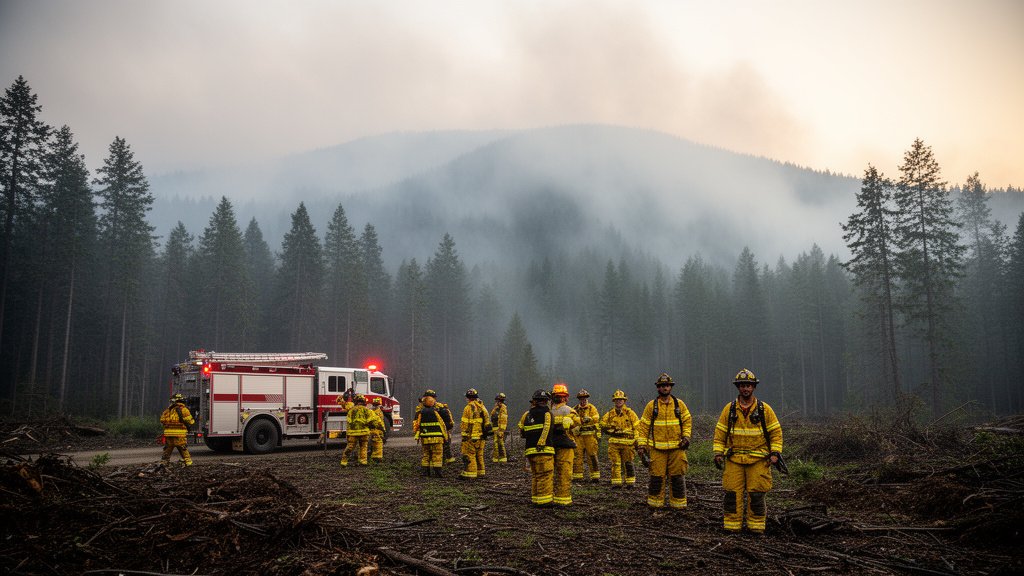
The situation in Summerland, B.C., remains critical as of August 12, with regional authorities confirming that evacuation orders for the Bald Range fire will persist. The combination of sustained, challenging weather patterns and ongoing operational risks has necessitated a cautious approach to the evacuation zone. Emergency crews are contending with a volatile environment where the fire continues to resist suppression efforts, forcing officials to maintain stringent access controls to ensure public safety.
Current Status of the Bald Range Fire
The persistence of the evacuation orders is not a precautionary measure taken lightly; it is a direct response to the current state of the Bald Range fire. Regional officials have indicated that despite the round-the-clock efforts of ground crews and aerial support, the blaze remains active. The primary driver of this stubborn containment status is the persistence of hot and dry conditions that have characterized the region throughout this period.
When a fire exhibits such behavior, it implies that the fuel load—the dried timber, underbrush, and debris—is primed for combustion. Even with containment lines established, the fire retains the potential for rapid advancement should winds shift or if the humidity levels drop further. Consequently, the evacuation zone remains a “no-go” area for the general public, as the terrain is unpredictable and the threat of flare-ups remains a high-probability event.
The Impact of ‘Poor Overnight Recovery’
One of the most technical and critical factors mentioned by officials regarding the Bald Range fire is the concept of “poor overnight recovery.” To the layperson, this term may be unfamiliar, but for wildfire management, it is a crucial indicator of fire behavior.
Under normal circumstances, overnight temperatures drop and humidity levels rise, allowing firefighters to regain control of the perimeter. This phenomenon, known as overnight recovery, essentially “cools” the fire, dampening the fuel and slowing the rate of spread. However, in the case of the Bald Range fire, this recovery has been insufficient. The air remains dry and warm even during the nighttime hours, meaning the fire does not get the break it needs. Instead of cooling down, the fire remains active and aggressive throughout the night, continuously consuming fuel and preventing crews from making significant headway in containment. This specific meteorological stagnation is why the evacuation orders remain in place: there is simply no “downtime” for the fire.
Triage and the Logistics of Utility Access
While evacuation orders generally mean a total exclusion zone for the public, the reality of modern infrastructure management complicates this. The Bald Range region contains vital utility infrastructure, including power lines and distribution networks that are essential for the broader Okanagan region.
Officials have confirmed that they are implementing a rigorous triage system for access permits. This is not a matter of simply granting permission to enter; it is a highly controlled logistical operation. Utility companies requiring access to inspect, repair, or maintain critical lines must undergo a strict vetting process. This involves verifying that the work is absolutely essential—such as preventing further outages or addressing immediate fire risks to infrastructure—and coordinating closely with fire incident commanders. These teams often have to be escorted by safety officers, and their window of operation is dictated by the current fire behavior. If the fire flares up, all utility access is immediately revoked to ensure the safety of the workers, highlighting the precarious nature of operating in an active fire zone.
Secondary Angle: The Nexus of Infrastructure and Climate
The ongoing situation in Summerland underscores a growing secondary concern: the vulnerability of critical infrastructure to the increasing frequency of “megafires.” Historically, utility grids were built with the assumption of manageable forest fire risks. Today, as fire behavior becomes more extreme and less predictable, the physical hardware—poles, transformers, and lines—is increasingly in the line of fire. This necessitates a shift in how utility companies and municipal governments collaborate, moving toward a “co-management” model where fire suppression strategies are integrated with infrastructure resilience planning.
Secondary Angle: The Meteorological Shift
Another layer to this story is the broader pattern of atmospheric “stagnation” over British Columbia. Meteorologists have noted that the atmospheric conditions causing the poor overnight recovery in Summerland are not isolated. They are part of a larger, regional weather pattern that limits the dispersion of smoke and prevents the cooling cycles that B.C. forests typically rely on. Understanding these macro-weather patterns is essential for residents to grasp why evacuation timelines are fluid and why “contained” does not mean “safe.”
Secondary Angle: The Economic and Psychological Toll
Finally, we must consider the cumulative impact on the Summerland community. Evacuation orders are not merely logistical inconveniences; they are major stressors. The uncertainty regarding when it is safe to return creates a psychological strain on residents who are worried about their property, pets, and livelihood. Furthermore, the local economy suffers as businesses in the perimeter are forced to shutter, and regional tourism, a backbone of the Okanagan summer, is severely hampered. Recognizing this toll is vital for policymakers when deciding how to distribute aid and communicate updates to the affected populations.
FAQ: People Also Ask
Why are evacuation orders still in place for the Bald Range fire?
Evacuation orders are maintained because the Bald Range fire remains active due to persistent hot and dry conditions and poor overnight recovery. These factors prevent the fire from “cooling down” at night, keeping it aggressive and unpredictable, which poses a direct safety risk to residents.
What does ‘poor overnight recovery’ mean in firefighting?
It refers to a lack of humidity increase and temperature drop at night. Normally, humidity rises at night, which helps dampen fuels and slow fire growth. Poor recovery means the fire continues to burn with high intensity throughout the night, leaving no window for crews to make safe, major containment gains.
How is utility access handled during a wildfire evacuation?
Access is strictly triaged. Only personnel performing essential work are considered. This involves a vetting process where the utility company must prove the work is critical, and crews are often escorted by fire safety officers to ensure they can be evacuated instantly if the fire behavior changes.
Is the Bald Range fire under control?
Officials have not declared it under control; they are managing it within a “triage” framework. The primary goal remains containment, but current weather conditions are actively hindering these efforts, meaning residents must strictly follow local government directives regarding evacuation zones.