
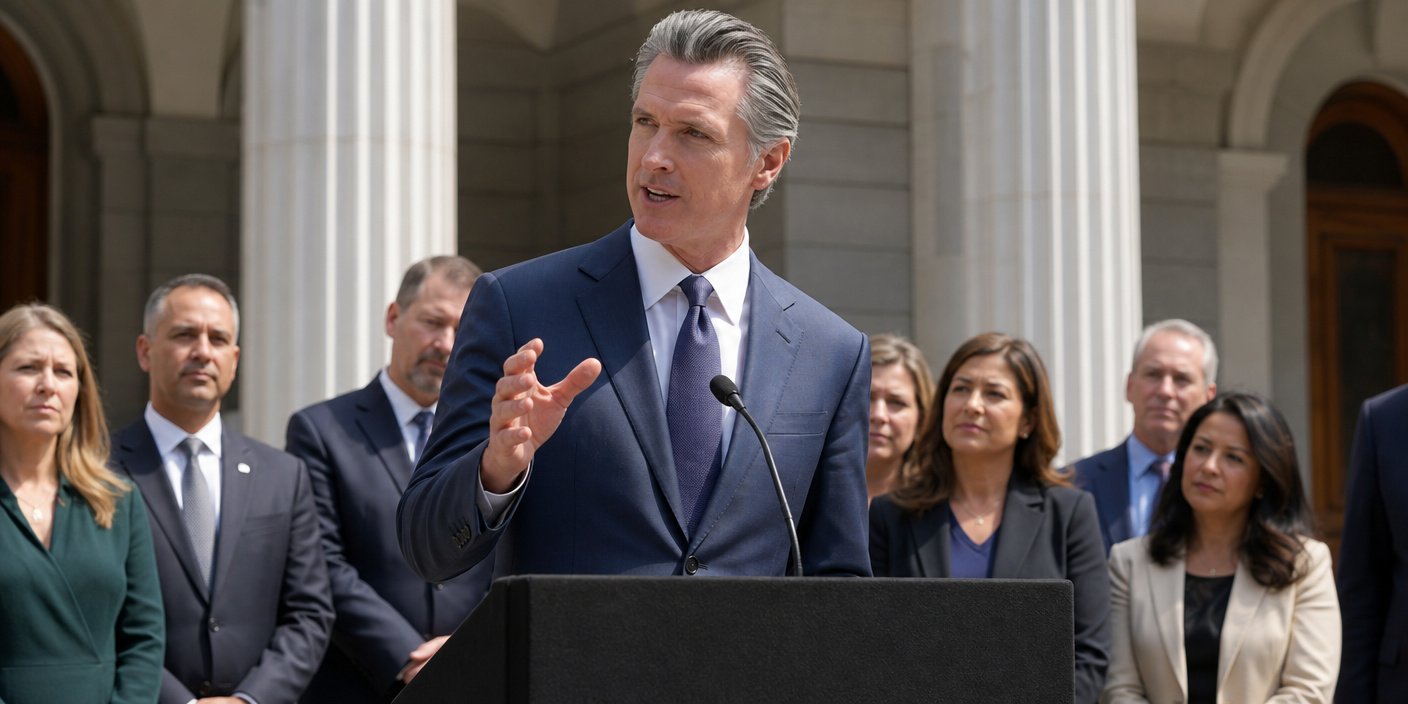
Governor Gavin Newsom has officially announced a pivotal three-party compromise regarding Senate Bill 492, a legislative cornerstone designed to fundamentally reshape California’s wildfire mitigation strategy and enforce rigorous accountability standards for utility companies. This legislative maneuver marks a significant escalation in the state’s ongoing battle against climate-driven fire risks, placing the burden of responsibility squarely on the infrastructure operators while simultaneously expanding safety nets for fire survivors.
Key Highlights
- Strategic Compromise: SB 492 represents a successful three-party negotiation between the Newsom administration, legislative leaders, and utility stakeholders to create a unified wildfire safety framework.
- Enhanced Utility Accountability: The bill introduces strict, enforceable metrics for power line safety, grid hardening, and vegetation management, with heavy penalties for non-compliance.
- Survivor-Centric Support: A significant portion of the legislative effort directs resources toward direct aid and support mechanisms for those displaced or affected by previous wildfire events.
- Risk Mitigation Focus: The legislation prioritizes the reduction of wildfire ignition probability, aiming to modernize grid technology across high-fire-threat districts.
A New Legislative Mandate for Utility Responsibility
The passage of Senate Bill 492 arrives at a critical juncture for California. For years, the intersection of high-voltage transmission lines, arid climate conditions, and historical forest management practices has created a perfect storm of environmental instability. SB 492 serves as a regulatory evolution, moving beyond previous incremental policies to establish a comprehensive framework for utility governance.
The Three-Party Compromise Framework
At the heart of SB 492 is the tripartite agreement. Historically, negotiations regarding utility liability and wildfire safety have been fractious, often pitting the California Public Utilities Commission (CPUC) against investor-owned utilities (IOUs) and survivor advocacy groups. This compromise aligns these disparate interests by creating a ‘Safety-First’ compliance structure. The administration has successfully brokered a deal where utilities receive clarity on regulatory expectations in exchange for binding commitments to aggressive grid-hardening initiatives. This reduces litigation uncertainty while ensuring that public safety is the primary metric by which utility performance is measured.
Technical Standards for Grid Hardening
The legislation is not merely policy; it is heavily technical. SB 492 mandates that utilities accelerate the deployment of covered conductors, advanced circuit protection, and AI-driven weather modeling systems. These technical upgrades are designed to minimize the risk of ‘contact-based ignitions’—where vegetation or debris hits a power line—which have been historically blamed for several of the state’s most catastrophic wildfires. By codifying these standards, SB 492 removes ambiguity. Utilities are now required to provide granular reporting on their vegetation management budgets, with the CPUC empowered to impose significant financial penalties if specific wildfire mitigation milestones are not met within the fiscal year.
Prioritizing the Human Cost
One of the most significant aspects of this bill is the formalization of support for fire survivors. Past wildfire legislation often focused on the structural integrity of the grid, frequently overlooking the long-term recovery of impacted communities. SB 492 integrates a survivor-support fund, which streamlines access to resources for those who have lost homes or livelihoods. This provision mandates that a portion of utility wildfire prevention investments must be decoupled from recovery costs, ensuring that utility infrastructure spending does not come at the direct expense of survivor relief funds. It is a dual-pronged approach that acknowledges both the technical cause of the fires and the human consequences of inaction.
Economic Implications and Ratepayer Protections
Critically, the legislation includes guardrails for ratepayers. As utilities undertake the multibillion-dollar effort of undergrounding lines and clearing vegetation, the concern has always been the inevitable impact on monthly utility bills. SB 492 introduces an audit process that requires utilities to justify expenditures as ‘prudently incurred’ before they can be passed on to customers. This prevents the rubber-stamping of expenses and forces utilities to optimize their operational efficiency. It forces a cultural shift within the corporate governance of California’s power providers: safety is now a cost-center that must be managed with the same rigor as profitability.
Secondary Angles: Adapting to the New Climate Reality
1. The Climate-Infrastructure Nexus: SB 492 acknowledges that the ‘new normal’ of climate change requires a radical departure from traditional grid engineering. The legislation forces utilities to use forward-looking climate projections rather than historical weather data to plan for future fire seasons.
2. The Shift in Legal Liability: By strengthening regulatory oversight, the bill potentially alters the litigation landscape. While it does not absolve utilities of negligence, it provides a clearer compliance roadmap, potentially reducing the sheer volume of wildfire-related tort litigation by setting industry-standard expectations for ‘reasonable’ safety measures.
3. Long-term Grid Decentralization: While not the primary focus, the push for safety under SB 492 accelerates the conversation around microgrids and decentralized energy. By making the central grid more expensive to operate safely, the bill creates a market incentive for the adoption of localized solar and battery storage systems as a fire-resilience strategy.
FAQ: People Also Ask
Q: What is the primary goal of Senate Bill 492?
A: The primary goal is to codify a three-way agreement between the state, utility companies, and survivors to mitigate wildfire risks through mandatory infrastructure upgrades and strict accountability protocols.
Q: How does this bill hold utilities accountable?
A: SB 492 imposes enforceable performance metrics and allows the California Public Utilities Commission (CPUC) to levy significant financial penalties if utilities fail to meet grid-hardening and vegetation management deadlines.
Q: Does SB 492 increase monthly utility rates?
A: The bill includes strict audit requirements to ensure that only ‘prudently incurred’ safety expenses can be passed on to ratepayers, aiming to protect customers from bloated infrastructure costs.
Q: How does the bill assist wildfire survivors?
A: It creates a dedicated focus on survivor-support mechanisms, ensuring that recovery resources are streamlined and that these funds are shielded from being cannibalized by utility infrastructure operational budgets.