
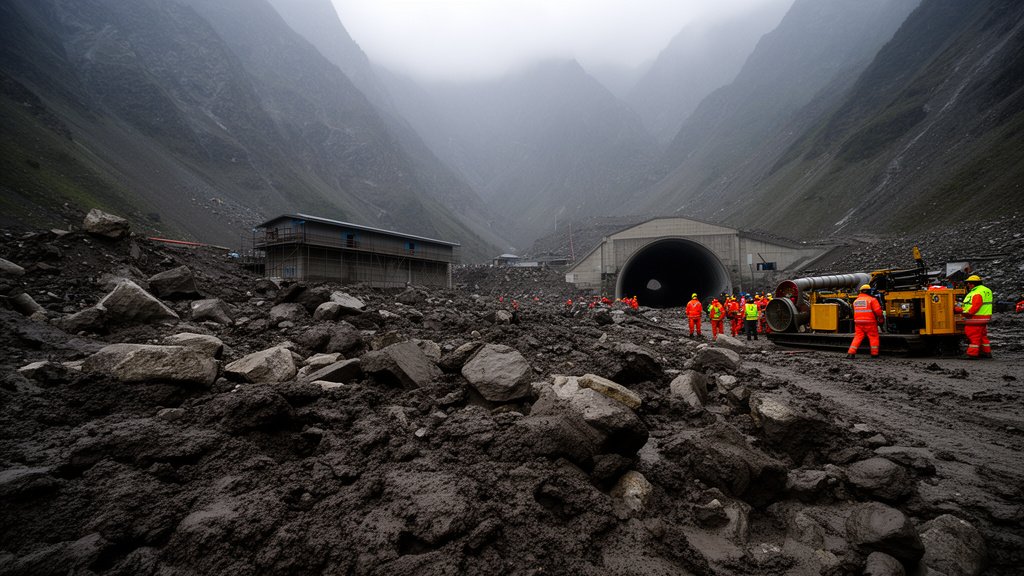
The death toll from the catastrophic Himalayan flooding that has gripped the region has risen to a staggering 939, with an additional 3,925 individuals reported missing, marking one of the most severe disasters in the nation’s history. In a harrowing race against time, emergency responders are currently utilizing high-pressure air pumps and controlled explosive techniques to clear debris and reach more than 600 workers who remain trapped within a series of mud-filled hydropower tunnels. The disaster was precipitated by a 5.2 magnitude seismic event, which triggered landslides and structural collapses across the delicate mountain infrastructure, exacerbating the already dire flooding conditions caused by seasonal monsoons.
Key Highlights
- Catastrophic Death Toll: The official death count has reached 939, with authorities warning this number could rise as search operations move into more remote terrain.
- Missing Persons Crisis: 3,925 individuals remain unaccounted for, sparking a massive humanitarian search and rescue deployment.
- Hydropower Tunnel Emergency: Rescue teams are engaged in a critical operation to extract 600 workers trapped in infrastructure tunnels following the 5.2 magnitude quake-induced collapse.
- Infrastructure Strain: The combination of seismic instability and flooding has severely compromised critical hydropower facilities, threatening long-term energy security for the region.
The Himalayan Catastrophe: A Multi-Front Emergency Response
The situation unfolding across the Himalayan range is a complex, multi-layered disaster that tests the limits of current emergency response capabilities. The primary focus of the government and international aid organizations remains the rescue of the 600 hydropower workers, a operation that is as much an engineering challenge as it is a search-and-rescue mission.
The Engineering Battle in the Tunnels
The 600 workers trapped within the hydropower tunnels represent the most immediate priority. Following the 5.2 magnitude seismic event, the tunnels—designed to channel mountain water for energy generation—were inundated with sediment, mud, and rock debris. Because these tunnels are deep underground and structurally compromised, traditional heavy machinery is often ineffective or too dangerous to operate. Rescuers are employing air pumps to force oxygen into pockets where survivors may be holding out, while engineers carefully use controlled, localized explosives to fracture specific rock formations without causing further collapse. This delicate balance of explosive engineering and rescue operations is being overseen by the National Emergency Operation Centre (NEOC) and specialists from the energy sector.
Seismic Instability and Infrastructure Failure
Geologists and disaster management experts have identified the 5.2 magnitude earthquake as the tipping point that transformed a severe monsoon weather event into a full-scale national crisis. The Himalayas are geologically active, and the monsoon season creates high saturation levels in the soil, which reduces slope stability. When the seismic event occurred, it triggered deep-seated landslides. These landslides did not merely block roads; they breached structural barriers at several hydropower sites, leading to the rapid flooding of tunnels. This phenomenon highlights a significant vulnerability in regional infrastructure planning: the interplay between high-energy hydroelectric projects and the volatile tectonics of the Himalayan belt. The disaster underscores an urgent need for the Department of Hydrology and Meteorology to integrate real-time seismic monitoring with flood forecasting protocols.
The Humanitarian Toll and Missing Population
Beyond the infrastructure crisis, the human cost is catastrophic. With 3,925 people currently missing, the scale of the search operation is unprecedented. Families are congregating at triage centers in nearby valleys, waiting for news from the rescue crews. The terrain is treacherous; in many areas, the combination of mud and high-water velocity has made the ground unstable for rescue teams on foot. Search-and-rescue units, supported by aerial reconnaissance, are scouring riverbanks and areas downstream where victims may have been swept away. The psychological impact on the affected communities is profound, as entire villages have been displaced or destroyed by the cascading effects of the floodwaters.
Economic and Energy Security Implications
Nepal’s energy sector has been dealt a massive blow. The hydropower industry is the backbone of the nation’s energy strategy, and the destruction of these facilities not only leaves 600 workers in danger but also halts electricity production across critical grid segments. The financial impact of the damage, combined with the cost of the rescue operations and the eventual reconstruction, will require a coordinated international aid response. Economists suggest that the long-term impact on the regional economy could be severe, as repairing the tunnels and restoring the electrical grid will take months, if not years, of specialized labor and significant capital investment. The focus must now shift to how such projects can be designed to withstand concurrent climate and seismic risks in the future.
FAQ: People Also Ask
1. What caused the tunnels to flood?
A 5.2 magnitude earthquake occurred simultaneously with extreme monsoon flooding. The seismic movement triggered landslides that breached structural defenses, allowing floodwaters and debris to inundate the tunnel systems.
2. Is there hope for the 600 trapped workers?
Yes. Rescue efforts are actively ongoing, utilizing specialized air pumps to maintain oxygen levels and controlled explosives to clear escape paths. Emergency teams are working around the clock under extreme conditions.
3. How is the government responding to the 3,925 missing?
The government has deployed national emergency teams, utilizing aerial reconnaissance and ground search squads. They are coordinating with international aid partners to cover the vast, high-altitude terrain affected by the disaster.
4. Why is this area so vulnerable to such disasters?
The Himalayas are a highly active seismic zone. During the monsoon season, soil saturation levels are high, creating a ‘double-threat’ scenario where geological instability combines with intense rainfall, frequently leading to landslides and, in this case, a major infrastructure collapse.