
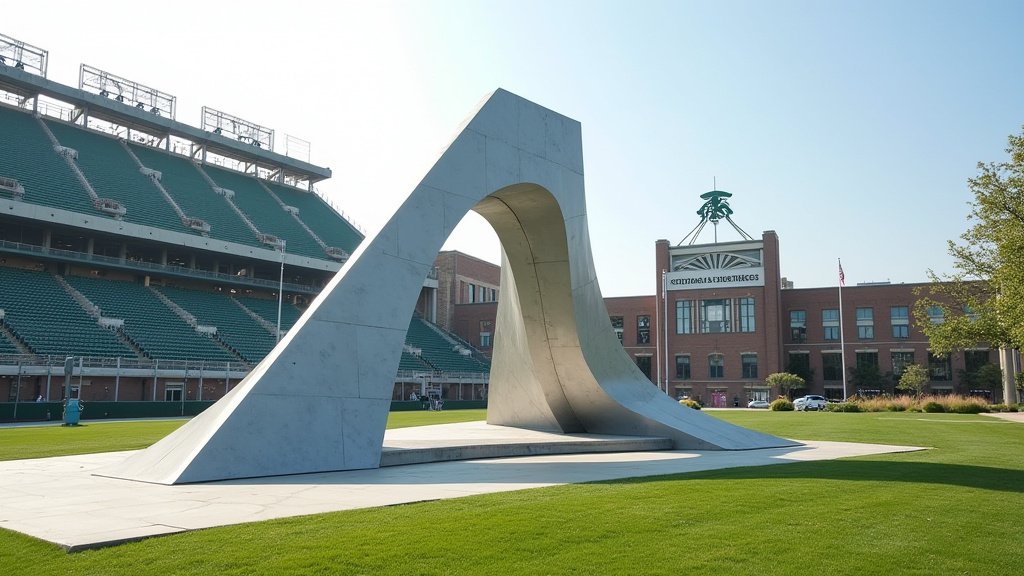
Michigan State University is solidifying a historic legacy, officially announcing a permanent art installation at Spartan Stadium dedicated to the 1965 and 1966 championship football teams. This monument serves as a tribute to the squads’ consecutive Big Ten and National Championship titles, while fundamentally honoring their courageous role in shattering racial barriers in collegiate athletics. The installation acts as a physical touchstone for a defining era in American sports history, ensuring that the legacy of these athletes—and the coach who led them—remains a fixture in the Spartan landscape.
Key Highlights
- Dual Championship Legacy: Honoring the 1965 and 1966 Michigan State football teams, both of which secured consecutive Big Ten and National Championships.
- Pioneering Integration: Recognizing the teams as the ‘Underground Railroad’ of college football, effectively changing the racial landscape of the sport during the 1960s.
- Permanent Commemoration: The art installation will be a permanent fixture at Spartan Stadium, embedding this pivotal chapter of athletic history into the university’s architectural identity.
- Coaching Vision: The tribute highlights the leadership of head coach Duffy Daugherty, whose progressive recruiting strategy helped dismantle segregation in college football programs.
Cementing a Legacy of Change in East Lansing
The announcement of this permanent installation at Spartan Stadium is more than a simple celebration of trophies and bowl games; it is an act of historical stewardship. For decades, the narrative of the 1965 and 1966 Michigan State football teams has been told through the lens of pure athleticism and dominance on the gridiron. However, this new art installation seeks to bridge the gap between their statistical success—winning consecutive Big Ten and National Championships—and the profound societal impact these players and staff had on the nation.
The ‘Underground Railroad’ Strategy
At the center of this historical re-evaluation is the concept of the ‘Underground Railroad.’ Under the leadership of legendary head coach Duffy Daugherty, Michigan State became a sanctuary for Black athletes from the Southern United States, where segregation and discriminatory laws severely limited their opportunities to play at top-tier universities. Daugherty’s recruiting pipeline brought immense talent to East Lansing, effectively desegregating the Spartans’ roster years ahead of many peers in the Southeastern Conference (SEC) and other major athletic programs.
This recruitment strategy was not merely about winning games; it was a systemic challenge to the status quo of the 1960s. By integrating his locker room, Daugherty fostered an environment where skill and dedication superseded race, laying the groundwork for the modern diverse makeup of college football. The upcoming art installation aims to honor those players who stood at the forefront of this movement, often facing scrutiny and intense pressure during a tumultuous period in American history.
A Dynasty of Dominance
The 1965 and 1966 seasons represented the peak of Spartan football power. The 1965 team finished with a 10-1 record, claiming the Big Ten title and a consensus National Championship. The 1966 team followed with an equally impressive performance, finishing 9-0-1. While the 1966 team is frequently remembered for the ‘Game of the Century’—a 10-10 tie against Notre Dame that remains one of the most famous contests in the history of the sport—their true legacy lies in their consistency and their role as trailblazers.
These teams proved that a diverse squad could not only compete but dominate at the highest level. The installation serves as a reminder to current and future generations of Spartans that the program’s identity was forged in a period of intense social transformation. It honors the individuals who chose Michigan State as their platform to rewrite the rules of the game.
Architectural Integration and Artistic Significance
The university has emphasized that this will be a permanent installation, intended to serve as a focal point for alumni, students, and visitors. By placing this monument within the grounds of Spartan Stadium, MSU ensures that the history of integration is physically woven into the venue. The choice of a permanent art installation—rather than a temporary plaque—underscores the weight of this history. It suggests that the university views the lessons of the 1965 and 1966 teams as foundational to the values of the institution today.
This project also prompts a necessary reflection on how universities commemorate their history. By moving beyond traditional athletic trophies, this monument invites a broader conversation about how sports facilities can act as public archives. It forces the viewer to engage with the reality that these athletes were not just players; they were activists by necessity, carving out a space for themselves where none existed before.
Future Implications for Collegiate Athletics
As college athletics continues to navigate the complexities of player rights, recruitment, and equity, the story of the 1965 and 1966 MSU teams offers a valuable case study. Their success serves as a testament to the fact that inclusivity is a strength, not a distraction. The installation acts as an educational tool, ensuring that the ‘Underground Railroad’ history is not forgotten or sanitized. It challenges modern programs to look at their own histories and acknowledge the pioneers who paved the way for the athletes of today.
By establishing this permanent marker, Michigan State is taking a proactive step in owning its history—warts and all—and celebrating the progress that was made possible by the 1965 and 1966 rosters. It is a bold statement that the home of the Spartans is a place where history is respected, analyzed, and honored for its full, complex truth.
FAQ: People Also Ask
Q: Where will the art installation be located at Spartan Stadium?
*A: The university has planned the installation to be a prominent, permanent feature within the Spartan Stadium complex, designed to be highly visible to fans and visitors to ensure the legacy of the 1965 and 1966 teams is front and center.
Q: Why are the 1965 and 1966 teams considered so significant beyond football?
*A: Beyond their dual Big Ten and National Championships, these teams are celebrated as pioneers of integration. Under coach Duffy Daugherty, they utilized an ‘Underground Railroad’ recruiting strategy to bring Black athletes from the South to Michigan State, directly challenging the segregationist norms of college football at the time.
Q: Who was the coach of the 1965 and 1966 MSU championship teams?
*A: The teams were coached by the legendary Duffy Daugherty, who is widely credited with championing the integration of his program and creating a model for a diverse, championship-caliber team.
Q: What was the ‘Game of the Century’ involving the 1966 MSU team?
*A: The 1966 matchup between Michigan State and Notre Dame is often cited as the ‘Game of the Century.’ It ended in a 10-10 tie, but it remains one of the most famous games in the history of college football, representing the collision of two powerhouses and, importantly, two different approaches to integration at the time.