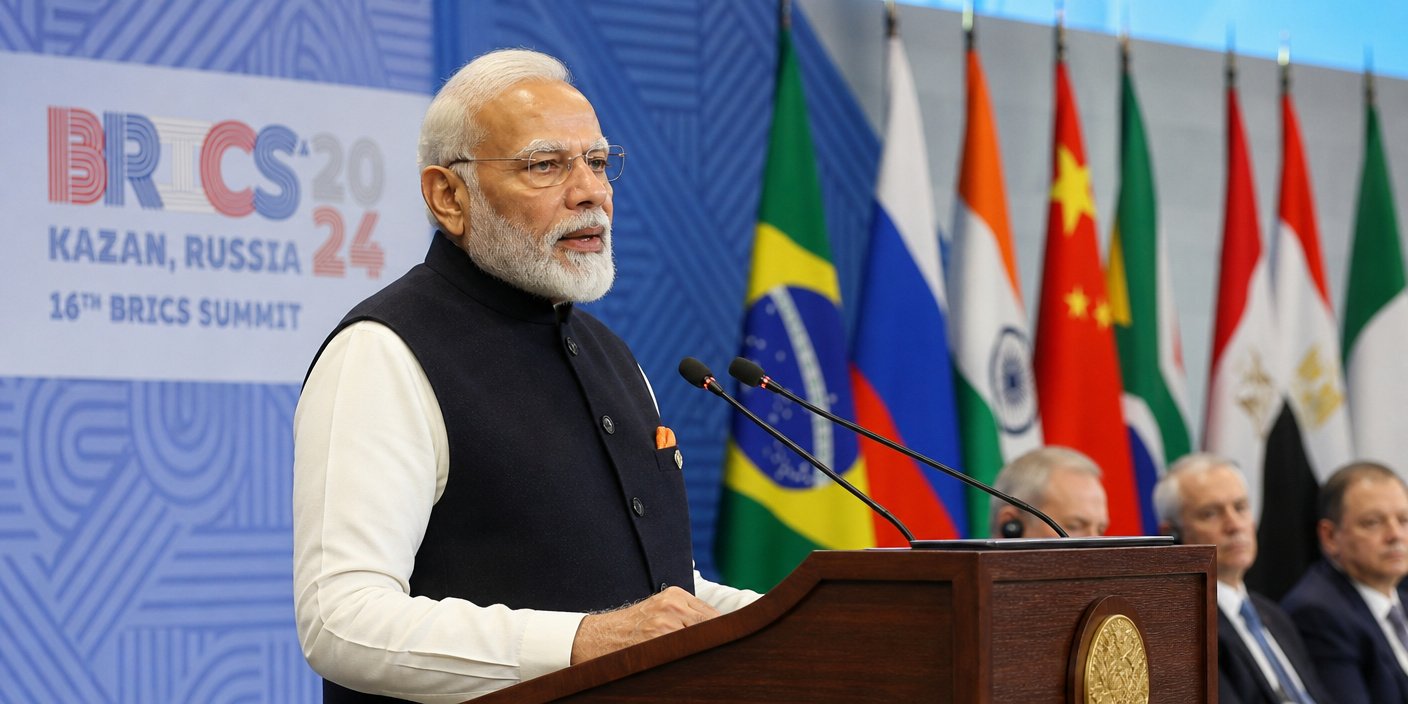
At the 16th BRICS Summit held in Kazan, Russia, Indian Prime Minister Narendra Modi delivered a pointed message to the expanded bloc: the global dependence on critical minerals cannot be allowed to become a tool for geopolitical coercion. As the world accelerates its transition toward green technologies—spanning electric vehicles, renewable energy infrastructure, and advanced microchips—the demand for resources like lithium, cobalt, and rare earth elements has surged. PM Modi’s warning reflects a broader strategic pivot by India and the Global South to insulate themselves from the supply chain vulnerabilities that have historically defined international trade.
The Strategic Imperative of Critical Minerals
Critical minerals are the backbone of the 21st-century economy. Often referred to as the ‘new oil,’ these materials are indispensable for high-tech manufacturing and the decarbonization of global energy systems. However, the current global landscape is characterized by high concentration; a handful of nations currently dominate the mining and processing sectors. This consolidation creates a significant leverage point for dominant suppliers, leading to risks of sudden export bans, price manipulation, or supply bottlenecks—essentially, the ‘weaponisation’ of access.
PM Modi’s intervention at the summit in Kazan highlights India’s commitment to building a resilient, diversified supply chain framework. For India, which is aggressively pursuing its ‘Make in India’ initiative and aiming to become a global hub for green manufacturing, ensuring a steady, non-politicized flow of these materials is not merely an economic preference; it is a national security mandate. By addressing the BRICS leaders, Modi sought to leverage the bloc’s combined economic heft to demand a new global paradigm—one that prioritizes transparency and security over leverage.
Diversification and the BRICS Agenda
One of the secondary angles of this discussion is the internal dynamic within BRICS itself. With the inclusion of new member states, the bloc now represents a vast array of both resource-rich nations and emerging industrial powerhouses. Modi’s call is designed to create a collaborative framework among these members. The objective is to foster a system where the processing and refining of these minerals are not monopolized by one region or controlled by external political pressures.
This shift is essential for the stability of the Global South. As these nations modernize, they require reliable inputs to sustain growth. If BRICS can establish an internal mechanism for resource sharing, recycling, and joint technological research, it would significantly dilute the ability of external actors to use resource scarcity as a weapon. This is also a play for long-term economic autonomy; by controlling the mineral pipeline, the bloc reduces its vulnerability to the boom-and-bust cycles dictated by traditional market-controlling powers.
Impact on the Green Energy Transition
Beyond pure economics, there is an urgent environmental angle. The transition to net-zero carbon emissions is theoretically impossible without these raw materials. PM Modi argued that if the fight against climate change is to be equitable, the tools of that transition—specifically the minerals required for batteries and solar panels—must remain accessible. When supply chains are weaponized, it is the developing nations, already struggling with the costs of climate change, that bear the heaviest burden.
India’s stance is that a ‘fair and secure’ access framework is a prerequisite for a just transition. This pushes back against the trend of protectionism that has begun to characterize Western trade policies, where strategic resource nationalism is becoming a dominant theme. By championing this within BRICS, India positions itself as the voice of the developing world, advocating for a multilateral, rules-based order that prevents the monopolistic control of the building blocks of the future economy.
Future Predictions and Technological Sovereignty
Looking ahead, the next decade will likely see an intensification of competition for control over these mineral-rich zones, from the lithium triangles of South America to the cobalt mines of Africa. The warning issued by PM Modi is a pre-emptive strike against the ‘geopolitical fragmentation’ that experts fear will define international relations through 2030. If the BRICS nations move forward with a unified policy on supply chain resilience, we may see the development of a ‘BRICS Mineral Exchange’ or a coordinated technological partnership for mineral processing.
This initiative would not only secure the supply for member nations but also accelerate the development of domestic refining capabilities. The broader implication is a push toward ‘technological sovereignty,’ where nations no longer outsource their industrial security to volatile external suppliers. In conclusion, Modi’s address in Kazan marks a defining moment in the bloc’s evolution, shifting its focus from a purely geopolitical counter-balance to a proactive economic cooperative capable of shaping the architecture of global resource management.
FAQ: People Also Ask
1. Why are critical minerals considered a ‘weapon’?
Critical minerals are considered a weapon because their production and processing are highly concentrated in a few countries. If a supplier decides to restrict exports, it can cripple the industries (such as electric vehicles or defense tech) of dependent nations, effectively using trade as a geopolitical lever.
2. How does this affect the Global South?
Many Global South nations are rich in raw materials but lack processing technology. PM Modi’s proposal advocates for a BRICS-led framework that helps these nations add value to their resources, ensuring they are not just exporters of raw materials but active participants in the global supply chain.
3. What specific minerals are involved?
While the list varies, the most critical ones include Lithium (for batteries), Cobalt (for high-capacity electronics), Nickel, Graphite, and Rare Earth Elements (essential for wind turbines and electric motors).
4. What was the outcome of the 16th BRICS Summit in Kazan?
The summit focused on enhancing economic cooperation, supply chain resilience, and the voice of the Global South. Modi’s emphasis on non-weaponization of resources became a central talking point regarding the future of trade within the bloc.