
California conservationists and fisheries biologists have announced a landmark breakthrough in salmon restoration, with new evidence demonstrating that targeted interventions in local creek habitats are yielding extraordinary results. Recent monitoring data from restored riverine environments confirms that young salmon—specifically Coho and Chinook species—are achieving growth rates twice as fast as their counterparts in degraded or unrestored sections of the same streams. Even more critical, these fish are exhibiting a 100% increase in survival rates, turning the tide for populations that have long teetered on the brink of collapse.
Key Highlights
- Accelerated Maturation: Restoration techniques, including the installation of large woody debris and floodplain reconnection, have drastically improved nutrient availability, allowing juvenile salmon to grow twice as fast.
- Survival Doubled: Enhanced habitat complexity creates critical “refugia” from predators and high-velocity currents, effectively doubling the survival rate of young salmon.
- Habitat Complexity is Key: Success is attributed to shifting from “streamlining” rivers to re-introducing natural structural complexity, which mimics the historical, untamed state of Northern California watersheds.
- Broad-Scale Application: The results provide a scalable model for the California Department of Fish and Wildlife (CDFW) and NOAA Fisheries as they look to mitigate the impacts of climate change on critical water infrastructure.
Revitalizing the River: A Blueprint for Salmon Recovery
For decades, California’s river management philosophy was dominated by the need to straighten channels and expedite water flow for irrigation and flood control. While this served industrial agricultural interests, it was disastrous for salmonids, which rely on the slow-moving, food-rich, and complex environments of floodplains and side channels to survive their early life stages. The recent success in Northern California, particularly within the Klamath Basin and tributaries of the Scott River, represents a complete pivot in ecological strategy.
The Science of “Complexity”: Why Simple Streams Fail
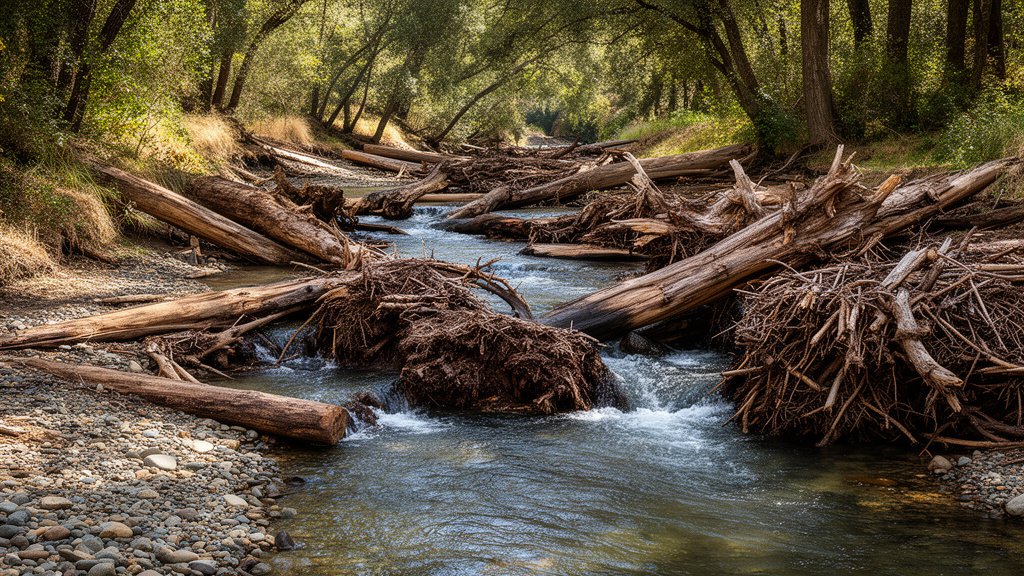
The traditional engineering approach to stream management stripped rivers of their “roughness.” In nature, a healthy river is chaotic. Fallen logs, tangled root wads, and undercut banks—collectively categorized as Large Woody Debris (LWD)—are not obstacles; they are the engines of a productive ecosystem. When biologists and environmental engineers reintroduce these elements into degraded creeks, they create “eddies” and low-velocity zones.
In these micro-habitats, juvenile salmon do not have to fight the current. By conserving their energy, they can devote more metabolic intake to rapid growth. Furthermore, the complexity provides essential visual cover, making it significantly harder for avian and aquatic predators to target the young fish. The data is clear: in sections of the creek where LWD was introduced, the “growth per day” metric increased by nearly 100% compared to sections left in their channelized, barren state.
Quantifying the Success: The Data Behind the Recovery
The monitoring phase of this project relied on Passive Integrated Transponder (PIT) tagging, allowing researchers to track individual fish as they move through different habitat types. The survival statistics are the most striking aspect of the findings. In standard, channelized waterways, salmon mortality during the juvenile “rearing” phase is high, often exceeding 70-80% due to exposure and predation.
In the restored segments, however, survival rates have effectively doubled. This is not merely a statistical anomaly but a reflection of the biological “carrying capacity” being restored to the environment. The restored floodplain acts as a filter, settling out sediments and boosting macroinvertebrate populations (the primary food source for salmon). As the fish feed on this increased biomass, their energy stores grow, giving them the resilience needed to survive the downstream migration toward the ocean.
The Economic and Cultural Ripple Effects
While the primary goal is ecological preservation, the successful restoration of these creeks carries significant economic weight. The salmon fishing industry, which spans from recreational angling to commercial operations, relies on consistent annual returns of adult salmon. By ensuring more juveniles survive the hazardous journey to the ocean, this restoration work acts as an investment in the long-term sustainability of the fishing industry.
Moreover, for indigenous nations, including the Yurok and Karuk tribes, salmon are not just an economic resource but a central pillar of cultural and spiritual identity. The degradation of these rivers was a direct blow to tribal sovereignty and traditional food systems. The restoration of these creeks is, therefore, a major step toward addressing historical environmental injustice and supporting the cultural continuity of the tribes that have stewarded these lands for millennia.
Climate Resilience: The Long-Term Vision
Looking ahead, the success of this restoration project offers a critical lesson for climate adaptation. California is increasingly facing extreme weather patterns—prolonged droughts followed by “atmospheric rivers” that bring catastrophic flooding. These high-energy flood events are lethal to salmon eggs and juveniles.
Floodplain reconnection projects act as a buffer. By allowing rivers to spread out across the landscape rather than forcing them into narrow, concrete-walled channels, these restored habitats can absorb the energy of floodwaters. The water soaks into the ground, replenishing aquifers, and providing a stable, cool environment for fish even during the hottest, driest months of the year.
Scaling Success: Can this Model Save Other Watersheds?
The results of this restoration effort have not gone unnoticed by policymakers. There is growing momentum within the California Department of Fish and Wildlife to replicate this model across a wider array of watersheds. The challenge, however, remains one of scale. Restoring thousands of miles of river requires significant investment, cooperation from private landowners whose property abuts these waterways, and the navigating of complex water rights laws.
Despite these hurdles, the “proof of concept” is now ironclad. We no longer have to guess whether habitat restoration works; we have the data to prove that nature-based solutions are the most effective tool we have. By prioritizing the ecological integrity of our creeks, California is ensuring that the iconic salmon, a species that has defined the state’s natural history for eons, has a fighting chance at a future.
FAQ: People Also Ask
Q: Why does habitat complexity help salmon grow faster?
A: Complex habitats, such as those featuring logs and root structures, slow down the water flow. This allows young salmon to conserve energy they would otherwise burn fighting the current, allowing them to allocate more calories to physical growth.
Q: What is “Large Woody Debris” (LWD)?
A: LWD refers to fallen trees, branches, and root structures in a stream. These items are vital because they create deep pools, protect against predators, and trap the nutrient-rich sediment that aquatic insects live on.
Q: Does this restoration only help salmon?
A: No. These restoration projects create “biodiversity hotspots,” benefiting a wide range of species including steelhead trout, river otters, migratory birds, and native amphibians, as well as improving local groundwater levels.
Q: Is this strategy being used across all of California?
A: While there is a strong push to adopt this model, it is currently implemented in specific pilot areas like the Klamath and Scott River basins. State agencies are working to scale these successes to other regions as funding and permitting allow.