
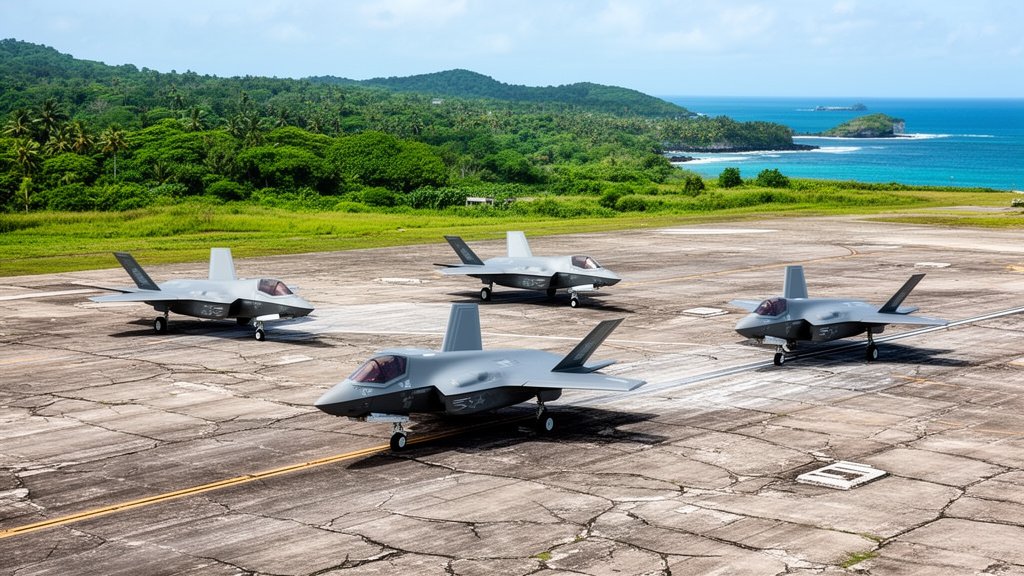
The US Air Force made a decisive tactical move in the Caribbean overnight, deploying advanced F-35 Lightning II fighter jets to the former Naval Station Roosevelt Roads in Ceiba, Puerto Rico. This surprise arrival, confirmed on September 18, 2026, signals a notable shift in the Pentagon’s approach to regional security, leveraging the island’s unique geography to project air power across the Caribbean Basin and toward the Atlantic corridor. The presence of these 5th-generation stealth fighters—renowned for their sensor fusion and tactical versatility—underscores a renewed focus on maintaining dominance in contested airspace near US territories.
Key Highlights
- Strategic Asset Deployment: US Air Force F-35 Lightning IIs were stationed at the decommissioned Roosevelt Roads naval base in Ceiba, Puerto Rico.
- Geopolitical Significance: The move marks a pivot in Caribbean security policy, emphasizing rapid response and interoperability in the Southern Command (SOUTHCOM) area of responsibility.
- Agile Combat Employment (ACE): The deployment serves as a live-fire validation of the ACE doctrine, testing the ability to operate high-tech platforms from austere or reclaimed facilities.
- Regional Stability: Analysts suggest this presence is a deterrent against increasing aerial activity from competing global powers operating near the Caribbean periphery.
The Caribbean Pivot: Reviving Roosevelt Roads
The arrival of the F-35s at Roosevelt Roads is more than a routine training exercise; it is a profound logistical statement. For decades, the former Naval Station Roosevelt Roads stood as a symbol of Cold War-era US dominance in the Caribbean, serving as a massive Atlantic Fleet hub before its controversial closure in 2004. For nearly 22 years, the site has been the subject of stalled development projects and environmental remediation. To see the roar of F-35 engines over Ceiba once again signifies that the Department of Defense is no longer content to leave this strategic asset dormant.
Tactical Deployment and the ACE Doctrine
The Air Force is currently operating under the ‘Agile Combat Employment’ (ACE) doctrine, a strategy designed to complicate the targeting calculus for adversaries. Rather than relying solely on large, static ‘super-bases’ which are vulnerable to long-range missile strikes, the Air Force aims to disperse its forces. By utilizing former hubs like Roosevelt Roads, the military creates a fluid network of airfields capable of supporting 5th-generation fighters.
The F-35 Lightning II is the linchpin of this strategy. With its ability to act as a flying data hub—linking ships, ground radar, and satellites—a small detachment of these jets can essentially create a protective ‘bubble’ over the Caribbean. This is not just about firepower; it is about situational awareness. By placing these sensors in the Eastern Caribbean, the US military gains a clearer picture of maritime and aerial traffic in a region that has seen increased activity from non-allied naval vessels.
Historical Echoes and Future Predictions
Historically, the US presence in Puerto Rico was deeply tied to the training of carrier strike groups. The return of the F-35 represents a technological evolution of that legacy. While the base is not being ‘reopened’ in the traditional 20th-century sense of a permanent garrison, it is being utilized as a high-intensity staging ground. We anticipate this will be the first of many ‘pop-up’ deployments throughout the 2026-2027 fiscal cycle. This model allows the Air Force to bypass the diplomatic friction of building permanent new bases while maximizing existing, underutilized infrastructure.
Economic and Environmental Complexities
The economic implications for the town of Ceiba are significant but double-edged. The reactivation of the airfield brings federal funding, infrastructure improvements, and specialized jobs to a region that has struggled with high unemployment rates since the base closure. However, it also re-ignites local debates regarding environmental cleanup and the long-term usage rights of the land. Local stakeholders are already pressuring the government for clarity on whether this military usage will be temporary or if it signals a long-term re-militarization of the Ceiba coastline.
Furthermore, the integration of 5th-gen aircraft requires sophisticated ground support. This entails not just fueling and munitions, but specialized secure communications networks and cyber-hardening of the facility. This infusion of technology is forcing a rapid modernization of the site’s utilities, which may provide a blueprint for other ‘dual-use’ facilities elsewhere in the US territory. Observers should watch for how the local government in San Juan negotiates with the federal authorities; the balance between national security interests and local economic autonomy will define the success of this deployment.
FAQ: People Also Ask
1. Why is the US Air Force using a closed naval base in Puerto Rico?
Roosevelt Roads offers an ideal strategic location in the Eastern Caribbean. The Air Force is using it to test ‘Agile Combat Employment’ (ACE), which involves operating modern, high-tech aircraft from distributed, austere locations to enhance survivability and reach.
2. Does this mean the Roosevelt Roads base is officially reopening?
Not in the traditional sense of a permanent, full-scale military installation. It is being utilized as a temporary deployment hub. The military is leveraging existing infrastructure rather than investing in permanent new construction.
3. Why are F-35s specifically being deployed to this region?
F-35s provide superior sensor integration and stealth capabilities. Deploying them to Puerto Rico allows the US military to monitor the Caribbean maritime and airspace corridors with significantly higher efficacy than older 4th-generation platforms.
4. How long will the F-35s remain in Ceiba?
The military has not released a specific timeline. However, ACE deployments are typically rotational, designed to be unpredictable and transient to keep potential adversaries from tracking established patterns.