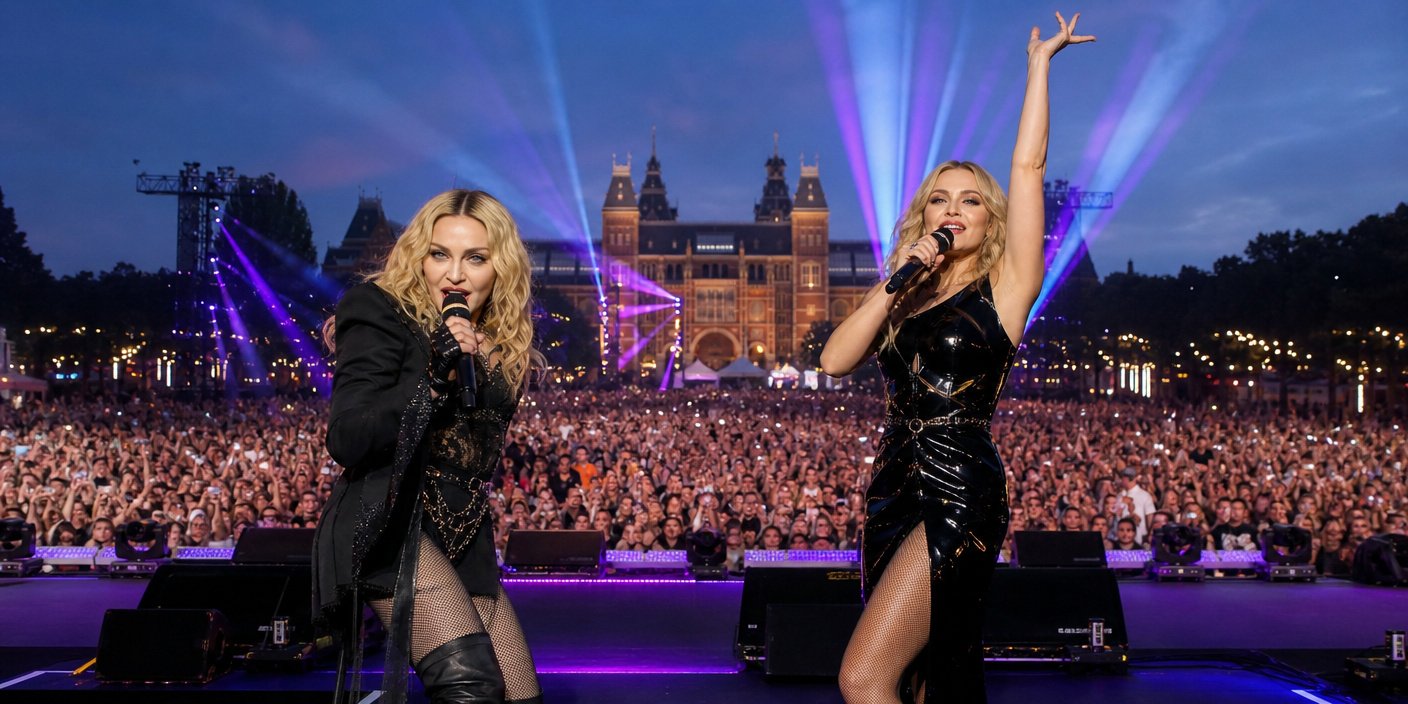
In a historic moment that transcended typical concert spectacles, pop legends Madonna and Kylie Minogue united on stage at the WorldPride Music Festival in Amsterdam. The performance, which drew an estimated crowd of 150,000, served as the emotional centerpiece of a week-long celebration commemorating the 25th anniversary of the Netherlands’ pioneering marriage equality legislation. As the first nation in the world to legalize same-sex marriage on April 1, 2001, the Netherlands utilized this milestone to host a global platform for LGBTQ+ advocacy, with the two superstars acting as the primary musical ambassadors.
Key Highlights
- Iconic Collaboration: Madonna and Kylie Minogue performed a medley of their chart-topping hits, ending with a collaborative rendition of an anthem celebrating global inclusivity.
- Historic Milestone: The festival recognized the 25th anniversary of the Dutch Marriage Equality Act, first enacted in 2001.
- Massive Turnout: Over 150,000 attendees gathered at Amsterdam’s Museumplein, making it one of the largest Pride-related musical events in European history.
- Global Advocacy: The performance emphasized the ongoing struggle for queer rights in regions where marriage equality remains unrecognized, leveraging the star power of the performers to reach millions of viewers via the livestream.
A Convergence of Pop Royalty and Human Rights
The air at Amsterdam’s Museumplein crackled with anticipation as the WorldPride Music Festival reached its crescendo. For decades, both Madonna and Kylie Minogue have been staunch advocates for the LGBTQ+ community, weaving themes of liberation and self-expression into their respective discographies. Seeing them share the stage was not merely a pop culture crossover; it was a symbolic convergence of two distinct eras of advocacy. Madonna, whose career has been inextricably linked with the AIDS crisis and the fight for gay rights since the 1980s, complemented Minogue’s status as a quintessential ‘gay icon’ for the modern generation.
The Historical Significance of 2001
To understand the gravity of the event, one must look at the legal landscape of 2001. When the Dutch parliament passed the legislation allowing same-sex couples to marry, it sent a shockwave through global social policy. Now, twenty-five years later, that act is celebrated as the bedrock of modern European social progression. The festival organisers explicitly stated that the performance was curated to highlight that rights, once won, must be continuously defended. By bringing together artists who have championed these causes from different cultural starting points—Madonna from the American underground scene and Minogue from the Australian pop sphere—the festival amplified the message that marriage equality is not a localized victory, but a global human right.
Economic and Cultural Aftershocks
The WorldPride event in Amsterdam is projected to have injected over €450 million into the local economy, ranging from hospitality to logistics. However, the ‘soft power’ impact is arguably more significant. Amsterdam, already a global hub for tolerance, effectively utilized the concert to reassert its position as the intellectual capital of LGBTQ+ rights.
Analysts note that such high-profile events create a ‘multiplier effect’ for city branding. As major metropolitan areas compete for tourist revenue and international investment, the branding of a ‘progressive’ and ‘inclusive’ city is a tangible asset. The image of two of the world’s most successful female entertainers standing together in the center of Amsterdam serves as a powerful magnet for tourism, effectively marketing the city’s culture of openness to a global audience.
The Future of Pride Festivals
As we look toward the future, this performance sets a new bar for how international cities approach Pride celebrations. Gone are the days of localized parades as the sole mechanism for advocacy. We are entering an era of ‘mega-festival’ advocacy, where major pop culture moments are strategically engineered to drive political and social discourse. The success of the Madonna-Minogue collaboration proves that when music and advocacy are aligned, the reach is exponential. Future WorldPride hosts—including cities in Asia and the Americas—are expected to emulate this model, leveraging A-list musical talent to ensure their local human rights milestones receive the global attention they require to keep the momentum of equality moving forward.
FAQ: People Also Ask
Q: Why was this specific performance held in Amsterdam?
A: Amsterdam was the natural location because the Netherlands was the first country in the world to legalize same-sex marriage. The concert coincided with the 25th anniversary of the 2001 Marriage Equality Act.
Q: Was this the first time Madonna and Kylie Minogue performed together?
A: While both have been icons for the same community for decades, a collaborative stage performance at this scale for a human rights festival is widely considered a career-first for both artists in this specific context.
Q: How many people attended the WorldPride Music Festival in Amsterdam?
A: Organizers reported a crowd of approximately 150,000 attendees at the Museumplein venue, supported by a global digital audience of millions via livestream.
Q: Does this event signal a shift in how Pride festivals are funded?
A: Yes, the move toward massive, commercially viable, A-list music festivals suggests that Pride events are shifting from local community gatherings to major international tourism and advocacy events that require significant corporate and governmental backing.