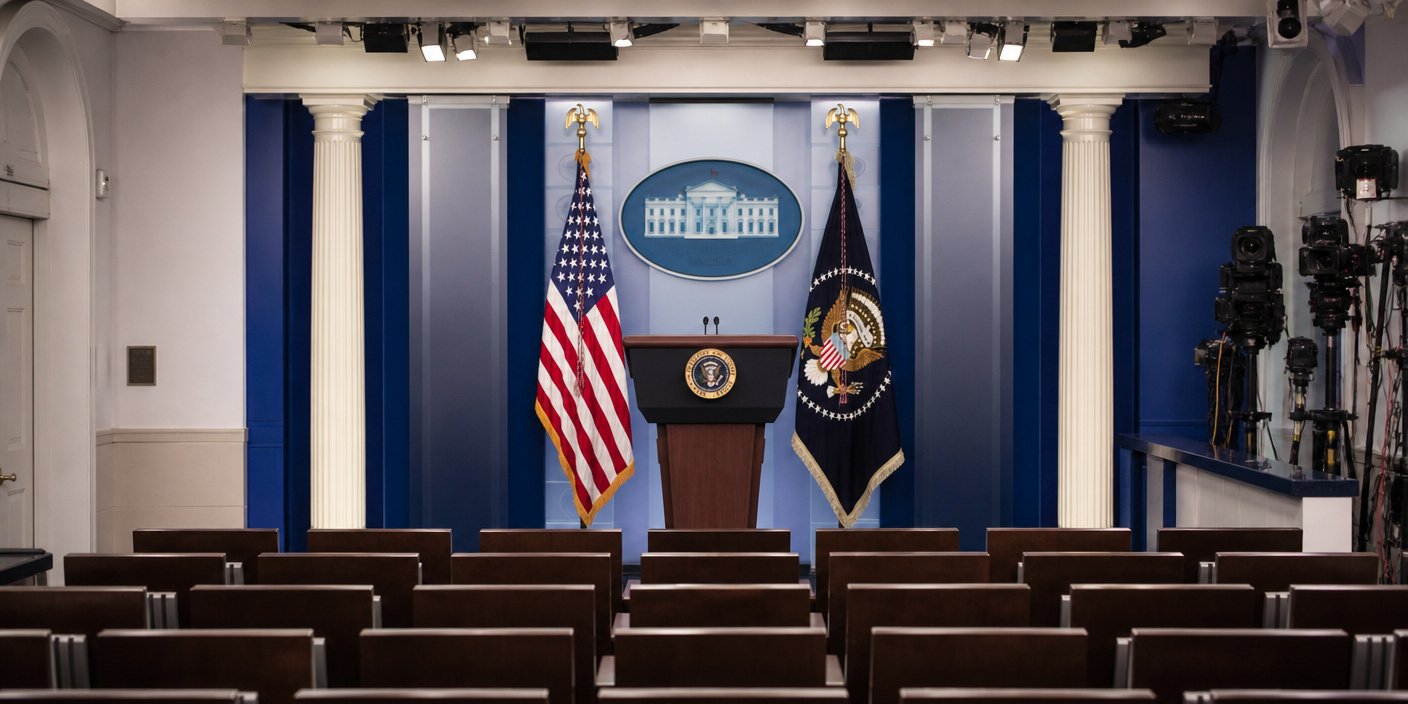
In a decisive move that has sent shockwaves through the Washington D.C. press corps, the Trump administration has officially barred major news outlets—specifically CNN, MS NOW, and Politico—from access to White House press briefings. The administration justified this exclusion by labeling the coverage from these organizations as ‘fake news,’ a term that has become a cornerstone of the President’s critique of mainstream media. This action, which limits direct access to the executive branch, has sparked an immediate and intense national debate regarding the boundaries of presidential authority and the foundational protections of the First Amendment.
Key Highlights
- Access Restriction: CNN, MS NOW, and Politico have been formally excluded from White House press briefings following persistent disputes over reporting accuracy.
- Justification: The White House cited the ‘fake news’ narrative as the primary driver for the restriction, arguing that the outlets have failed to provide balanced or factual reporting.
- Constitutional Conflict: Legal scholars and press advocates are questioning the constitutionality of the ban, citing potential First Amendment violations regarding the freedom of the press.
- Industry Response: The White House Correspondents’ Association (WHCA) and various media watchdogs are evaluating their next steps in challenging this executive decision.
The Escalation of Executive-Media Tensions
The decision to ban these specific outlets from the White House briefing room is not an isolated incident but rather the culmination of a long-standing antagonistic relationship between the Trump administration and segments of the traditional press. By designating CNN, MS NOW, and Politico as purveyors of ‘fake news,’ the administration is actively attempting to bypass traditional information gatekeepers. This strategy seeks to reframe the media landscape, positioning the President as a direct communicator with the public, thereby reducing the influence of investigative journalism that often relies on these briefing room sessions for accountability.
The ‘Fake News’ Strategy
For years, the term ‘fake news’ has been used as a rhetorical weapon to discredit institutional media organizations. When applied to specific outlets like CNN, MS NOW, and Politico, it serves a dual purpose: it delegitimizes the reporting produced by these entities in the eyes of the President’s base and provides a justification for the administrative restriction of access. By framing these organizations as partisan or dishonest, the White House creates a narrative where exclusion is not seen as an attack on the press, but as a defense of the truth. This shift fundamentally alters the relationship between the governing body and the watchdog, potentially setting a precedent for how future administrations may handle critical press coverage.
Constitutional Implications and First Amendment Debates
The core of the conflict lies in the interpretation of the First Amendment. While the White House is a private space controlled by the executive branch, the press briefing room has historically served as a public forum of sorts, representing the citizenry’s ‘right to know.’ The exclusion of specific, high-profile outlets raises serious questions about viewpoint discrimination. If the government is excluding media outlets based on the content of their political coverage, it could be interpreted as an infringement on the freedom of the press. Legal experts suggest that while the President has broad authority over the administration of the White House, the act of picking and choosing which members of the press can hold the government accountable may face significant judicial scrutiny.
Historical Precedent and the Digital Evolution
To understand the magnitude of this decision, one must look at the history of White House press access. Previous administrations have certainly had adversarial relationships with the press—famously during the Nixon era or the contentious exchanges during the Clinton and Obama years. However, a formal ban of major, established news organizations represents a significant escalation.
Precedent in the Oval Office
Historically, the press corps has functioned as an essential intermediary. Presidents have often chafed under scrutiny, but there has historically been a begrudging recognition that the press acts as a necessary check on power. Previous administrations have occasionally restricted specific reporters for protocol violations, but targeting entire organizations like Politico or CNN based on their editorial stance marks a distinct departure from the post-Watergate norms of transparency. This move signals a pivot away from the concept of the ‘press pool’ as a representative body, favoring instead a more controlled, direct-to-audience communication strategy.
The Rise of Direct-to-Consumer Communication
Beyond the legal and ethical arguments, this ban underscores a technological shift. The rise of social media has provided the White House with a mechanism to reach voters directly, bypassing the traditional gatekeepers of the news cycle. By leveraging digital platforms to disseminate information, the administration can shape the narrative without the immediate pushback of a live Q&A session. This allows for a more curated, controlled version of events, which complicates the role of legacy media outlets like CNN and MS NOW. As the administration relies more on digital messaging, the physical access to the briefing room becomes less critical to their communication strategy, making the threat of a ban a more potent political tool.
Public Trust and Media Polarization
Finally, this policy must be viewed through the lens of extreme media polarization. Studies have shown that trust in legacy media is at an all-time low among specific demographics. By highlighting the exclusion of these outlets, the administration is able to solidify support among a constituency that already views mainstream media with deep skepticism. Conversely, for the organizations themselves, being barred from the White House can become a badge of honor, reinforcing their brand to their own core audience as a ‘truth-teller’ against an opaque administration. This feedback loop of polarization means that actions like this do not just affect the news cycle; they deepen the divide in the public’s perception of reality itself.
FAQ: People Also Ask
Q: Is it legal for the President to ban specific news outlets from the White House?
A: The legality of this action is a subject of intense legal debate. While the President has the authority to manage White House operations, legal precedents regarding ‘public forums’ and viewpoint discrimination make this a complex issue that courts would need to adjudicate.
Q: What is the White House Correspondents’ Association (WHCA) role in this?
A: The WHCA is an independent organization that represents the press corps. They advocate for access and fight to ensure that journalists can do their jobs. They have historically issued strong statements opposing any efforts to restrict press access.
Q: How does this ban affect the public’s access to information?
A: By limiting the number and variety of voices in the briefing room, the public may receive a more homogenized, government-approved narrative. The exclusion of critical outlets reduces the diversity of questions asked, which can limit the depth of information available to the public regarding government policies and actions.