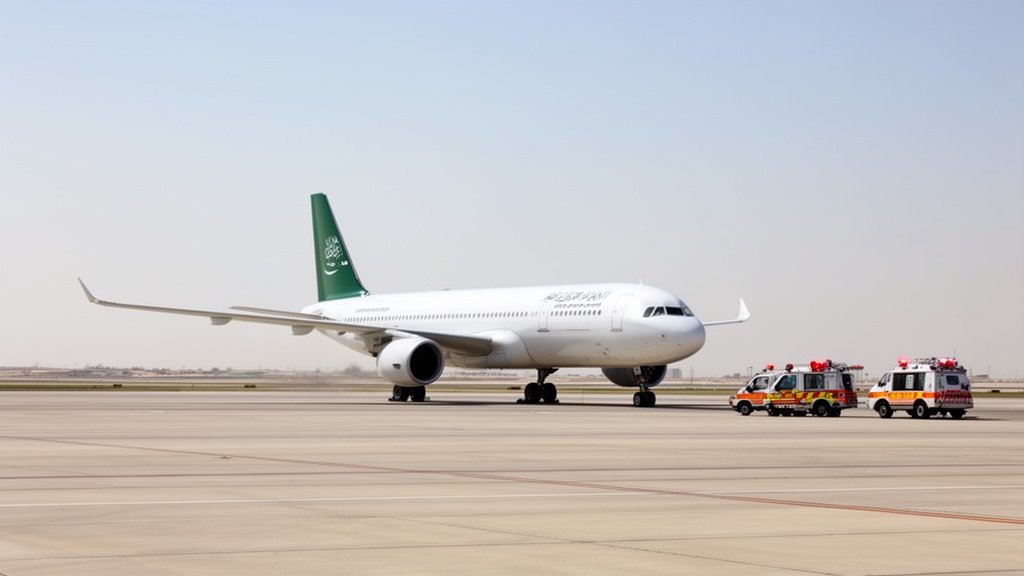
The aviation industry is reeling following a rare and alarming in-flight emergency that saw a FlyDubai flight diverted to Saudi Arabia after a violent physical altercation broke out between pilots in the cockpit. The incident, which occurred on a route from Dubai to Tel Aviv, reportedly escalated to the point where an official hijacking alert was transmitted to air traffic control, prompting immediate intervention from Saudi authorities and the rapid deployment of regional security protocols.
Anatomy of an Unprecedented Mid-Air Crisis
The sequence of events began shortly after the aircraft reached its cruising altitude. According to preliminary reports, a verbal dispute between the flight crew rapidly deteriorated into a physical confrontation. The localized chaos inside the cockpit necessitated an immediate response, as the integrity of the ‘sterile cockpit’ was severely compromised. With both pilots reportedly incapacitated or injured during the scuffle, the flight’s automated systems—or secondary crew members—were unable to maintain standard operations, leading to the activation of the hijacking alert.
This alert, typically reserved for instances of external interference, triggered a cascade of emergency procedures across the Middle Eastern flight corridors. Saudi Arabian air traffic control directed the aircraft to deviate from its flight path toward Tel Aviv and conduct an emergency landing at the nearest suitable airport. The intervention of passengers, who reportedly became aware of the disruption and attempted to assist in stabilizing the cabin environment, proved vital in maintaining order during the turbulent descent.
The ‘Sterile Cockpit’ and Security Protocols
The aviation industry operates on the fundamental ‘Sterile Cockpit’ rule—a regulation that mandates no non-essential conversation or activity in the cockpit during critical phases of flight, such as takeoff and landing. However, this incident highlights a critical vulnerability in the broader cockpit environment: the physical behavior of the pilots themselves. Aviation safety experts are already calling for a comprehensive review of the security mechanisms that isolate flight decks.
Modern cockpit security measures, largely implemented post-2001, were designed specifically to prevent unauthorized entry from the cabin. They did not, however, account for the potential of internal hostility between the pilots. This event creates a paradox in aviation security: the same doors designed to protect the cockpit from the outside also trapped the combatants inside, preventing flight attendants from immediate de-escalation. The International Air Transport Association (IATA) and relevant regional authorities are expected to initiate a probe into how such a breakdown in professional conduct occurred at 30,000 feet.
The Human Element: Pilot Mental Health and Stress
Beyond the tactical and security implications, this incident forces a difficult conversation regarding pilot mental health. The aviation industry is notoriously demanding, characterized by irregular hours, extreme fatigue, and immense responsibility. While screening processes for pilots are rigorous, they are often snapshot assessments that may fail to account for the gradual accumulation of psychological strain or unresolved interpersonal conflicts between crew members.
Historically, pilot altercations are virtually unheard of, making this incident an outlier that threatens to shift regulatory focus. We may see a push for enhanced psychological monitoring, or potentially, a requirement for more frequent crew resource management (CRM) assessments. The industry must reconcile the necessity of a ‘closed’ cockpit with the need for oversight, potentially introducing more sophisticated interior surveillance or automated behavioral monitoring systems to detect distress or aggression before it compromises flight safety.
Regional Geopolitics and Air Corridor Impacts
The route from Dubai to Tel Aviv is a significant symbol of the warming diplomatic ties between the UAE and Israel. Any disruption to this corridor, particularly one involving an emergency landing in Saudi Arabia—a nation with complex regional dynamics—carries significant implications. While the diversion was a standard safety procedure, the nature of the emergency caused understandable concern among regional aviation regulators.
Saudi authorities managed the situation in accordance with international civil aviation conventions, prioritizing the safety of the aircraft and its passengers over political considerations. Nevertheless, the event serves as a stark reminder of the reliance on the Saudi and wider Middle Eastern air traffic control networks to facilitate safe regional travel. Moving forward, the coordination displayed during this emergency will likely be held up as a case study in cross-border air safety cooperation, though the primary focus remains on the investigation of the pilots’ conduct and the subsequent disciplinary and safety outcomes. As the investigation progresses, the industry waits to see what systemic changes will arise from this singular, violent disruption in the sky.