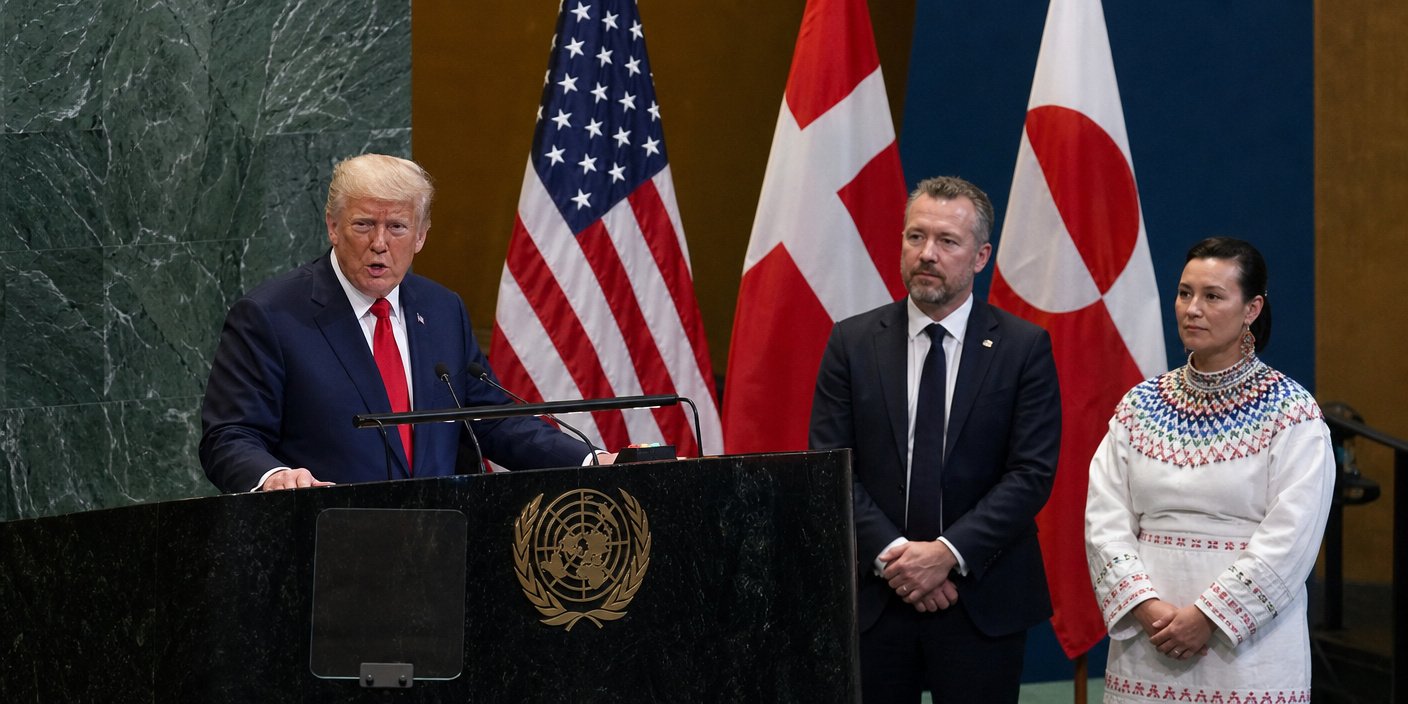
President Donald Trump, alongside high-ranking officials from Denmark and Greenland, finalized a landmark security agreement at the United Nations General Assembly on Wednesday, September 23, 2026, marking a profound expansion of American military infrastructure in the Arctic. The accord serves as a comprehensive update to the foundational 1951 defense agreement, signaling a new era of strategic deterrence in the high north. Central to the announcement is the immediate authorization for the large-scale expansion of the Pituffik Space Base—formerly Thule Air Base—alongside the development of two entirely new, major military installations situated in the southern and eastern regions of Greenland.
Key Highlights
- Modernization of 1951 Accord: The agreement formally sunsets outdated provisions of the original 1951 treaty, replacing them with a framework tailored to modern 21st-century geopolitical and technological requirements.
- Pituffik Space Base Expansion: Significant investment is allocated to upgrade the Pituffik Space Base, enhancing satellite tracking, missile warning capabilities, and long-range communication infrastructure.
- New Strategic Footprint: The U.S. will establish two new major military bases in Southern and Eastern Greenland, creating a more robust surveillance and rapid-response network across the North Atlantic.
- Tri-Lateral Cooperation: The deal is presented as a cooperative security arrangement between the U.S., the Kingdom of Denmark, and the Greenlandic government, focusing on sovereignty and regional stability.
Strengthening the Arctic Shield: A New Geopolitical Reality
The signing of this agreement at the UN General Assembly represents one of the most consequential shifts in Northern Hemisphere defense policy in decades. By moving beyond the static limitations of the 1951 defense agreement, the United States, Denmark, and Greenland are effectively redesigning the security architecture of the Arctic Circle. For years, the Pituffik Space Base has served as the bedrock of U.S. northern surveillance, but today’s agreement elevates this facility from a legacy monitoring station to a modernized hub for space-based operations. The expansion will focus on high-fidelity radar and sensor arrays, critical for detecting incoming ballistic threats and managing the growing density of satellite traffic in polar orbits.
The Strategic Necessity of the Southern and Eastern Bases
Beyond the modernization of existing facilities, the construction of two new bases in southern and eastern Greenland marks a pivotal change in territorial reach. Historically, U.S. military operations in Greenland were concentrated in the north, primarily to maintain radar coverage of the Arctic approach. The decision to place new bases in the south and east suggests a focus on the North Atlantic sea lines of communication and a growing need to monitor shipping lanes that are becoming increasingly navigable due to changing ice patterns. These bases will provide a forward-operating capability that ensures the U.S. maintains a persistent, visible presence in a region that has seen a surge in competitive activity from rival global powers.
The Geopolitical Chessboard: Why Greenland Matters Now
This agreement does not exist in a vacuum. It is a direct response to the increasingly contested nature of the Arctic. As sea ice recedes, the region is transforming into a theater of major economic and military interest, characterized by new shipping routes and untapped resource potential. The Greenlandic government has navigated a complex path to ensure that this military expansion benefits local infrastructure and security. For Denmark, the pact signifies a commitment to NATO obligations in the Arctic while maintaining territorial sovereignty over Greenland. The integration of these new facilities is expected to change the calculus for any nation seeking to challenge U.S. influence in the High North. By cementing this trilateral partnership, the U.S. is effectively asserting that the Arctic remains a space of secure, monitored, and protected international navigation.
Economic and Infrastructure Implications
While the primary driver of this deal is military security, the secondary implications for Greenland’s infrastructure are substantial. The construction of two major bases requires deep-water port access, regional power stability, and the development of logistical supply chains that will inevitably integrate with the local Greenlandic economy. Experts anticipate that the project will create a long-term investment pipeline, bringing modern infrastructure to parts of the island that have previously remained largely isolated. The agreement includes provisions for local employment and environmental stewardship, aiming to balance military necessity with the cultural and ecological preservation of the Arctic environment. This dual focus on defense and sustainable development is being touted by the administration as a new model for international military basing agreements.
FAQ: People Also Ask
Q: What is the primary purpose of the new bases in Greenland?
A: The primary purpose is to bolster U.S. and NATO surveillance capabilities, enhance satellite tracking and monitoring via the Pituffik Space Base, and establish a permanent, rapid-response presence in the North Atlantic to secure shipping lanes and ensure regional stability.
Q: How does this deal differ from the 1951 agreement?
A: The 1951 agreement was drafted for the Cold War era and focused on static radar installations. The 2026 update modernizes the treaty to include space-based surveillance, expanded military footprint to the south and east, and updated legal frameworks for modern military-to-civilian cooperation.
Q: What impact will this have on local Greenlandic communities?
A: The agreement mandates local involvement in construction and infrastructure development. While military in nature, the expansion is expected to generate significant economic investment in regional ports, energy, and supply logistics, which the Greenlandic government expects to benefit local civilian infrastructure.
Q: Why was this agreement announced at the UN General Assembly?
A: Announcing the deal at the UNGA serves to legitimize the trilateral cooperation between the U.S., Denmark, and Greenland on the world stage, reinforcing it as a collaborative security effort rather than a unilateral action.